
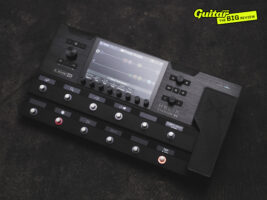
Line 6 Helix Stadium XL review – “bewilderingly ambitious… but it feels like the future”
$2,199.99/£1,980, line6.com
On their current development trajectory, floor-based guitar processors will control the entire known universe by 2046. Digital amp modelling has come a long way since the original Line 6 Pod appeared in 1998, and it’s the same company that’s now pushing forwards towards cosmic domination with its new twin flagships, the Helix Stadium and Stadium XL.
This is the latter. It’s big, it’s heavy, and in pricing terms it’s a cost-of-living crisis in a box. But it’s also stuffed with new processing tech and advanced features, which should make it more useful – and more tonally realistic – than any previous offering in the Helix line.
Line 6 Helix Stadium XL – what is it?
When you see a huge black rectangle like this, either you’re watching the opening scene of 2001: A Space Odyssey or there’s a new deluxe guitar processor in town. In fact, the Helix Stadium XL is slightly less monolithic in dimensions than the old Helix Floor, despite having the same basic layout – two rows of six footswitches plus an expression pedal – and a bigger display: a full eight inches instead of six and a bit, and now with touch control.
What it’s packing on the inside is, in a word, everything – and that includes such bonuses as imported backing tracks, stomp-free looping and automated setlists – but let’s start with the modelling basics. Plug your guitar in at one end, and connect one of the assorted outputs straight to a live PA, a recording interface or simply a pair of headphones; you now have access to 134 amplifier models, plus 46 speaker cabinets and 246 effects pedals. These can be arranged in up to 512 user presets, all controlled by swishing a fingertip around on that screen (with some help from the many knobs and buttons plus the touch-sensitive footswitches).
Image: Adam Gasson
Of course, having a touchscreen is nothing new in this field – the HeadRush Pedalboard had one back in 2017, and Line 6 is really catching up with everyone else here – but there’s more that’s new in the Stadium XL… starting with the all-important amp models. These have been built using a new technology called Agoura, which claims to provide more lifelike sounds and feel than ever before. This is thanks to its component-level capturing of real amplifiers, right down to such ultra-nerdy details as measuring impedance levels between gain stages and current flow within valves at different voltages.
Mind you, if you still don’t trust anyone else to supply your amp tones, you can always use your own: also new is a system called Proxy, which is Line 6’s take on profiling, cloning, capturing or whatever else you want to call ‘the Kemper thing’. This wasn’t ready for the initial launch but has arrived with firmware version 1.3, allowing you to clone your own amps and pedals so you can take them on the road in virtual form.
And finally, there’s Showcase – the ‘live automation engine’. This lets you set the unit to switch automatically between different settings at precise points – including recording loops then playing them back later in a song – and sync those cues with external MIDI gear. You can also use it to import stereo backing tracks and send different mixes to different outputs – Line 6 gives the example of routing a click track to a drummer via the headphone socket while everything else goes to the main stereo outputs.
Image: Adam Gasson
So basically, you’re no longer dealing with a mere guitar processor here but a sort of robot performance hub. You might find that idea wildly exciting; you might find it utterly irrelevant to your guitar-playing life. Either way, note that all the Showcase stuff happens in the Helix Stadium PC/Mac app, with your files jumping over to the unit afterwards via WiFi.
Line 6 Helix Stadium XL – is it easy to use?
Unless you nodded off halfway through the previous section – don’t feel bad, it happens all the time – you’ll have gathered that this is an extremely powerful and complex piece of equipment. That means one of the main design challenges for Line 6 was ensuring ease of use; and on the whole, thanks in no small part to that spacious touchscreen (it’s about the same size as an iPad Mini), they’ve succeeded.
Image: Adam Gasson
You’ll probably want to set aside a distraction-free evening for getting used to the main navigation procedures, but the fundamentals are all pretty intuitive and there’s plenty of help at hand from the online guides and tutorials. Even the cloning process is just about foolproof: all the steps are laid out clearly on the screen.
If you do want to dive into the Stadium XL’s more advanced features, be prepared for some head-scratching along the way – but honestly, there’s so much going on without them that you might never feel the need.
Line 6 Helix Stadium XL – what does it sound like?
People get awfully combative about why their preferred amp modeller sounds so great and all the others are so crap, don’t they? But it seems to me that the differences are getting smaller year by year… and if Line 6 was behind the competition in terms of sheer realism before, it isn’t any more. The Agoura models sound consistently excellent, to the extent that it’s hard to see what more you could possibly ask of them. And that goes for the playing feel too.
Image: Adam Gasson
As ever, there are dozens of factory presets to scroll through in order to get a sense of what the device can do; and as ever, most of them have too much reverb. But everything is covered, from chiming black-panel cleans to roaring Marshall crunch, from oddball ethereal ambiences to aggressively gated modern metal tones – and there are no obvious weak points.
A couple of new tone-shaping features are worth mentioning here: Hype and Focus View. The former is an extra control that lets you push an amp beyond strict realism into something a bit more ‘big’ and compressed – think of it as a sort of pre-mastering option – and the latter, much more interestingly, is a way of adjusting multiple controls at once by moving the cursor around a screen with different tone types in each corner. This is adding nothing in terms of available sounds, but as an extra-intuitive way of navigating a virtual amp (or pedal) it’s wonderfully clever.
The effects are good too, within certain limitations: I couldn’t get a Muff to sound as expansive as my Stomp Under Foot Ram’s Head, or a Klon to quite match my Bondi Effects Sick As… and there’s still no such thing as a satisfactory digital emulation of the Deluxe Memory Man. But they’re generally very close, and I had no complaints about any of the modulation pedals.
Image: Adam Gasson
And I was, in the end, able to get an absolutely identical sound to that Ram’s Head… by cloning it. The Proxy tech works really well on both pedals and amps, though the process does take a while and, like rival systems, involves a lot of strange noises if you’re using a speaker cab and microphone to get the full picture. Make sure the windows are closed if you’ve got easily spooked neighbours.
The power of Showcase is also impressive. Its most useful element is probably the ability to import multiple backing tracks, then tweak their levels and panning in mid-performance, turning the Stadium XL into a highly flexible virtual band on top of all its other skills.
One practical issue to mention is the half-second gap when switching between presets. But this is easily avoided as long as you don’t insist on changing amps in mid-song: if you use ‘snapshots’ instead to store and jump between different settings within the same rig, the changes are gapless.
Line 6 Helix Stadium XL – should I buy it?
The Stadium XL is full of ‘wow’ moments; it’s just unfortunate that one of them is for the price. If that’s not an issue for you, then go for it – this is a fabulously powerful processor with a user-friendly interface and a sackload of top-quality tones.
For the rest of us, it might make sense to wait and see if Line 6 rolls out a more affordable model as a replacement for the Helix LT. If that comes along with the same touch display and Agoura amp modelling as the Stadium and Stadium XL – never mind Proxy and Showcase, which are very cool but inessential for the average player – then it will surely be the one to get.
Line 6 Helix Stadium XL alternatives
We gave the Neural DSP Quad Cortex ($1,799/£1,449) a 10/10 review, although that was five years ago and its seven-inch screen is no longer the state of the art. The Fender Tone Master Pro ($1,599.99/£1,499) is another strong contender with a seven-inch display, but don’t forget the non-XL version of the Line 6 Helix Stadium ($1,799.99/£1,549), which saves you more than a few pennies by chopping off the expression pedal.
The post Line 6 Helix Stadium XL review – “bewilderingly ambitious… but it feels like the future” appeared first on Guitar.com | All Things Guitar.
Source: www.guitar-bass.net