HeadRush x Tone3000 review: latest A2 NAM models meet simple-yet-effective hardware
headrushfx.com
There’s an argument that Neural DSP’s Quad Cortex hit the amp-modelling industry in the same way the iPhone hit the tech world back in 2007. Here was a very swish-looking alternative to the clunky old guard; so sleek and powerful that all its predecessors suddenly seemed quite outdated. The Quad’s design made the hefty cases and LCD screens of things like the Axe-FX and Kemper Profiler look positively prehistoric, without any compromise on power. And so, its general vibe would go on to set the tone for floor modellers in the years to come.
READ MORE: Neural DSP Quad Cortex Mini review: “this is the most universal Quad Cortex yet”
But, true to the iPhone comparison, going Neural comes with a pretty high price of entry, and the ecosystem is somewhat locked down – Neural captures work on Neural gear, and plugin support is limited to, well, Neural plugins. So that’s a more Apple approach – premium, straightforward and powerful – but those garden walls are a little high. What, then, is the guitar equivalent of a slightly hacked-together Android build filled with sideloaded, solo-developed .apks called things like “Alan’s PDF Scrumbler”? That would be the subject of today’s review: Tone3000, and the Neural Amp Modeler architecture – NAM.
Neural DSP’s and NAM’s models are both implementations of a similar approach, that is, training a neural network to behave like a real amplifier. The difference is that the NAM platform is open-source, and hence can be implemented however a third party sees fit. There are a bunch of hardware products that already support NAM models, some of which are very affordable, and they’re all technically cross-compatible. In the same way an IR file is just a .wav file, a NAM model is a .nam file you can chuck onto any USB stick you like, and load into a bunch of different multi-effects pedals and desktop plugins.
And this year, Tone3000 (the biggest central resource for distributing user NAM captures) announced the release of Architecture 2, or A2 for short – the latest iteration of the NAM standard. Tone3000 claims it’s more CPU-efficient than even the previous A1 architecture, and sounds better than literally anything else, including Neural DSP’s models
The new dedicated Tone3000 plugin is 100% free, and A2 models are now available on a few affordable practice amps, as well as HeadRush’s latest run of mid-to-high-priced effects units. Can the combination of open-source capture architecture and affordable hardware truly go toe-to-toe with Apple? I mean, Neural?
What hardware are we using?
Today we’re looking at the NAM A2 architecture as hosted by the HeadRush Flex Prime, the most affordable of the bunch at $499/£419. You may have noticed we already reviewed it early last year. As a quick note on the thing itself, I basically agree with reviewer Richard’s overall assessment – the screen’s a little cramped (a perhaps inevitable payoff for its frankly adorable little footprint), but the thing is otherwise easy to use, well-built and the basic models and effects sound pretty damn excellent.
It’s also worth noting that all of the latest generation of WiFi-enabled HeadRush modellers – Prime, Core, and Flex Prime – support the new A2 models. And that’s the full A2 version, too – there’s also A2 Lite, a version that uses even less CPU power for more budget gear, but HeadRush’s stuff runs the main, full-power version.
Image: Adam Gasson
How does it work?
To get access to the Tone3000 hub, you’ll need to update the firmware of your HeadRush unit. I’m a fan of the approach taken to this side of things – the update tool is lightweight, easy to download and quick to use. You do need to find a USB-B cable, though, also known as a USB-are-we-still-using-this-wait-my-printer-has-one-I-think cable, but still, HeadRush’s straightforwardness is a nice change after I spent a literal afternoon installing UAFX firmware 2.0 on two pedals.
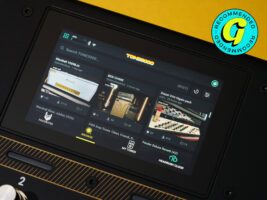
Once on the latest firmware and connected to your WiFi, you can browse the full Tone3000 library in the same way you can explore the standard HeadRush cloud. To integrate a new A2 model into a HeadRush preset, all you need to do is download the capture you want, tab back into editing the actual rig, and load the .nam file into a NAM block. It takes me a second to find where the NAM block actually is in the list of effects, mind, as it’s under the ‘clone’ sub-category, but once this is done, it’s treated much the same as another amp model.
Well – with one exception. An unfortunate limitation is that you can only load one NAM model per preset, whereas you can load multiple stock HeadRush amps. This nixes a few possibilities, such as running a NAM-captured overdrive into a separate NAM-captured amplifier, or creating a dual-amp stereo tone with two A2 models. However, for more straight-ahead sounds, it loads fine and leaves more than enough CPU headroom to build an otherwise complex patch.
Image: Adam Gasson
How does A2 sound?
So, yes, upon launch the big claim was that these models sound better than all previous digital amp models, including Neural’s. Quantifying quite an abstract thing in a couple of bar charts does seem like some good old marketing bluster, but, having spent a lot of time with a lot of A2 models, I am quite inclined to believe said bar charts. These models don’t just sound good considering they’re free – they sound bloody fantastic, to the point where you’ll question every amp plugin and hardware modeller you’ve paid for up until this point.
First – some clean things. The library, as it goes with amp modelling, skews slightly towards the chugs – but after a little scrolling I find a Twin Reverb capture, and, well, it sounds like a good Twin – big headroom, clean but not sterile, and nice and bold and bassy. Adding some compression and ambient effects, and it eats them all up with aplomb. Feel goes a long way here, too, and the best clean sounds from amps like these have a certain chewiness that encourages a more dynamic approach. I’m pleased to say that feel is pretty well replicated here.
The feel stays chewy and approachable towards the mid-gain side of things, too – captures of cranked AC30s and vintage Marshalls are all a dream to play, really, and it’s startling to hear such consistent clarity and string separation when exploring the wider catalogue. Some captures are better than others (that’s the nature of the beast here as they are dependent on how well the amp was captured originally), and certain amp-head-only captures sometimes don’t gel with certain IRs, but broadly it’s very hard to find a bad sound here.
Image: Adam Gasson
On the more metal side, I’ve been learning some Death riffs recently (a great way to find out just how much you don’t use your pinky) so I seek out something ragged and high-gain – and spot that Ola Englund has uploaded a capture of his Randall Satan. Frankly, it’s one of the best high-gain sounds I’ve heard come out of a digital device, being at least on par with everything I’ve tried from Neural, and with notably more clarity and punch than even something like the UAFX Anti.
I give a few different high-gain models a spin, the Satan and a few 5150 captures, plus a few Sunns and Oranges. What’s cool to see is these amps work well with HeadRush’s own virtual effects – as you’d hope, the Tube Screamer model does the thing when placed in front of a mid-gain 5150, and virtual RATs and Big Muffs also behave realistically when run into appropriately doomy A2 captures, without any artefact-laden digital nonsense coming through.
To go back to the Randall Satan, that particular model also demonstrates one of the neatest things about NAM: Ola demoed that capture in a video about the launch of the Tone3000 plugin, and, despite the fact he was running it in a completely different environment, I can easily dial in pretty much the exact same sound in my own rig. Preset-sharing is hardly new, of course, but what is new is virtual amps of this quality being so portable and cross-compatible, with Tone3000 operating as a truly central hub, rather than each brand of multi-effects being siloed into their own tone-sharing spaces.
There are some bugbears with the system. The previously-mentioned limitation of just one NAM block is one – the other is the fact that people capture NAMs with vastly different gain-staging – I blast my ears unintentionally a couple of times as some uploads kicked out far more dBs than others.
And speaking of gain – like most capture/profile tech, NAM does not offer ‘virtual device’ controls – A2 captures are still pre-set in their on-device EQ and gain settings. There is built-in post-EQ for the NAM block, and you can boost or underdrive things to adjust your saturation level as needed, but if you’re used to the flexibility of virtual amps that do have virtual controls, it feels like a bit of a step backwards.
Image: Adam Gasson
Should I buy one?
If you’re looking to explore these sounds yourself, you can easily do so with the new Tone3000 plugin. As for the hardware implementation in the Flex Prime – it’s pretty darn good. Not faultless, and the limitation of just one NAM model at a time may be a deal-breaker. But its price and this limitation does court comparison with the Nano Cortex – the HeadRush’s NAM support now means that you’re very much not compromising on sound if you want to pay slightly less, and get similar IO, but add a screen and an expression pedal.
And regardless of whether the HeadRush’s implementation is for you specifically, it’s still gratifying to see a relatively notable chunk of the multi-effects world embrace a more open standard – even affordable, dinky practice amps like the Blackstar Beam Mini support A2 models! It’s only good for the industry as a whole if Neural, Kemper and Line 6 have to truly back up their higher prices and more walled-off ecosystems with sounds that are on par with A2 is. Or, at least install a door into their walled garden and offer NAM support, which they currently do not.
This is absolutely not to say that buying a Quad Cortex is now the equivalent of pouring cash into the toilet. Sure, the A2 amps sound great, but it’s not like they’re orders of magnitudes better than Neural’s. And the hardware has its own benefits – open-source software alone cannot replicate the effects processing headroom, the connective power or the live usability of a full-fat Quad.
But overall the A2 launch is still a very positive change for the industry. I am predisposed to bat for the more crunchy, open-source solutions anyway, pain points and all (I am very much the person from that Hard Drive article that will never shut up about installing emulators on a Raspberry Pi) – more open standards almost universally lead to good stuff for the consumer, and I think that holds true with NAM A2.
Headrush x Tone3000 alternatives
There are a few NAM-compatible hardware loaders of varying budgets that can use A2. The HeadRush stuff is probably still the most flexible in terms of offering a multi-effects signal chain, while the most stripped-back is perhaps the Valeton GP-5, a $76.99 mini pedal that currently uses the more limited Snaptone versions of NAM captures – but is set to get an update for A2 Lite support soon, according to the manufacturer.
For full A2 support, there’s also the DimeHead NAM player, a German unit that’ll set you back €595, and the pricier Darkglass Anagram, a bass-focused multi effects currently running at $1,199.99/£999 that has recently benefitted from an Andertons and Sweetwater-exclusive Guitar Essentials version (with the guitar software element set to be available separately for a fee). The most extensive loader when it comes to amps is the Sonulab StompStation PRO, a €475 unit (currently on sale) that can load a whole three full-resolution A2 files at once.
The post HeadRush x Tone3000 review: latest A2 NAM models meet simple-yet-effective hardware appeared first on Guitar.com | All Things Guitar.
Source: www.guitar-bass.net