How Angel Du$t became the most unconventional band in hardcore
What do Justice Tripp, Wes Eisold, Kevin Baker, Dave Weinberg and Frank Carter have in common? Well, aside from being some of the most revered and influential singers in modern hardcore, they’ve all shared a stage with Jim Carroll, a guitarist who’s a punisher’s dream – essentially a heavily-tatted Zelig with a Les Paul Custom cinched at his waist. “I guess I’m fairly versatile,” he says, playing it down during a Zoom call from New York. “I like a lot of different shit.”
READ MORE: The Molotovs want to be the solution to the problem of “insular and wallowing” guitar bands – this is how they’re going to do it
But, in fairness, that self-deprecation is perhaps only natural given how long he’s been bouncing between gigs. Hailing from Worcester, Massachusetts, Carroll came up in a febrile hardcore scene at the turn of the millennium, joining local band Hold Strong while still in his teens. “I went to one of their shows and they announced over the PA between songs that they needed another guitar player,” he recalls. “So, I went up to their merch table. I ended up playing with them when I was 17, 18 and they were in their late 20s. That was a big thing.”
From there, dominoes kept falling. Carroll moved to Boston when he was 19 and started touring, chipping away at a rep as a collaborator capable of switching gears with verve and adaptability. He played with Weinberg on some early Suicide File recordings and would later indulge his inner rocker in Carter’s post-Gallows project Pure Love, while pulling double duty as a touring member of American Nightmare and the Hope Conspiracy, switching between backing Eisold’s mile-a-minute-bark and Baker’s muscular roar. Of late, though, it’s been his job to tune in to Tripp’s way of thinking as a member of Angel Du$t.
Image: Nat Wood
Chilled Out
And that remains a unique proposition in hardcore thanks to the genre-defying sprawl the vocalist has embraced since Trapped Under Ice hung up their recording spurs almost a decade ago.
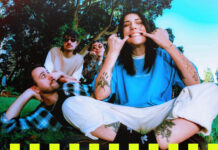
Angel Du$t was originally a side project for Tripp to have fun with his buddies Michael Quick and Nicholas Heitman, alongside Daniel Fang and Pat McCrory of Turnstile. Turnstile’s tilt for unprecedented stardom for a hardcore band has been based on their willingness to push its musical boundaries, and it’s something that’s baked into Angel Du$t in different but no less experimental ways.
On their new record Cold 2 The Touch, Carroll and guitarist Steve Marino, better known for his indie-rock solo work as Bugg, make themselves right at home, lending sinuous riffage to songs such as Pain is a Must, warped pop flourishes to Man on Fire and straight-up hardcore carnage on The Beat. So far, so Angel Du$t, you might think, but it’s been a while since the group has sounded this sure of itself, this hench.
“That’s Justice’s brain,” Carroll says. “He’s described it to me as ADHD music. He always wants something new to catch the listener’s ear. It’s been a cool way of approaching music, because I feel like it’s not my natural way of doing things. It’s been fun to jump into it and then try to write songs that will fit what he’s doing, and what he wants.
“I think Steve is the same way – we’re filtering our way of writing into the Angel Du$t vision. Approaching this record, I definitely tried to put my stamp on it. I like big guitars, I like layers, I like cool psychedelic elements that go with heavy music. I feel like I was pretty successful with that.”
Cold 2 The Touch was recorded with producer Brian McTernan, who worked on a lot of Angel Du$t’s early stuff, including their debut A.D., and also Nonstop Feeling, the first LP by another TUI offshoot: Turnstile. Given Carroll’s long history in hardcore and the fact McTernan has been around since the early 90s himself, as vocalist of the underrated Washington, DC youth crew band Battery and a Boston-headquartered collaborator with everyone from Cave In to Snapcase, it’s surprising to discover that they were strangers when recording began.
“I grew up seeing his name on seven inches,” he says. “When we went into the studio and I met him for the first time, we realised we have a ton of mutual friends. We clicked. We definitely have a lot of the same interests — he’s great at getting good guitar sounds and making things huge, but he’s a great songwriter as well, and makes great suggestions [when it comes to] harmonies and melody. He’s a guitar player, a singer. It was cool to work with him. We had to shove a lot into a short period of time, so it would get hectic at times. But it worked out.”
Pumping Iron
In truth, Carroll’s tenure with Angel Du$t has been hectic from the drop. It began in his local gym, where bassist Zechariah Ghosttribe is a trainer. “One morning he was talking about how their guitar player couldn’t go to Brazil, and it was kind of screwing up some shows they had,” Carroll recalls. “And I was like, ‘If you need a guitar player, I’ll go to Brazil for a weekend. That sounds all right.’ Justice and I had met over the years, but very briefly. We got on the phone later that night and talked about it. Two weeks later, we went and did a couple shows with No Warning. We had a good time, they had some stuff coming up, and he was just like, ‘If it’s something you want to do…’”
Serendipity aside, Carroll and Marino make a lot of sense as a pairing given Angel Du$t’s split personality. In the past, Marino has described playing with the band as “exercising a different muscle” to his own songs, and from the outside the same is true for Carroll. Where Marino is being drawn into heavier realms than he’s used to, Carroll is pushing different buttons to the one he needs to rely on when on stage with American Nightmare or Hope Con.
There is a moment a minute or so into Cold 2 The Touch standout Zero when all of this comes into focus: the guitars slow and Tripp barks out a line that feels like a mosh call, but instead of a breakdown we get Carroll peeling off a solo. It’s a bait and switch that serves as a perfect encapsulation of what Tripp calls “aggressive rock and roll”.
In the studio, Carroll’s search for punchy tones took him down an unexpected path. Using a JCM800 as a starting point, and with everything from a Pro Co RAT to a API Tranzformer and a JHS Bonsai in the mix pedals-wise, he settled on a Rickenbacker Dakota 650D for most of his contributions, swerving away from the 2000 Black Beauty that’s been his go-to for decades and the 2017 humbucker-rigged Fender Jaguar that’s served as his Angel Du$t live guitar. “Brian had a handful of guitars in the studio, and I played that on the first day,” he says. “It felt great, it had a good sound. You could run the gamut of nice, gain-y distortion, and cleaner, more percussive, classic Marshall sounds. I think I played that on every song.”
Image: Nat Wood
Solid State Logic
On the road, Carroll is still wearing a few different hats. For him, touring means switching between the more abrasive sounds required by American Nightmare and Hope Con, with Angel Du$t presenting a different, more tonally nuanced challenge. So, if he was playing a show tomorrow, what would he be taking with him? “I am playing a show tomorrow,” he replies. It’s with AN at Rough Trade in NYC, before a couple of dates with youth crew icons Gorilla Biscuits, so the Les Paul is up.
“These days, I have a Quilter Tone Block 202 and then I’ve been playing through a Line 6 HX Stomp XL,” Carroll adds. “If you told me five years ago that I would have a solid state head and a digital modeller, I would have called you crazy. But it’s made travel and jumping between bands so much easier. I fit all my stuff into a Pelican and a two-guitar Gator case.”
“I know that every night when I plug in, I have every band programmed,” he continues. “It’s just a flip of the switch. At festivals or shows where you’re not the headliner, I can get up there and set my stuff up in five minutes. I don’t have to think about pedals and dead cables, trying to find where things are going wrong. It has its downsides, because it’s like a computer on stage and, if you’re playing a smaller hardcore show, you have people running up and maybe trampling on stuff.”
And there are a lot of feet out there right now ready to do that trampling. Hardcore is as big as it’s ever been, and that’s down to people like Jim Carroll slogging it out during some lean years. Over the past two decades and change, every good show, every bad show, every connection, every recording session, has led to this niche, outsider music catching fire in a manner few could have expected it to.
He’s seen it all first hand, just like so many of his peers have. It feels fitting that Carter and Eisold both guest on Cold 2 The Touch, underlining the fact that hardcore, before merch, Grammys and social media beefs, is about pulling together with your friends. “It’s just a case of, ‘Hey, do something on this,’” Carroll says. “Make it cool.”
Angel Du$t’s Cold 2 The Touch is out February 13 through Run For Cover.
The post How Angel Du$t became the most unconventional band in hardcore appeared first on Guitar.com | All Things Guitar.
Source: www.guitar-bass.net