How Jackson and Charvel broke new ground for Sleep Token’s double signature models: and created 2026’s biggest artist launch
The biggest signature guitar launch of 2026 was for two musicians who have never said a word publicly, have never given an interview, and whose faces have never been seen. And yet within days of their Charvel and Jackson instruments being revealed to the world, they had completely sold out – despite the four figure price tag. Strange? Well…
Sleep Token signatures on the Guitar.com Cover. Image: Joseph Bishop for Guitar.com
And in truth, nobody was really surprised. The masked collective known as Sleep Token are, to put it mildly, a phenomenon – their huge, ever-growing presence has seen them bring death growls and djent-inflected riffs to staggering arena-sized shows, and become one of the newest bands to headline Download festival.
As well as a formidable listenership they’ve also crafted a whole universe of intricate mythology from behind their masks and bodypaint that has built a remarkably devoted and passionate following. This was never going to be a normal set of signature instruments, or a normal launch.
For starters, it was the first ever joint launch for Jackson and Charvel – with guitarist IV opting for a signature Jackson, and bassist III creating his own Charvel bass. The two brands have been under the wider Fender Musical Instrument Corporation brand for a long time now, but they’d never collabed like this before. But here’s where it gets really tricky…
Image: Joseph Bishop for Guitar.com
Within their music, Sleep Token offer up cryptic storytelling, hinting at but never overstating a deeply-imagined lore. But, remarkably for a band of their size, everything else is a mystery. Outside of their songs and their other “offerings”, the band maintain an anonymous, enigmatic presence – an approach that’s hardly forthcoming to the usual cycle of interviews and demos that would usually accompany a launch like this.
The total number of words said by bandleader Vessel in his extremely rare interviews could fit on about six post-it notes, and even then he presents the project pretty cryptically. Drummer II did a video with Drumeo in 2023. But for III and IV? Nothing – no rig rundowns, no tour diaries, no get-ready-with-me TikToks. The band members don’t even appear in music videos anymore.
So how do you go about launching not one but two signature instruments for Sleep Token, when the band’s non-music communication mostly consists of mysterious lore and runic symbolism? Tim Hillier-Brook is the artist marketing manager for Fender’s specialty brands, and helmed the collaboration between Sleep Token, Jackson and Charvel – and it was up to him and his team to find out.
“Guitar is one of the most exciting places it’s been in for a long time, Sleep Token are a really important part of that”
Old friends, new connections
Since he started in his role, a Sleep Token collaboration was always a goal for Hillier-Brook. Then a few years ago, the former Architects guitarist crossed paths with an old friend.
“By complete coincidence, their guitar tech is an old mate of mine from back when I played in bands,” he says. “He reached out to us, saying, ‘Hey, Sleep Token is growing, and we’re looking to get some more instruments’. I was delighted to hear that, particularly as it came through a friend – there’s a level of trust there.”
Image: Joseph Bishop for Guitar.com
“It quickly became all about getting them the perfect guitars for what they do,” Hillier-Brook adds. Things started with existing production models, such as Gretsch Baritones, but after around a year of discussions, it was time for some custom instruments. “We made an eight-string for IV, and there’s a four-string non-multi-scale for III – those let us troubleshoot some things, and find what was going to be the main instrument for both of them.”
Given how broad the Sleep Token sound is – going from expansive, cinematic pop to pummelling, brutal metal – it was going to be impossible for the signatures alone to cover everything III and IV needed. But the team took aim at the instrument that could work for the bulk of a given set. “It was about looking for something that would be what they needed for the most amount of time. So we landed on the specs from a lot of trial and error. III and IV are both exceptionally knowledgeable about gear and what sounds they need – they were very much like this is how it has to sound’, and it was always in a very positive, creative way.”
“Artists are not only being more creative with blending genres, they’re also being more creative with signature guitars”
A double offering
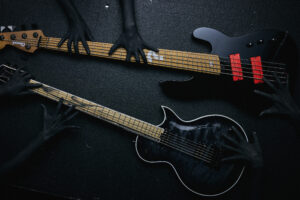
The collaboration has netted some truly singular guitars. “They’re both extremely bespoke to the music that the band makes and performs live,” Hillier-Brook says. “IV’s guitar is a 30-inch baritone, fitted with an EverTune and custom tension modules – tuned E-E an octave down, all wound strings. Essentially it’s a Bass VI designed for metal, and pretty much the first-ever production 30” baritone with those specs. There are other 30” guitars out there that players like to mod for metal, but this one is unique.”
III’s bass marks some firsts too – “it’s the first ever production reverse headstock Charvel has done, and it’s the only multi-scale Charvel bass, too – including custom. The prototype was literally the first time we’d done that. from has ever done,” Hillier-Brook says. “It’s a more gradual multi-scale, too – Sleep Token use a load of different tunings, and both of these instruments reflect the ability to switch between them. The way we’ve done the multi-scale helps with that.”
Those tunings are, as a rule, extremely low, and obviously a 30” scale helps keep things tight and percussive on the guitar side, particularly when tuning more than an octave lower than E standard. But it’s about more than sheer string length:
“For both of them, I think the main word is clarity,” Hillier-Brook says. “It’s obviously very easy when tuning that low for it to be an inaudible mess. So with the bass, it’s got the multi-scale, and the active Fishman pickups in it with multiple voicings which help things stay controlled.”
Image: Joseph Bishop for Guitar.com
“And for the guitar, it’s got a mahogany body, but with a maple cap on top alongside its quilted veneer. That’s a tonal choice to add a bit of that snappiness and brightness to things. It’s all about how those notes are going to cut through live. If you’re playing a big arena in those kinds of tunings, with those impactful and dynamic moments in the music, you need to hear every note.”
And despite those arena-ready sounds and specs, the guitars don’t sport custom-shop price tags. “That was really important to me, and the wider team, and to Sleep Token too,” Tim says.
“It can be a difficult thing when developing a signature model with an artist, to hit the specs where it’s something they will genuinely use live, especially in venues of that size, but still to make it attainable. That was definitely top of mind – getting the right specs while staying at a price-point where they’re obviously not cheap guitars, but they’re not an impossible thing for a fan to purchase.”
“III and IV are exceptionally knowledgeable about gear and what sounds they need”
Unmasking the signatures
“Anonymous” and “signature” may seem like antonyms, but that tension was something that ended up helping the designs have, weirdly, more personality. There are some literal signatures on the guitars, with a IV on the guitar’s headstock, a III on the bass’ fretboard – but for Hillier-Brook, the identity present within them comes from Sleep Token having “complete creative control” – something masked personas don’t really get in the way of.
So you don’t need to peruse their wild spec-sheets to have them stand out – these guitars will remain pretty recognisable even through a haze of fog and stage lights. “Obviously we do the Monarkh, and we do the San Dimas bass but there are little details about these that make them so unique,” Hillier-Brook adds.
“It’s not quite the same as doing a Soloist with a signature on the back of the headstock. That can be really cool, but these are something else. No matter where you see them, you’ll know exactly whose signatures they are straight away, without needing a big name on the headstock. And that all came from III and IV – they were really smart about the aesthetics as well as the specs.”
Image: Joseph Bishop for Guitar.com
A unique moment
The fact that the Sleep Token collection of guitars are so singular for Hillier-Brook reflects on where the wider world of guitars is at right now. “It’s in one of the most exciting places it’s been in for a long time,” he says, “and because of that, people are trying new things. One of the benefits of streaming is that every genre ever is in everyone’s phone – which has made people approach guitar very differently. Sleep Token are a really important part of that, where players are doing things sonically and stylistically that haven’t really been done before.”
When it comes to guitar themselves, we can see that approach reflected in other recent releases. Jack Antonoff and Lee Malia’s recent signatures, for instance, certainly garnered attention from beyond their respective fanbases thanks to their cool, genre-agnostic mashup vibes.
Image: Joseph Bishop for Guitar.com
“The name is the stamp of approval,” Hillier-Brook notes. “But it isn’t the thing about it. Lee [Malia]’s guitar doesn’t have ‘Bring Me the Horizon’ across the fretboard, and these don’t say ‘Sleep Token’ across theirs – and I think it’s linked to that trend. Artists are not only being more creative with how they’re blending genres, they’re also being more creative with guitars when the opportunity of a signature arises.”
Cynicism about signatures as a whole has also declined. “Some people used to be like, ‘I don’t want to play a guitar with someone else’s name on it’,” Hillier-Brook says. “I had it myself, years ago, when I played a Jim Root Tele in Architects! Like, ‘Oh, that’s someone else’s guitar, why are you playing it?’ – but I love Telecasters, and they’re designed for metal. Why wouldn’t I? – but there’s less of that.”
More players – particularly within the heavy world, seem keen to embrace the unique potential within the world of other artists’ signatures. “And I think we’ll see so much of that with these instruments,” Hillier-Brook notes. “Just because they do such a unique thing, and again that attitude of, ‘I’m not playing so-and-so’s guitar’ is less common. Some people might get annoyed about it, but if you are… don’t buy one. That’s fine too!”
“A lot of the positive response isn’t from Sleep Token fans – people are just excited about the guitars!”
Ready for launch
From the start it was pretty clear to the whole team that these guitars would land with a splash, no matter what happened. “Working on the whole campaign was very exciting, just because of all of the firsts,” Hillier-Brook notes, “so we had to work out how to make this the biggest thing. The run would have sold out anyway, really, because the guitars are incredible and Sleep Token are who they are, but it was so important for us to really amp it up to 11.”
The fan response to the guitars speaks for itself, and, yes, as predicted, the first wave of guitars sold out extremely quickly. But the impact went beyond units sold, particularly thanks to the fact that for the launch III and IV had finally appeared in a music video of sorts, performing a never-before heard instrumental version of Vore. For a band in such clear control of their audiovisual presence across, getting to contribute to a bonafide capital-O Offering is a pretty big deal.
Tim points towards the flipside of this, too. “A lot of the positive response isn’t just from Sleep Token fans – a lot of people are just excited about the guitars! Really, I’ve just been embarrassingly glued to my phone since the launch. The response has been unbelievable, more so than you might expect – and that’s extremely validating for us as a company, and for them as musicians.”
Image: Joseph Bishop for Guitar.com
Building worlds
In talking about these two instruments it’s easy to get caught up in a whirlwind of specs – but it’s good to remember that their uniqueness doesn’t just come from ultra-low tunings or any given set of pickups. It’s a reflection of the totally singular approach that’s made Sleep Token the band they are.
“In terms of artists that build worlds, whether you like them or not, they’re the best at it,” Hillier-Brook says. “And these guitars are just a symptom of them being so at the top of the game in terms of everything they do, from that world they’ve created, their aesthetic, down to every last tiny little detail of spec of these guitars.”
And for Hillier-Brook there’s one main takeaway from the craziness of the launch. “The way they’ve been received, the reaction from fans, artists and influencers to all of the things we tried to do with them – to see that come to fruition, as, really, just a positive thing for the whole guitar community? That’s the biggest success of these.”
Words: Cillian Breathnach
Photography: Joseph Bishop
The post How Jackson and Charvel broke new ground for Sleep Token’s double signature models: and created 2026’s biggest artist launch appeared first on Guitar.com | All Things Guitar.
Source: www.guitar-bass.net