How Josie and the Pussycats became one of the greatest guitar soundtracks of the 2000s – and why it cost over $2 million to make
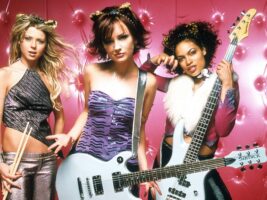
You might be familiar with the film, Josie and the Pussycats (loosely based on the Archie comic) that follows a trio of friends from Riverdale who take their girl band harmonies and hard-charging riffs from a local bowling alley to the bright lights of New York City.
READ MORE: “It’s the reason why I got into music in the first place” Towa Bird on reclaiming her status as a new generation guitar hero
Despite its stellar cast of teen movie breakouts – She’s All That star Rachael Leigh Cook as Josie McCoy, ably supported by American Pie’s Tara Reid, Rosario Dawson, and even Alan Cumming as dastardly MegaRecords label exec Wyatt Frame – the movie flopped at the box office. But, a quarter of a century later, it’s often hailed as a cult classic. Whether you regard it as a subversively prescient commentary on the rapid commercialisation of rock music that occurred around the turn of the Millennium, or a fun teen comedy about three friends in a band (it’s kinda both to be honest), there’s one thing that’s undeniable – that soundtrack absolutely rips.
What you might be less familiar with is the fact that those powerful pop-punk numbers that brought the energy and starry-eyed ambition of Josie and her Pussycats, bassist Valerie Brown, and drummer Melody Valentine, were initially slated to sound like something else entirely.
As film songwriter and co-producer Dave Gibbs of Gigolo Aunts explains from his home in Boston, “My theory was the directors (Henry Elfont and Deborah Kaplan) were hoping for a bit of that Babyface, L.A. Reid magic. More dance pop, with an urban flair.”
Babyface’s involvement as the film’s executive music producer made perfect sense on paper. Having helped define the sound of TLC, he knew exactly how to craft modern girl-group pop: the trio’s third studio album, Fanmail, won Best R&B album at the 1999 Grammy Awards, with nods to Edmonds’ own guitar playing in that iconic plucked acoustic opening of standout single Unpretty. The trouble was that the soundtrack’s polished early recordings didn’t match what audiences were seeing onscreen.
Josie and the Pussycats. Image: Universal Studios/Getty Images
Guitars & Marshall Stacks
After our call, Gibbs shares early demos of You’re A Star and Spin Around, both of which appear on the soundtrack. The pace is immediately slower, the guitar slashes almost languid. Josie’s scrappy start-up vocals from the film (this version performed by Grammy-award winning songwriter Tracy Bonham) are surprisingly crystalline without a hint of a snarl or affliction. Something had to shift.
Enter Letters to Cleo co-founder and vocalist, Kay Hanley. “By the time I got there, they had let the original Josie go, because Rachael was lip syncing to her voice, and people were just like, ‘Oh, there’s no way that voice is coming out of Rachael’s mouth.’”
Hanley had arrived on set for the Pussycats’ backing vocal duties alongside her then-husband and Cleo guitarist Michael Eisenstein. The pair travelled from Boston to West Hollywood, bundling all their belongings into a rental car alongside their 11-month-old daughter, Zoe Mabel. After months of back-and-forth to California, Hanley secured the lead role for the soundtrack, but capturing the trio’s fast and frenetic fretwork on record was still up for debate.
Buoyed by her position alongside the core production team, Hanley piped up about her bandmate taking a shot. Eisenstein remembers the moment clearly. “I put a pass down with this set doubling combination I used at the time through a Vox AC30 Top Boost and Mesa/Boogie Dual Rectifier Trem-O-Verb. A guy who was never introduced to me was sitting in the corner of the room. We got through that first pass, and he goes, ‘Yeah, have him redo all the songs!’ He was the co-director of the film, Harry Elfont.”
Kay Hanley performs at the Josie and the Pussycats reunion. Image: Press
That Thing You Do
Yet Letters to Cleo weren’t the only alternative-rock recruits drafted into the project. “At the time, I was living with Adam Duritz,” recalls Gibbs. “Adam lived in Beverly Hills above Sharon Stone!” The Counting Crows’ frontman’s apartment became a haven for Californian creatives during the late 90s, including yet-to-be-discovered film costume designer Alex Bovaird Sprouse (The White Lotus).
“She and a bunch of people were in the hot tub,” says Gibbs, casting his mind back. “Adam and I came down and played Merry Go Round, the long-lost power pop song. Somewhere there’s a recording of Adam and me doing the songs, on piano with his vocals. It sounds like an acoustic Counting Crows record.”
A key song that wasn’t lost to the archives came from one of pop music’s greatest collaborators, the late, great Adam Schlesinger of Fountains of Wayne. Who better to craft the staccato punch of Josie’s imagined single, complete with Thin Lizzy-style octave guitar solo, than the man who effortlessly spun chart-topping earworms for a living? Gibbs had already pitted himself against Schlesinger for songwriting credits in 1996’s That Thing You Do, but Pretend To Be Nice is a masterclass in pop dynamics and unquestionably catchy, crowd sing-alongs, as Gibbs concedes. “When he gave me the demo of Pretend To Be Nice, I was like, ‘Oh, my God!’”
Dave Gibbs. Image: Press
A Whole Lotta Money
Enlisting big names like Babyface and Schlesinger, alongside countless auditions and re-records, didn’t come cheap, though, as Eisenstein shares. “They had blasted through $2 million of soundtrack money and had five songs to show for it.” Gibbs likens the split to an old school vinyl track listing: Side A was recorded at Babyface’s legendary Brandon Way Studios. Side B saw the Boston-based heart of the band returning home. “Half that record I did in LA, the other half got finished in Q Division in Boston with original Cleo producer, Mike Dineen, and Schlesinger,” explains Gibbs.
Faced with an empty B-side, Hanley and Eisenstein stepped up with their alt-rock chops to contribute the chugging charge of Shapeshifter with that standout slam from Hanley, as she spits, “If you think that’s cool, whatever dude!” For Eisenstein, the second half of the soundtrack benefited from recent session work. “Not even a year prior, I’d performed on Nina Gordon’s (Veruca Salt) solo album with Bob Rock. I learned a lot, so I had my Cleo tricks and my Bob Rock bag of tricks.” Despite the wildly different circumstances, the guitarist believes the output proves it’s all about the songwriters behind the tracks. “Those two groups of Josie songs… different producer, different city. It shows you how much it really is about the musicians and not so much the gear and the studio.”
Michael Eisenstein. Image: Josh Pickering
Rock’s Not Dead
The soundtrack’s influence extended far beyond its original release. In 2017, The New York Times published Rock’s Not Dead, It’s Ruled by Women, a round-table discussion featuring some of the most vital voices in contemporary guitar music. Among them was Speedy Ortiz’s Sadie Dupuis, who singled out Josie and the Pussycats as a formative influence. “Am I the only one who can speak to the importance of Josie and the Pussycats?” she asked. “Because that was the game changer!”
She wasn’t alone. In an interview with The Fader, Mitski also reflected on how the fictional trio shaped her early ideas about performing. “The little gestures and facial expressions they do in those music videos,” she recalled. “I’d be like, ‘Oh, that’s how you do it! That’s how you hold a guitar!’”
While the movie underperformed, grossing less than its production budget, the soundtrack has since become a gateway record for a generation of women discovering guitar music. In many ways, its legacy stretches far beyond the film itself.
The songs gave aspiring musicians a vision of what a guitar band could look and sound like, while finally earning Kay Hanley recognition for a performance that had spent years hiding behind a fictional alter ego. “It’s overwhelming to me to imagine that people listen to something that I did, especially young women, and decide, ‘Oh, I want to do that,’” she says.
Don’t You Know These Kitties Rule
That legacy was impossible to miss when the cast, directors, and musicians reunited for a sold-out screening at Los Angeles’ Ace Hotel in 2017 to celebrate the soundtrack’s long-awaited vinyl release. For Eisenstein, the scale of the event came as a shock.
“People travelled in for it,” he remembers. “After soundcheck, we went to get dinner sitting in this outdoor cafe, and we started seeing people show up, with the ears on and the outfits, lining up. I was like, ‘Oh, damn, this is big!’”
During the performance, the audience sang every word back to the band. “That screening night crowd was one of the most enthusiastic audiences I’ve ever played for,” he says. “During the ballad (You Don’t See Me), volume of the band and the audience was equal.”
Because this cult classic shouldn’t just be remembered for its sharp satire or killer soundtrack, it’s also a heartfelt love letter to fan culture. And even with a fictional band like Josie and the Pussycats, there’s no denying that the love and spirit behind the music was real all along.
Michael Eisenstein and Kay Hanley onstage at Brooklyn Made. Image: Press
Gear For Cats
The varied gear that was used by guitarists Eisenstein and Gibbs to record the legendary Josie and The Pussycats OST
Mike Eisenstein
Gibson Les Paul Junior
Gibson Les Paul Special
Fender Telecaster
Vox AC30 Top Boost
Mesa/Boogie Dual Rectifier Trem-O-Verb
Line 6 Echo Pro rack delay
Dave Gibbs
Gibson J-185 (later stolen from the film set)
1964 Gibson J-45
Fender Telecaster
Höfner-style bass
Fender Deluxe amp
The post How Josie and the Pussycats became one of the greatest guitar soundtracks of the 2000s – and why it cost over $2 million to make appeared first on Guitar.com | All Things Guitar.
Source: www.guitar-bass.net