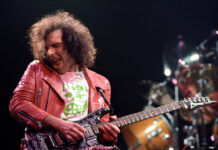

How Wheatus distorted an acoustic guitar to make Teenage Dirtbag an early 2000s classic
“I thought it was a peculiar track and interesting and people might like it, but I had pretty much excluded the possibility of it being a single of any kind,” exclaims Brendan B Brown, frontman, guitarist and songwriter of Teenage Dirtbag, the 2000 anthem by Brown’s group Wheatus that appeared on the group’s self-titled debut album.
It’s now 25 years since Teenage Dirtbag took Brown from playing to a handful of people to taking to the festival stages around the world. The song hit number one in several countries, including Australia, and made the top 10 in the US and UK. No one is more surprised at the song’s longevity than Brown himself. “I thought it was too long and that it had this kind of character switch in the middle that felt a bit theatrical,” he says.
READ MORE: Trivium’s Matt Heafy names the five up-and-coming metal bands everyone needs to watch in 2026
Teenage Dirtbag’s instantly recognisable and unmistakable opening riff came about after Brown struggled to figure out Mark Knopfler’s opening guitar riff to Dire Straits’ Money For Nothing.
“I was trying to get my head around Mark Knopfler’s playing of the riff on Money for Nothing,” he explains. “It was such a big single when I was a kid. In the video it had Mark’s pinky sticking out, and I remember thinking, what’s he doing? And I ignorantly stabbed at that for many, many moons.
“Eventually I came up with my own version of it, which was similar, in regards to the shape of the hand. I wasn’t taught to do it by anyone. I just watched him in the video, as the video starts with a big closeup of Mark playing it, and I went from there.”
Brown’s attempt at mastering Knopfler’s legendary ‘clawhammer’ fingerpicking style was further informed by two other unlikely sources.
“I realized that AC/DC’s Malcolm Young did it on Rock and Roll Ain’t Noise Pollution too, and also Angus Young on Who Made Who,” he says. “So, I really learned how to play fingerstyle from rock and roll guitarists, which was kind of a little weird. You’re supposed to play fingerstyle with the pinky but I got there with my own incorrect version of it.
“Playing the main riff to Teenage Dirtbag absolutely destroys my fingernails on tour, so much so that I have to put glue on them to keep them together. It’s quirky how I play it too with a sort of thumb, thumb, finger pluck, thumb, thumb, finger pluck pattern. It’s very percussive, like a kick, kick, kick, snare, kick, snare, kind of thing.
“I’m just using a regular standard E major chord which to me, is a big chord. There’s a lot of big rock records that have big sounding opening E chords. For example, you have Back in Black and you have Rush’s Tom Sawyer. And those two songs came out around the same time and were big tunes back then, so, it inspired me to write a song that had a big E chord in it, too, which I did with Teenage Dirtbag.”
Leader Of The Gang
First written and demoed back in 1995, Brown asserts the song was pivotal in his transition from band member to frontman. “Doing the demo was the first exploration for me as to what it would be like to be the leader of a band where my voice was the lead voice,” he says. “And that’s a very nerve wrecking thing to try and do after you’ve only been a guitar player in previous bands, and feeling not very confident about.
“I did the demo on a Tascam Portastudio 424, one of the small four track units, which I still have in the attic. The finished recording was recorded on a Tascam DA-78HR system, which was the front loading ADAT machines from Tascam that you would stack and sync together. We had four of those that we bought with our advance money.”
The song’s change in dynamics, from acoustic driven verses to a choir of distorted electric guitar in the chorus has proved a mystery to many in how Brown achieves those heavily distorted tones. His answer will surprise somewhat.
“There’s no electric guitars whatsoever on the recording,” he reveals. “A hundred percent of the electric guitar that you hear on the record is a Martin 00016 TR. A guitar I picked up from the Guitar Center in Los Angeles. When I first played it, I was like, ‘Yeah, this is the one’. So, I took it home and it’s been with me ever since. It’s also the one that’s in the video, too. It’s retired from the road now as it’s a little too fragile. But it spent a good 15 years on the road with me.”
In order to achieve the distorted tones on the recording, Brown plugged his Martin into a SansAmp PSA-1 preamp, “with some very particular settings”.
“And I doubled-tracked it twice,” he adds. “So, there’s two performances on the right, and two performances on the left. I also took a Mesa/Boogie Subway Blues amp that I had, and put the volume knob just right before the breakup point so that if I played it hard, it gave me a little bit of tube distortion from the power amp tubes. And if I backed off of it, it would give me a sort of chunky clean sound. And I overdubbed one per side, too. When you listen to the Teenage Dirtbag recording, you’re hearing six tracks of six performances of guitars. So, there’s six layers of guitars on there.”
The song has of course become a staple of the band’s set ever since, but replicating that tone in the live environment proved challenging, but Brown found a way around it. “When it came to getting that distorted tone live, I initially was using a little Danelectro Daddy-O pedal for the real fuzz to give me that crunch, and an Ibanez Tube Screamer for just a bit of overdrive,” he says. “And I had it split through a Whirlwind ABY Splitter where I had the acoustic sound going out. Eventually, I put the acoustic sound on a volume pedal, so that it ducked when I played the ‘electric’ part. So, I was initially just tapping on and off the distortion pedal when playing Dirtbag. Then I switched over to expression pedals with the DigiTech 2120s [a rack-based valve amp simulator] which is what I now use.”
It’s an unconventional way of doing things, but one that fits perfectly in with the history of this most eccentrically recorded, but enduringly popular, slice of early 2000s rock.
The post How Wheatus distorted an acoustic guitar to make Teenage Dirtbag an early 2000s classic appeared first on Guitar.com | All Things Guitar.
Source: www.guitar-bass.net