Martin D-X2E Molly Tuttle review: “if I closed my eyes, I really could tell myself I was playing a 1940s guitar”
$999/£999, martinguitar.com
The world of bluegrass flat-picking acoustic guitar is in rude health at the moment, as a new generation is elevating and propagating the form to new audiences and new levels – from Billy Strings and Trey Hensley, to Chris Eldridge and Cody Kilby, and many others.
READ MORE: Martin Road Series DC-13E Modern review: a stunning cutaway Dreadnought aimed at contemporary players
And then there’s Molly Tuttle. The 33-year-old Californian is a two-time IBMA guitar player of the year and back-to-back winner of the Grammy Award for Best Bluegrass Album, and was even nominated in its hugely prestigious Best New Artist category in 2023. That’s an honour shared in recent years by everyone from Noah Kahan and Gracie Abrams, to Ice Spice and Chappell Roan.
All of which to say is that Tuttle is not just a flatpicking guitarist of rare talent, but one whose artistry is crossing the floor to bring a whole new audience into the realm of bluegrass and Americana.
As is usually the case with flatpickers, Tuttle has been a great exponent of the Martin dreadnought throughout her career, and so it makes all the sense in the world that Martin would honour her not just with one signature model, but two. There’s a fancy Nazareth-made D-18 for the well-heeled ($4,199.99), but interestingly also a more affordable Mexico-made version, we’re looking at the latter.
What is it?
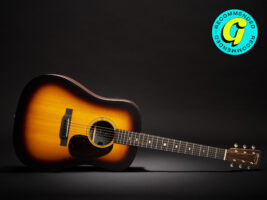
The DX-2E Molly Tuttle is, like its US-made sibling, inspired by Tuttle’s most beloved and cherished Martin: a 1943 D-18. The most notable thing that sets it apart from a regular X Series dreadnought is the neck profile, which is a fast, comfortable 1940s carve with the same 1 11/16″ nut width. This 1941 carve has a soft V to it, and unlike most of the X Series guitars, it has a standard taper, so it doesn’t get narrower as you move up the neck.
The other striking differences are mainly cosmetic – the spruce top is finished with a lovely vintage sunburst, while the satin-finished HPL back and sides have a vintage mahogany pattern. The ebony fingerboard features a faux abalone and pearl custom Moon Phase pattern on it, and you also get a silver logo on the headstock, plus a set of open-gear tuners with custom oval buttons.
Otherwise, it’s pretty much the same as a standard Martin DX-2E – with a solid top, HPL back and sides, a select hardwood neck, and Martin E-1 electronics. You also get a plush Martin-branded gig bag.
Image: Press
Build and playability
Upon pulling the guitar out of the aforementioned gig bag, the aesthetics of Tuttle’s DX-2E really grabbed my attention. The satin-finished top with its vintage sunburst gives a very ‘old’ vibe, and sat on a guitar stand across from my desk, it really does look like a pre-war Martin, at first glance at least. The more rounded shape of the headstock compared to a modern Martin, combined with those open-gear tuners, really does change the vibe of the guitar and make it seem more classic and worn in – a nice touch.
Picking it up, and on close inspection I’m less taken with the lack of binding – a feature common to all X Series but one that really does make the guitar feel less premium. I understand that there are likely cost and range-differentiation reasons behind this (the Road Series exists after all!) but on a signature model like this, especially one that costs $200 more than a regular DX-2E, it’s a shame to have the illusion broken so easily.
Because when you play the thing, it’s very easy to forget that you are in fact playing an X Series, because this satin-finished 1941 neck is an absolute superstar. I’ve played a few pre-war Martins, and you can tell the care and attention that’s gone into getting this profile and feel just right. When I closed my eyes, I really could tell myself I was playing a 1940s guitar.
What’s more, in contrast to say, the slimmer nut of the Billy Strings model that seemed more readily designed for bluegrass picking at speed, the fingerboard here feels like a nice, accommodating middle ground that will suit any playing style. It’s something that the original 40s Martin dreadnoughts did so well, and it’s very impressive that the company has recreated it here.
Image: Press
Sounds
It might be damning the DX-2E with faint praise to say that it sounds like a standard Martin dreadnought, but in truth that’s exactly what it’s supposed to be. It’s absolutely not going to trick my ears into thinking that it’s a 1940s guitar in the way it fooled my eyes and hands, but this is a sub-$1,000 guitar we’re dealing with here, c’mon!
What it offers is a powerful, strident voice that’s warm and subtle, and I do notice a bit more treble and mid-frequency bite than a typical Martin dread, which is all rather pleasant.
Plugged into an amplifier, I found the E-1 system to be very usable and effective – it does a nice job of replicating the unplugged sound. The subtle soundhole controls are really handy in the heat of battle, as is the onboard tuner, which looks up at you from inside the bottom of the soundhole. Some may not love what it does to the aesthetics of the guitar, but I like how the E-1 system’s battery is stowed behind a flip-up plastic cover around the strap button – it’s a lot easier than fishing around the guitar for a velcro’d battery inside!
Image: Press
Should I buy one?
This is another really impressive Mexico-made signature model from Martin – the Navojoa team is doing some really fantastic work right now, and we’re seeing the best of it in how they’re being entrusted with artist guitars like these.
The great thing about this guitar in particular is how much of a great all-rounder it is – that neck is one of the finest Martin carves I’ve felt outside of the Nazareth factory, and you can tell it’s put a lot of time and effort into nailing the playability and feel of Tuttle’s guitar.
It’s a shame that the aesthetic appointments let things down somewhat, but the thing about looks is that they’re subjective – and the rest of the package far outstrips its price tag.
Alternatives
The regular D-X2E ($/£749) doesn’t have the wonderful neck of the Tuttle version, but it’s still a fine guitar for a lot less money. The other signature guitar in the X Series is the D-X2E Billy Strings ($949) and is another fine guitar that’s more ready to shred. Taylor’s Academy 10E ($799) is another quality Mexico-made dreadnought for not a lot of money.
The post Martin D-X2E Molly Tuttle review: “if I closed my eyes, I really could tell myself I was playing a 1940s guitar” appeared first on Guitar.com | All Things Guitar.
Source: www.guitar-bass.net