RhPf Electronics Mosrawr review – a noise-bringer that’s designed for post-rock and shoegaze
CHF149/€159/$179, rhpfelectronics.com
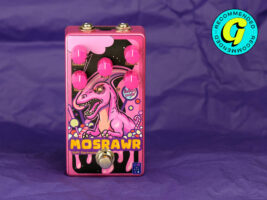
Some people believe guitar pedals sound better when they’re pink. Some believe they sound better when they have dinosaurs on them. These theories require further research, but if they’re both right then things are looking seriously good for the RhPf Electronics Mosrawr.
Vibrantly pink and fiercely dinosaury, this compact fuzz box is handmade in the cauldron of rock’n’roll that is Basel, Switzerland. It’s an original circuit, designed in collaboration with Loopy Demos, and claims to be the ultimate summoner of mids-focused rage.
READ MORE: Gamechanger Audio Motor Pedal review – a radical synth pedal for sonic extremists
Image: Richard Purvis
RhPf Electronics Mosrawr – what is it?
According to RhPf, this MOSFET-powered pedal “delivers dense walls of fuzz” and “speaks the language of shoegaze, noise rock and post-rock”. This tells us two things: firstly, that it’s not just another Fuzz Face or Big Muff clone; and secondly, that it’s been designed to work with other pedals for creating layered textures of immersive noise.
RhPf is a fairly new operation and this is the first of its pedals I’ve tried. The others in the range look very nice too, but the graphic design by Sketchy Pedals has given the Mosrawr a distinct lift… that is, as long as you’re OK with cartoony artwork and candy-store colours. You won’t want to look at it too long while hungover.
Image: Richard Purvis
RhPf Electronics Mosrawr – what does it sound like?
The first challenge is to get a handle on the controls. They seem simple enough – basically gain, level, bass, middle and treble – but the way they work is not always predictable. For a start, it never gets very bassy even with ‘low’ at maximum, and it never gets very dark, even with ‘hi’ at minimum. The good news is, it sounds glorious with everything set to halfway so that’s a safe place to start.
Used on its own as a simple fuzz, the Mosrawr lives up to the second part of its name (in the sense of both ‘raw’ and ‘roar’) with the force of a hungry Jurassic carnivore ripping the bars off your protective cage. In EQ terms it’s something like a Tone Bender, but high gain and a pronounced lack of headroom give it an edge of splatty delinquency, almost like an extra-gnarly octave fuzz.
RhPf says this pedal can go from sticky velcro tones to something much more smooth and open; in practice it doesn’t get very far along that road, but that’s no tragedy as a million other fuzzes cover that stuff already. What you can do is manipulate the controls to accentuate the features that are already present: the biting treble, the lower-midrange grunt, the soaring sustain.
For the real test, though, this lonely dinosaur needs to find some friends. My live pedalboard includes a phaser, a flanger, a Leslie simulator and two delays (one of them set to reverse mode), and the power that’s unleashed when they all join forces with the Mosrawr is really quite spectacular. It sounds enormous, just as you’d expect, but also has a midrange focus that keeps it commandingly present in a band mix. If you think fuzzy soundscapes have to be soft and washy, this pedal might make you think again.
Image: Richard Purvis
RhPf Electronics Mosrawr – should I buy it?
First things first: if you’re a classic rock or blues player looking for velvety fuzz textures, please turn back, you’re lost. But for those of a more shoegazey disposition, things get a little more complicated.
The Mosrawr will be too boisterous for some tastes, even within the parameters of alternative rock – it is a great textural tool, but the textures in question are more gravel than silk. Where it will find a place – at least, where it certainly deserves to find one – is on the pedalboards of noise-scapers with attitude.
Image: Richard Purvis
RhPf Electronics Mosrawr alternatives
The Fender Shields Blender ($346.99/£235) is a multi-layered distortion unit with My Bloody Valentine pedigree; or if you want to get your whole wall of noise from one box, try the combined fuzz and reverb of the Keeley Loomer ($299/£315). Just need to make wild noise? It doesn’t come any wilder than the Ritual Devices Grimalkin Fuzz (£195).
The post RhPf Electronics Mosrawr review – a noise-bringer that’s designed for post-rock and shoegaze appeared first on Guitar.com | All Things Guitar.
Source: www.guitar-bass.net