Stop wasting your money on professionals – here’s how to install a new guitar pickup yourself
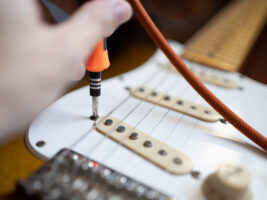
Changing pickups on an electric guitar is a surefire way to quickly shift the sound of your instrument, this know-how being very helpful for troubleshooting, repair and maintenance. This is a potentially expensive endeavour once you add up the prices of pickups themselves as well as the tech to install them, so a quick lesson on the basics can save you in the long run. A quick word of warning though, removing this barrier and furthering your knowledge will enable a deep dive into the tonal rabbit hole, one you may never escape from!
READ MORE: How to tab a basic riff in Guitar Pro – the essential guide
First, be aware that this isn’t a step by step guide for absolute beginners to work their way through the process – think of it more as an overarching explanation of how and more importantly WHY it’s fun and interesting to do this job. With some helpful practical advice along the way of course.
Learning to solder is essential here, and unfortunately the best way to learn is to dive in. Your initial attempts might be messy, but you’ll learn how to work with the solder best. While I can’t hold your hand through the learning, I can set you on your path with this: tin your contact points for hot solder joints, buy a solder-sucker and don’t hold that dang iron on contacts for too long!
Getting Started
At its most basic level, a single pickup will have two wires connected to the magnets that pick-up the sound of your guitar strings. These two wires can serve as either your “hot” or “ground”, the “hot” carrying signal to the output jack and the “ground” being sent to ground. The output jack (often incorrectly cited as an input jack) features two terminals intended to mechanically connect these two wires to a cable (connected to pedals or an amp) to the hot and ground of your pickup. Everything else simply intercepts this initial connection.
When installing a new pickup, it can be as simple as tracing their connection to a pot or switch and de-soldering the old pickup to make way for the new pickup, after you’ve identified the hot and ground in your new pickup. This goes for switches, pots and anything else you might have jammed in that control cavity! Troubleshooting or augmenting your electric guitar, however, is where things get more complicated.
Pardon the pun, but these interceptors potentially include potentiometers to be used as volume and tone pots. These have three terminals that (when used as a volume control) serve as input, output and ground. Switches for toggling between pickups have connections for ground as well as a switch (usually blade-style or toggle) that switch between different hot connections. At its most basic level, this is guitar wiring in its entirety. Humbuckers act like two pickups connected (therefore usually have four wires), pots can be used for tone roll off frequencies for a warmer sound, and additional complex switching options like those in a Fender Jazzmaster or active pickup switching augment this basic connection principle.
In terms of signal flow, adding a potentiometer at the end of the chain, right before the output jack will serve as a master volume, as all signal is passing through it before output. However, a pot before a switch will only affect the signal before the pot, usually a single pickup, so this would be a dedicated volume for that pickup.
Fender Jazz Basses, for example, work in this way, where each pickup has a master volume and no switch, the sound summing at the output jack. A Les Paul on the other hand, features volume for each humbucker before a three-way toggle, so you can adjust the volume of each pickup independently and toggle between them or choose to engage both pickups (middle position) and blend.
How To Troubleshoot
When troubleshooting, understanding this signal flow can help find problem areas. For example in a two pickup guitar, if one pickup is working and not the other, the problem is most likely at the pickup stage, not at the master volume or output stage, otherwise both pickups wouldn’t be working. Conversely, if there’s no output at all, it’s most likely a master volume or failed connection at the output jack, rather than two pickups coincidently failing at once— though stranger things have happened!
Generally speaking in terms of wiring, pickups are either single coil or humbucking, the latter being two pickups wired out-of-phase with one another to cancel, or buck, the ground hum out of the signal. All grounds are still sent to ground, and all hot are still sent to hot terminals in your wiring, though be aware that different manufacturers colour code the wires differently.
Capacitors can also play a huge role in tone, being used to to turn potentiometers into tone pots. Instead of adjusting the volume output of the signal after the potentiometers, a capacitor controls how much high end bleeds out of the hot signal from the pot, allowing just the low end to continue on, reducing the treble of the signal.
Therefore, a tone pot on its ‘maximum’ setting is actually allowing the entire signal to pass, whereas turning it down allows more high end to filter out. The tone pot isn’t adding more treble, it’s just reducing it.
Overall, as confusing as schematics and control cavities can appear, it’s about tracing where the signal begins and where you want it to end up. At a basic level you’re connecting the pickup to the output jack, and everything else between it is auxiliary. Switches and toggles simply (usually) switch which hot signal flows onward to the output. Capacitors turn potentiometers into tone pots and they filter out high end from the main line, and your carefully crafted tone can flow onto pedals, amps, cabs and listener’s ears!
The post Stop wasting your money on professionals – here’s how to install a new guitar pickup yourself appeared first on Guitar.com | All Things Guitar.
Source: www.guitar-bass.net