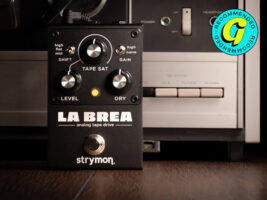
Strymon La Brea review – is tape saturation about to be your new favourite kind of overdrive?
$199/£199, strymon.net
In the coming war between humanity and AI, it’s possible that digital guitar pedals will be considered spies in the human camp and will all have to be melted down in a giant vat like Arnie in Terminator 2. So is it any wonder that Strymon is continuing to explore its analogue side?
READ MORE: Strymon Deco V2 review – one of Strymon’s most musical pedals
Following on from the Fairfax overdrive and Canoga fuzz, the La Brea is number three in Strymon’s new Series A line of simple, DSP-free stompers… and it promises to be the most interesting of the bunch.
What is it?
The first disappointment – don’t worry, there aren’t many – is the realisation that Strymon is just naming the Series A pedals after suburban neighbourhoods in LA. How mundane. It’s just as well the company is based in southern California and not south London – who’d buy an overdrive called the Tooting Bec? Or the Penge?
More important than the La Brea’s name, though, is its heritage – which brings us to the Strymon Deco. That two-in-one stompbox was designed to reproduce the gritty mojo of early reel-to-reel tape machines, with saturation on the left side and digital time-based effects on the right. The firm has now taken this saturation effect as the inspiration for a fully analogue standalone unit. So yes, it’s basically an overdrive pedal… but with a twist or two.
Image: Press
Build quality and usability
There’s something really appealing about the blocky simplicity of the Series A pedals, and this one appears to be just as solidly built as the excellent Fairfax I reviewed back in May. The controls are housed in a bolt-on panel, the sockets are all up top, and it’s cutely compact.
The most important knob is for tape saturation, with an accompanying toggle switch for choosing high or normal gain mode. This part of the circuit also has an output level control, and there’s a separate one for blending in the clean signal. Not that it’s completely clean, though: everything runs through an EQ section controlled by a three-way switch with settings for flat, more treble or more mids.
Image: Press
Sounds
This is the stompbox equivalent of an extremely good-natured dromedary: it can cover a huge amount of ground – from barely audible grit to flat-out fuzzy immersion – and it never gets grumpy or difficult to wrangle. Unlike a dromedary, however, it doesn’t have a hump in the middle – because this is drive of the most transparent kind.
At its lowest-gain settings, with or without some clean signal mixed in, it really is the type of pedal that doesn’t sound like it’s there at all: this is your bypass tone, just with a touch of natural scuzzing-up around the edges. From there we progress into pleasing mid-gain overdrive that stays fresh and open in the top end, with a nice bit of compression letting you crank it up without the note attacks getting painfully spiky.
There’s a considerable overlap between normal and high-gain modes, and you don’t even need to flip that switch to reach the fuzzy zone – but once you do, it gets seriously heavy. It’s also impeccably smooth, and if you now find the compression is flattening things out too much you can bring back some clean tone to help the transients cut through. This can be very useful, and it doesn’t sound weirdly separated from the distorted signal unless you really overdo it.
The EQ switch allows for a gentle push to the treble or the upper midrange – not transformative but, again, useful. The only slight limitation here is that there’s no darker option for taming spitty single-coils, and no way to shelve off a little bass when the gain is whacked up high.
Image: Press
Should I buy one?
It’s probably best not to get too hung up on the tape saturation thing – what the La Brea offers is simply extra-tasty overdrive, at an impressive range of gain levels, characterised by absolute tonal transparency and organic-sounding compression. You might already have pedals that do something quite similar… but whether they do it quite as well as this is another matter.
Alternatives
Silktone Expander ($199/£199): a fiendishly classy pedal that covers a lot of the same tonal territory as the La Brea.
Superlunar SR-01 ($280/£249): distinctive and super-stylish, this is another option with a very broad gain range.
EarthQuaker Devices Plumes ($129/£125): if you’d prefer to keep it simple, you could do a lot worse than this versatile modern classic.
Image: Press
The post Strymon La Brea review – is tape saturation about to be your new favourite kind of overdrive? appeared first on Guitar.com | All Things Guitar.
Source: www.guitar-bass.net