
TemPolor Melo-D review: world-first “generative AI guitar” is a cynical waste of time and plastic
$599, tempolorguitar.com
Broadly speaking, the creative world has responded to the encroachment of generative AI like a panicked primary school teacher would respond to the encroachment of a lorry full of poisonous spiders into the classroom.
READ MORE: Positive Grid Reactor review: does your guitar amp really need an AI chatbot?
The robots are supposed to be doing the boring work so WE can make the art, not the other way around. It’s a reasonable refrain, but one that seems to have fallen on deaf late-stage capitalist ears, and so here we are.
Thus, AI-generated music has been welcomed into the places where human artists vainly try to promote themselves and their art. These platforms are already designed to reward the bland, the hastily-made and the derivative – how are flesh and blood musicians meant to compete?
It’s all enough to make many musicians very angry indeed, but after spending time with the TemPolor Melo-D, the world’s first “generative AI guitar”, I think maybe we aren’t angry enough about how some people envision the AI-assisted future of music.
Image: Press
TemPolor Melo-D – what is it?
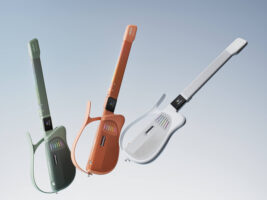
In the most basic physical sense, the Melo-D is part Guitar Hero controller, part chord sampler. But its main goal is to leverage the power of TemPolor’s own AI song generation platform (plus some third-party ones) to allow anyone to ‘play the guitar’ instantly.
The main TemPolor platform is broadly similar to Suno, but it’s marketed more as a tool for adding royalty-free backing music to ‘content’. It even offers a tool that generates copyright-free soundalike versions of copyrighted tracks. Given that this sort of thing is exactly why many musicians hate the very existence of GenAI, it’s… not an exactly encouraging start.
TemPolor is what you’d use to avoid having to think about what tunes best accompany your ASMR slime TikToks, so to bake it into an ostensibly ‘real’ musical instrument – one that claims to enable authentic self-expression – is pretty baffling.
Furthermore, there’s something fundamental about the TemPolor’s very reason for being that feels almost offensive to anyone who has spent any time learning an instrument – or indeed learning how to do anything creative.
If you’re reading this, chances are you’ve probably put in the time – learning chords, scales, building calluses, writing songs. It’s the graft that makes the craft. It’s why we gain satisfaction from making something, and provides the foundations for learning to make better things. TemPolor says that you don’t need any of that, just a $600 plastic toy and an LLM.
Image: Press
TemPolor Melo-D – what does it actually do?
Holding the Melo-D in my hands, on many levels it’s quite hard to understand how it got this far – and I suspect it really does show how much you can get away with right now if you put “AI” in your product pitch.
Because while it might look like a toy, the marketing around the product is not short of bluster and big claims. The Melo-D is not presented as a clumsy musical shortcut – which at least would be more accurate. Instead its flagship advert calls it “the future of music”, and TemPolor continually asserts that playing it is basically indistinguishable from playing a real guitar.
In practice, what it is is a vaguely futuristic guitar-shaped object that replaces the fretboard with squidgy rubberised buttons and the markers with light-up buttons that supposedly ‘tell you where to play’. In place of the strings, we have a strum bar from a Guitar Hero controller, and a weirdly Gigeresque rubber ribbed section that is supposed to enable single-string picking.
There’s a flip-up screen where the neck joins the body, which is where all the AI stuff happens, and the idea is basically that you can hum a melody or similar into it and it’ll create an entire song that you can then ‘play’ by doing as you’re told with the various lights and buttons and such.
Now, before we continue, I should say that I’m not opposed to guitars that aren’t really trying to be guitars. I was genuinely pretty impressed with the Jamstik when I reviewed it a few years ago – I don’t oppose moving the instrument forward in new and unexpected ways.
What I do oppose, is the artistically vacuous pursuit of AI song generation, and the way the Melo-D mashes that into a cheap, unpleasant pseudo-guitar that tries to pretend that any of that makes you a real musician.
I said it was hard to understand how the Melo-D got this far – it’s equally baffling what TemPolor thought was going to happen when they sent this product to a guitar website for the purpose of review.
Because I hate it. So much. The reaction of every other member of the Guitar.com team who’s tried it has been a similar level of fundamental revulsion. The only reason I can’t give this product a lower rating than 2 is because it hasn’t shown up broken or technically defective.
But you do not, under any circumstances, “gotta hand it to them” for that. Believe me when I say the Melo-D has bored a hole straight through the bedrock of how much I thought I could dislike a product and found the molten planetary core beneath.
Image: Press
TemPolor Melo-D – build quality and usability
If I am going to attempt to judge this on some of its very few merits, you can make the argument that the Melo-D isn’t that ugly. Forgetting that it’s meant to be a guitar for a moment, it has a smooth, vaguely futuristic, Temu-Apple aesthetic that isn’t totally offputting.
Any positive feeling evaporates upon actually holding the instrument. The body is lumpy and uneven, feeling simultaneously too bulky and too small. Your forearm rests against a foldable frame which, along with a folding neck, lets you pack the guitar down to an admittedly impressive degree.
The frame is just very uncomfortable as the top half of a guitar body. It’s so uncomfortable that I try to play the guitar with the frame folded away – but this means my forearm rests against the volume knob, which is also the power control, and so I just end up turning the thing off. Maybe it’s trying to tell me something…
The neck is equally unpleasant to interact with. It does not need to stand up to string tension, so why is it so thick? It’s much wider and much deeper than any real guitar neck I’ve held, and has a completely insane profile seemingly designed by someone who’s never held a guitar before.
The fretboard is, for want of a better word, fleshy. Futuristic, sure, but let’s just say that the board’s texture evokes something from LoveHoney’s high-tech R&D division and leave it at that. Pressing it, then, is an awful experience – imagine trying to play the guitar on a very long orange. Who approved this design? Why is it so soft?
The on-board speakers are pretty loud, definitely enough for bedroom-level play. However the headphone output is incredibly noisy – you can hear the characteristic crackle of a cheap DAC as samples fade out.
There’s also no ¼” output, an omission that by itself should preclude the Melo-D from being taken seriously as an instrument. Playing it live would necessitate mic’ing it up like an acoustic, or running the hissy ⅛” output through the PA. Plus, how would anyone hear you through the paper bag you’d have over your head?
In truth, the idea of ‘playing’ it live or anywhere else stretches the definition of the term. Your left hand smushes down the horrible fretboard at a given position, and your right chooses between the short and long ‘magnetic picks’ (Guitar Hero levers), or the ‘rainbow strings’ (fleshy protuberances).
The guitar will be set to a given key, and the soft frets denote chords I through VII in that key. There’s also the option to engage a 21-position mode, letting you choose between major/minor/7th chords using the three horizontal positions on the fretboard. The two magnetic picks let you play either arpeggiated or strummed versions of whatever chord your left hand has chosen, and the rainbow strings will play the various component notes of it.
The press release for the guitar claims that the rainbow strings “preserve the feel of authentic strumming and picking,” but nothing could be further from the truth. They are, like the fretboard, unpleasantly soft things, poking through a rubbery membrane like the spines of some alien fish. There are absolutely no playing dynamics imparted by how hard you hit them, and the feedback you receive when picking or strumming them is viscerally unpleasant.
Image: Press
TemPolor Melo-D – sounds
It sounds bad. The magnetic picks trigger digitally-compressed, noisy samples. They sound bad. The rainbow strings trigger different digitally-compressed, noisy samples. They also sound bad.
The sound presets for the rainbow strings and the magnetic picks are also totally separate. There’s no way to achieve a distorted electric guitar sound on the rainbow strings, and the distorted electric guitar samples for the magnetic picks are completely unusable in their messy harshness.
Moving chords about both feels and sounds bad. There are no frets to give you the tactile feedback as to where your hands would be – only supple robotic flesh – and the samples will either awkwardly get cut short or messily play over each other when you change chord.
You can’t let strings ring, you can’t do any voice-leading, you can’t play inversions, you can’t tap, you can’t pull-off, and as far as I can tell you can’t predict what strumming pattern the long lever will initiate. The advanced 21-key mode relies on the outer edges of the fretboard, and the detection here is extremely inconsistent about how much pressure it wants before it registers a chord.
The Melo-D is effectively working as a very limited chord sampler in this mode, and here I want to remind you of the price – $599. It’s cheaper for preorders, but that’s the base dollar amount, and so we have no choice but to judge it thusly.
$599 pits it against the best smart guitars (such as the LAVA ME 3), and high-end chord synths like the Telepathic Instruments Orchid. Imagine paying similar to what you would for an Orchid – very much viewed as a buzzy-but-pricey boutique thing in the synth world – and not being able to do 9th chords.
Image: Press
TemPolor Melo-D – AI song creation
So if “playing” the thing sounds and feels like total shit – which I assure you it does – then surely the big headline-grabbing AI song creation thing works well right? One of the paid-for influencers that TemPolor has promoting this called it a “cheat code for producers”, after all.
Let’s momentarily leave aside the question of why you might want to learn to translate your life experience into musical expression when you can press a button and let the magic robot do it for you, and ask – can it make something that fits the above claims?
Having put in a prompt, what trickles out of the Melo-D’s speakers is completely awful – mostly swinging between the sort of corporate-approved indie-pop you’d hear over the end credits of a streaming-only romance movie, and the sort of butt-rock you’d hear in an energy drink advert.
If you do succeed in prompting it to make a “metal” track, it will sound pretty much like this video, no matter what strain of metal you’ve asked for.
In fact, most prompts result in something completely unconnected to what you actually ask for, unless you presuppose that the training data is a bunch of hyper-generic stock music.
The example text prompts given in the accompanying app are, verbatim, things like “powerful pop-folk about healing after heartbreak”, “sweet pop fingerstyle about a school dance crush”, or “upbeat rock for a spontaneous road trip”. TemPolor’s heritage as a generator of royalty-free nothingness is on full display here.
The hum-to-solo feature (wherein you hum a melody and the guitar reconfigures it into a ‘guitar solo’) creates incredibly overwrought fingerstyle pieces that make Marcin sound positively restrained. As soundtracks to the machines taking over the planet go, I think I’ll stick with Brad Fiedel’s.
You can use the app to generate songs from whole cloth, or generate “tabs” (not actual tabs – this is the term TemPolor uses for the Guitar Hero-style mode of the guitar) or chord patterns for existing songs.
Weirdly, when you generate a tab for an existing song, the AI engine re-generates it into a completely unlistenable fingerstyle acoustic version, no matter what you upload. When you upload a song to generate a chord pattern, the AI will reinterpret the song and ‘sing’ it with a truly hateful voice. This voice always sounds artificial. Sometimes generically so – other times it sounds as if Hatsune Miku has lived in a cave for many lifetimes, eating only raw fish and being corrupted by an evil ring.
It’d be hilarious if it wasn’t completely dystopian – a vision of a future where all musical expression is mediated by robot overlords that reconfigure everything into algorithm-friendly, mawkish ballads. And speaking of dystopian, here’s an insane caveat that makes me genuinely feel like I’m in a Black Mirror episode: TemPolor seemingly doesn’t want you to release the music made on this thing, and wants to keep some of the credit if you do.
There’s no official way to grab an audio file directly from the app or the guitar – and the Melo-D’s FAQ page asks that you add a label reading “Created with TemPolor Melo-D” if you do share anything. Imagine if the EULA of a Stratocaster required that you give Fender a quick shoutout at the end of your guitar solo!
A thing that’s meant to be the “future of music” chains what is ostensibly your creative output to the company that hosts the AI models that made it. Not only is this extraordinarily depressing, it’s also a tacit admission that you’re not really making anything on this guitar.
TemPolor Melo-D – is it a good educational tool?
TemPolor explicitly draws the comparison between the Melo-D and Guitar Hero, and states that this makes it great for education, as it makes learning so fun. But nothing could be further from the truth.
It’s easy to forget that a big part of the success of Guitar Hero (and why Rock Band became a smash a few years later) was because they weren’t teaching you how to make music, they were fun party games that let you get some friends around and have fun pretending to be in a band.
Yes, they inspired many thousands of people to try the real thing, but no matter how perfectly you aced Through The Fire And The Flames on expert, you weren’t learning anything that could meaningfully translate to a real guitar. It would be like assuming that playing FIFA makes you better at stepovers.
Crucially, Guitar Hero was also fun. The gamified bits of the Melo-D have nothing in common with this experience, other than the basic ‘press the right button at the right time’ mechanic. There’s no scoring system, you just get through the miserable AI-generated songs, and the screen gives you a pathetic “” at the end of it. No score, no assessment. It’s boring.
The Melo-D removes all of the things that make Guitar Hero compelling, and adds nothing of any educational import; there’s no mention of the actual chords you’re playing, nor is there any formal or informal rhythm notation, or any onus to sustain longer notes, or any meaningful evaluation of how well you’re doing.
What ‘fret’ you have to press only has the loosest relationship to the music you’re hearing, and the window for what counts as a successful in-time hit is genuinely about half a second – way too wide to build up any real rhythmic accuracy, and also massively limiting how challenging the Melo-D’s version of the game can be.
Image: Press
TemPolor Melo-D – is it for absolute musical beginners?
I would imagine that TemPolor’s counter-argument to everything above is that it’s designed to take total newbies and let them make music more easily. It even says on the website that from day one, “your first session sounds like music – not practice exercises.”
This, to me, is the tragic core of the whole thing. Yes, fumbling through your first steps on an instrument can be discouraging. But that is where good teaching – both human and digital – should support and encourage you along the way.
Instead, the Melo-D suggests that by the end of the first week, you should be ready to enable the 21-key mode, without any real theory backing or understanding of chord theory. But who cares when you’re just following some lights, right?
TemPolor wants to offer you a shortcut to making something polished, but without having to understand or have any real input into why it sounds the way it does. Humming something into a machine and then plucking along to the terrible auto-generated tracks it produces doesn’t make you a musician, or a producer.
It’s like taking a foreign language course where they spend the first month getting you to repeat sentences without any context, and then turning around at the end and say, “Ah, just get Google Translate to do it for you”.
Image: Press
TemPolor Melo-D – should I buy one?
If you’re a guitar player reading this, absolutely not. And in truth I’m struggling to think of anyone that should.
I’ve seen some people claim that the Melo-D offers a more accessible route to playing guitar, and while there may be some mileage there, I would say there are many other much more credible alternative ways for people with disabilities to make music than this. Also, as a colourblind person, TemPolor certainly doesn’t seem to have considered me when they chose to put the red and green LEDs directly next to each other.
The brand itself suggests that it might be for musicians for whom “theory killed the dream” which is weird given how many all-time guitarists didn’t know the first thing about theory. Ringing equally hollow is the “gamers and rhythm fans” claim – I would remind you that this costs more than a PS5 and is far worse than even the most mediocre Guitar Hero game.
The other potential buyers that TemPolor flags are perhaps more telling – namely “tech and AI enthusiasts”. I guess if you’re someone who is obsessed with buying gadgets they never use, this wouldn’t look any more out of place in your living room than all the other tat on the shelves – a fool and his money, etc.
The “AI enthusiast” thing is the most revealing of all, because it probably speaks to a lot of why this thing exists. The website for the Melo-D proudly claims, “play guitar in seconds”. A statement that presumes the ultimate goal of human endeavour is to make the process of producing something more efficient, and that us puny meat sacks are simply a rate-limiting step to be bypassed in the pursuit of efficiency.
Does this self-negating philosophy gel with people who aspire to actually make music? Well, the popularity of AI music, video and image generators seems to imply that there’s an audience for people who want the reward of creation without the satisfaction of making it. Maybe that’s why hundreds of people have committed tens of thousands of dollars to the Melo-D Kickstarter?
But regardless of your outlook on AI music, I’m not sure anyone, no matter how artless and cynical their approach, will want to bother with all of the other pain-points and limitations introduced by the awkward, expensive, and frankly weird Melo-D.
I fail to see how it is a compelling educational tool, an entertaining video game, or a way of actually expressing yourself. The argument that it’s simply a toy with a low barrier-to-entry is dissolved by the absurd price tag. No amount of AI hype should justify such a markup on what is otherwise a complete failure of music hardware design.
TemPolor website. Image: Guitar.com
TemPolor Melo-D alternatives
If you want a decent smart guitar, just get a LAVA ME 3, or if you want a good chord sampler, the Telepathic Orchid. However if you feel you really must introduce some non-human element into your creative process, may I suggest the following alternatives to AI:
A deck of Oblique Strategies cards
Progressions made by assigning chords to I Ching/Tarot readings
A massive chord chart on the floor that your cat can walk across, thereby demonstrating its preferred progression
Guitar solos tabbed out using your friends’ mobile numbers
A handful of powerful hallucinogens taken in your nearest forest
Serialism
The post TemPolor Melo-D review: world-first “generative AI guitar” is a cynical waste of time and plastic appeared first on Guitar.com | All Things Guitar.
Source: www.guitar-bass.net