
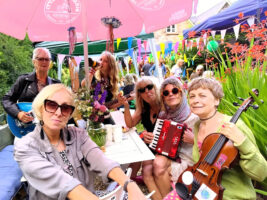
The Real Riot Women: the Gen Xers discovering punk and embracing guitar
“People on Facebook I hadn’t spoken to in a decade were all sending messages, going, ‘Hi. How are you?’” begins Lucy Morgan of London-based, kitchen punk band, I, Doris. “Just wondering, have you seen this TV show?” The series in question is Riot Women, a critically acclaimed six-part drama from the BBC that the New Yorker described as “genius” and currently sits at 92% Fresh on Rotten Tomatoes.
READ MORE: How Women Are Giving Metal Guitars A Mainstream Moment
Set in the quirky and inclusive Northern town of Hebden Bridge, pub landlord Jess Burchill assembles an unlikely crew of women to form a band for a local talent contest. But for a legion of Gen X women across the globe, the storyline felt far from fictional.
Director of the upcoming documentary Menopunks, Alicia J. Rose, performs in two bands born from Portland’s punk energy, the city also responsible for seminal riot grrrl acts like Heavens to Betsy, Team Dresch, and later, Sleater-Kinney.
For Rose, the show was a welcome tonic in its focus on women in their 50s and 60s reclaiming their voices. “[It] reminded me of The Full Monty but with women and rock and roll as the MacGuffin,” she says from her home in Oregon City. “I love every fucking character in the show. They’re not the real thing, but I’ll tell you, the real thing does fucking exist.”
Nana Punk
South Wales sextet the Nanaz, an outfit that formed in 2024 through a punk rock workshop, proves not only that these women exist, but their sounds are in demand, thanks to the BBC series. “We’re riding a very good wave, partly as a result of Riot Women,” admits bassist Anne-Marie Bollen. “People are looking at who’s actually doing this for real.” The group met through the Nana Punk project, an initiative hosted at Wales’ Millennium Centre to break barriers and build new communities.
For the Nanaz’s Deborah de Lloyd, the sessions were a crash course in stepping out on stage. “At the end of the workshops, they got us to play a gig, with no rehearsal time, in the middle of the Millennium Centre. I was working out the chords ten minutes beforehand!” Lead guitarist Angela Samuel, who played acoustic before turning to electric in the last few years, is still astounded by their progress. “When we started, I thought ‘There’s no way we’re going to get a band going,’ but we actually have!”
I, Doris’s Lucy Morgan’s entrance to music was more traditional. Rather than taking in the toilet circuit of dingy East London dive bars, she was classically trained. But the desire to perform with other creatives like her was strong.
“I liked the idea of having a band with Cassie [Fox, LOUD WOMEN founder and I, Doris bassist and frontperson]. We have a shared love of pop music, Dolly Parton, and gin-soaked evenings.” For Fox herself, it’s railing against societal expectations. “It’s what we do, rather than play bridge or golf,” she quips. “What are normal middle-aged women supposed to do with their time?”
Portland’s Alicia J. Rose feels similarly, learning drums when she turned 40 and forming Party Witch. She’s since added another artistic output to her arsenal that’s quickly picked up steam in the community, as she shares. “I’m in another band called The Fabulous Bloodstains with Gilly Ann Hanner [ex Calamity Jane and former tour support for Nirvana]. It’s the most real version of the Riot Women that I’ve ever experienced in my life. We formed to open for two sold-out shows of Sleater-Kinney playing as the Ramones last October.”
Anne Marie Bollen of the Nanaz. Image: Press
Seeing Red
This new burst of creative flow didn’t come easily for Rose, though, whose forthcoming documentary, Menopunks, paints an intimate portrait of celebrated female musicians (think vocal tornado Neko Case and original riot grrrl Allison Wolfe of Bratmobile) navigating midlife. In the BBC’s Riot Women, vocalist Kitty Eckersley and keyboardist Beth Thornton pen the band’s talent show entry, Seeing Red, supercharged with the frustrations of accessing HRT (hormone replacement therapy).
The struggle isn’t a new subject for I, Doris, who wrote their own powerful post-punk number about gynecological healthcare three years prior. Alicia J. Rose is adamant that the shift from hot flashes and brain fog on stage is all thanks to the drug. “Now I have the energy to be in two bands. Now I’m making a movie, and I couldn’t be doing any of these things if I were as miserable as I was two years ago.”
While the TV series’ songwriting themes line up with lived experience, there’s a longstanding ethos from the riot grrrl era that doesn’t chime so well. In the ‘90s, Bikini Kill’s Kathleen Hanna began demanding “Girls to the front!” at her band’s shows to create safe spaces for women in a male-dominated scene. While the riot women of today are happy blasting out their politically charged tunes, they’re demanding visibility on their own terms, as I, Doris’ Lucy Morgan explains.
“In my last band, I hid behind a trombone. I, Doris is my first opportunity to be on a stage as a performer, not someone hiding in the background, [but] it took me a lot of years to get over some really crippling stage fright. It’s only as I got past 40 that I became comfortable with standing up on stage and people looking at me.”
Lucy Morgan of I, Doris. Image: Press
Getting Things Wrong
This trepidation to take up space also feels familiar to the Nanaz’s second guitarist, Claire Symons. “They’re always trying to get me out from behind a pillar!” she admits before bandmate Marega Palser chips in. “When we started, it was like if you’re shy, just put a fucking bag on your head.” But as Symons reflects, that’s not so easy when you’re a woman of a certain age. “Someone said, ‘Wear a balaclava. Do a Kneecap!’ And I was like, ‘Jesus Christ, I’m always hot!’”
Pushing past the debilitating stage fright and questionable accessories, bands like the Nanaz and I, Doris are channeling a lot of the early DIY spirit that post-punk godmothers The Raincoats gifted us back in the 1970s, a learn-as-you-go mentality. “We’ve got no shame in making mistakes or getting things wrong,” says Marega Palser of the Nanaz. “The fact that you’re getting up on stage and doing it is enough of a signal to women of the same age. It’s important to see that there are other ways of being and behaving.”
The same could be said for the bands’ attitudes to guitar culture. I, Doris’ latest addition, Lenie Mets, who has consistently performed in London’s live music circuit, is unsettled by the weight often placed on an artist’s gear. “I honestly couldn’t give a blank shit about that. You see a guy with his 500 guitars and the pedal boards they come up with, and you just think, why?” Some of that resistance may stem from how the gear is marketed and displayed.
Research by Fender revealed that women were predominantly buying guitars online “because in the bricks-and-mortar stores there was nobody to relate to, and they weren’t getting treated well”. For the Nanaz’s Anne Marie Bollen, her bass came via an unlikely punk grapevine about a decade ago. “Richie from Dub War told me to drive over quickly — a guy had been kicked out, and I could have his bass for £100,” she laughs. “Years later, we’re playing shows with Bad Sam featuring Dean Beddis, and he goes, ‘I had one like that!’ I said, ‘I know — it’s yours!’”
With the Welsh creative community rallying around them, it’s no surprise that the Nanaz have been embraced on the live circuit. But there’s one particular supporter in the crowd who’s been rooting for lead guitarist Angela Samuel for years. “We’ve got Ang’s dad in the audience,” beams Bollen. “He’s 87 and an old rock and roll drummer. He’s always wanted Ang to be in a band.”
Claire Symons of the Nanaz. Image: Press
Louder Than Ever
It’s champions like these that are helping to turn up the dial on women’s voices that have been systematically suppressed and repressed for generations. In the ‘90s, women-fronted bands grappled for the single slot on an all-male festival bill. Today, initiatives like Nana Punk and Leicester’s Riotous Collective mean more Gen X women are making noise than ever before.
“We deserve to be louder than fucking ever,” insists Alicia J. Rose back in Portland. “So why the fuck not pick up the loudest instrument possible and turn it up to fucking 11, as Tufnel said, and rage against every fucking machine that will be in listening distance?” The beauty of this collective coming-of-age? The message is spreading far and wide for others to reconnect with their creativity, regardless of status or tech setup.
Like The Raincoats’ Gina Birch seeing the “madness and chaos” of The Slits for the first time, sometimes we just need to see someone like us on stage. Today’s real-life riot women are making that visibility louder — and contagious.
“What I’ve found really amazing is talking to other female friends who have said, ‘I’ve started singing lessons!’ or ‘I’m going to play the guitar!’” says the Nanaz’s Claire Symons. “My sister-in-law even said, ‘Oh, I’m gonna get my mandolin out that I bought 15 years ago, and I’m now gonna have another go!’”
Follow the real riot women at @thenanazband, @idorisband and @menopunks
The post The Real Riot Women: the Gen Xers discovering punk and embracing guitar appeared first on Guitar.com | All Things Guitar.
Source: www.guitar-bass.net