
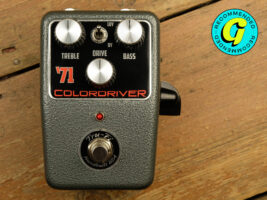
Tru-Fi Mini ’71 Colordriver review – an underrated classic of early fuzz is reborn… in miniature
$199/£199, tru-fi.com/joespedals.com
There are normal people, and then there are fuzz pedal geeks. Normal people know about Fuzz Faces and Tone Benders, and might be vaguely aware that the British stompbox boom of the late 60s also produced one or two other models; fuzz geeks howl and weep in despair over the thought that those ‘others’ – specifically the Colorsound Power Boost and Overdriver – have been so widely forgotten.
READ MORE: Manson Supermassive Black Fuzz review: heavy, heady filter fuzz that’s not just for Muse worship
Essentially 18V and 9V versions of the same circuit, the Power Boost (1969) and Overdriver (1971) were arguably not only fuzzes but also the first ever overdrive pedals. No wonder David Gilmour, Jeff Beck and Jan Akkerman loved them so much.
Time for a revival? American boutique maker Tru-Fi certainly thinks so, and has included a combined tribute to both pedals in its Mini series, with a toggle switch letting you flip between the two voltages (and power coming from a standard 9V supply or battery). It’s been brought to the UK by Joe’s Pedals, and it looks very cute indeed.
Image: Richard Purvis
Tru-Fi Mini ’71 Colordriver – what is it?
Tru-Fi specialises in vintage-minded pedals, mostly fuzz, in beautifully made metal enclosures. They’re also somewhat vintage-sized, but the Minis have been shrunk down by 1/3 and have the jack sockets at the top, making them significantly more ’board-friendly.
This is the ’71 Colordriver; there’s also a ’69 version that’s bright orange and has different silicon transistors (BC109 instead of BC184), for a tone that’s described as “a bit smoother”. Both have a volume knob on the side – a feature the originals lacked, leaving them stuck in extra-boosty mode. Maybe that’s why they went out of fashion in the first place?
Image: Richard Purvis
Tru-Fi Mini ’71 Colordriver – what does it sound like?
There’s a theory that this circuit demands a lot of headroom – it was, after all, designed to be plugged into much louder tube amps than what most people use today – but that really depends on what you want from it. I began my testing with a 20W combo attenuated for bedroom levels, so about as much headroom as a catflap… and fell in love with the Colordriver instantly.
With the amp set clean-ish, anything shy of halfway on the pedal’s central dial is definitely more overdrive than fuzz: it’s tonally uncoloured (until you start messing with the highly responsive tone controls), and crunchy in a way that caresses the eardrums. There’s a roughness to decaying chords that some people won’t like, but the full-frequency openness works brilliantly for tight rhythm playing.
The second half of that drive knob is all classic Brit filth, with some colossal Fuzz Face sounds on offer towards the very top, just as it starts to feel splattily overloaded. It also opens up really nicely when you turn the guitar’s volume down, albeit with a slight thinning out of the tone.
Through a bigger amp it’s a dramatically different story: now we feel the real noise-bringing potential of the Colordriver, with a tremendous low-end thump to go along with that sweetly singing midrange. It’s a match for any Fuzz Face, but only if you’re in the mood for high gain: with the guitar volume backed off it now sounds quite clangy, and with the pedal’s gain at halfway it’s just not as likeable as it was through the little amp. At the other end of the scale, though, the combination of treble, bass and master volume knobs does allow for some extremely tweakable boosting with the gain set even lower.
All of the above, by the way, is equally true at both voltage settings, with 18v sounding that little bit bigger and clearer than 9v. It’s great to have the choice, but you might find yourself popping that switch into the up position and leaving it there forever.
Image: Richard Purvis
Tru-Fi Mini ’71 Colordriver – should I buy it?
This pedal sounds great through a small amp and great through a big amp, but in totally different ways. That makes the “should I buy it?” question more complicated than usual, but here are two key facts to bear in mind: one, the ’71 Colordriver is an absolutely top-class stompbox; and two, the geeks are right and this near-forgotten giant of early fuzz needs to be on your radar.
Image: Richard Purvis
Tru-Fi Mini ’71 Colordriver – alternatives
You can still buy a full-size reissue Colorsound Overdriver (£429) or Power Boost (£399), both with master volume, courtesy of legendary London dealer Macari’s. Modern US-built alternatives include the IdiotBox Effects Power Drive ($139/£125) and Basic Audio Futureman ($200/£209.99).
The post Tru-Fi Mini ’71 Colordriver review – an underrated classic of early fuzz is reborn… in miniature appeared first on Guitar.com | All Things Guitar.
Source: www.guitar-bass.net