Twilight Pulse Audioworks Konstante review – a dual dirt pedal that’s faster than the speed of light
€185/£185/$289, twilightpulseaudioworks.com / northernstomps.com
Guitar pedal makers are electronic engineers and therefore, by definition, nerds. So there’s a little clue to the inspiration behind the Twilight Pulse Audioworks Konstante in its name… but you’ll only get it if you’re a physics fan.
READ MORE: DOD Badder Monkey review: much-memed pedal gets a bananas reissue
The most famous constant in science, as proposed by Einstein himself, is the speed of light (in a vacuum). This overdrive pedal from German indie maker Twilight Pulse, then, is a tribute to the Greer Amps Lightspeed. Not that it’s a mere clone, though – the presence of a second footswitch is enough to make it clear there’s something else going on inside this handsome blue box.
Image: Richard Purvis
Twilight Pulse Audioworks Konstante – what is it?
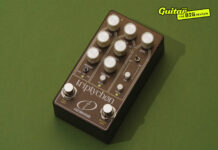
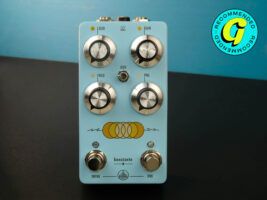
First of all, it’s not normally Pelham Blue: this is a limited-edition colourway for UK dealer Northern Stompboxes, the standard finish being white. On the inside, the Konstante is a two-in-one pedal, offering Lightspeed-style transparent overdrive – with the promise of more gain and more headroom than the original – alongside a separate Echoplex-style boost circuit.
Three of the controls are for the drive – output level, gain and tone – while the boost/preamp gets just a level knob. There’s a toggle switch in the middle for changing the order of the two circuits, and a pair of bypass switches that are about as far apart as they could be without falling off the edges of the enclosure. Mind you, this being a compact pedal, that’s still not very far – something to bear in mind if you don’t happen to have the feet of a ballerina.
Image: Richard Purvis
Twilight Pulse Audioworks Konstante – what does it sound like?
There’s a laid-back fluffiness to the overdrive side of the Konstante that reminds me of the Coggins Audio Dinosaural Hypoid Drive – and considering I gave that pedal 10/10, well, it’s safe to say we’re off to a decent start. But it’s slightly more tonally transparent than the Dinosaural, with only the merest hint of a sweetening effect in the mids, and it’s distinctly more fresh and zingy at the top end.
The gain range runs from virtually clean to moderately filthy, but the tone knob isn’t quite so transformative: it stays pretty crisp almost all the way round, with some extra upper-mids bite coming in as you push it past halfway. If you like your drive pedals on the dark side, you might find this one a bit too chimey. The key feature here, though, is that it has a truly organic sound and feel – which is exactly what the Lightspeed is famed for.
If anything, the boost side of the Konstante is even closer to transparency, giving a lift to the top and bottom ends of the spectrum that leaves the spiky mid frequencies fractionally softened by default. On its own it’s excellent, and teamed up with the other half of the pedal it offers two compelling options: an extra kick to the front end of the drive for added saturation, or a powerful loudness boost on the way out.
Image: Richard Purvis
Twilight Pulse Audioworks Konstante – should I buy it?
If you’re in Europe, this pedal is cheaper than the one that inspired it – and it has an added boost option that’s anything but an afterthought. That has to make it wildly tempting… as long as you’re not put off by the brightness of its core tone, or the potential for mishaps caused by having two footswitches barely an inch apart.
Either way, the Konstante is a superb little stompbox that marks out Twilight Pulse as a very classy boutique contender.
Image: Richard Purvis
Twilight Pulse Audioworks Konstante alternatives
For the sound of the Greer Amps Lightspeed, you might consider the Greer Amps Lightspeed ($249/£229). Other overdrive pedals with an independent boost circuit include the Keeley D&M Drive ($229/£229) and ThorpyFX The Dane MkII (£264.99/$319).
The post Twilight Pulse Audioworks Konstante review – a dual dirt pedal that’s faster than the speed of light appeared first on Guitar.com | All Things Guitar.
Source: www.guitar-bass.net