What are pots anyway? A working guide to the knobs on your guitar, and what they actually do
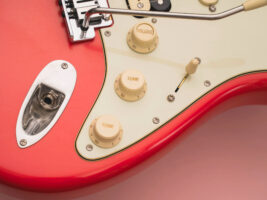
We talk a lot about guitar construction and the components that can have an impact on your tone, but one item is far too often left out of the equation, and they appear on nearly every electric guitar model made today. The pots – these are the things underneath your guitar’s control knobs that control what happens when you turn said knob.
READ MORE: This is why your guitar’s scale length actually matters
A guitar pot (short for potentiometer) is a variable resistor with three lugs. Inside the case sits a horseshoe of carbon-resistive material and a wiper that sweeps across it when you turn the shaft. It’s really quite simple. The full resistance of the track lives between the two outer lugs, and the wiper picks off a point somewhere along it. The design has barely changed since the 1930s, and the part still costs a few dollars. It also has more say over how your guitar sounds than most of the hardware players actually obsess over.
The Value
Let’s start with the number stamped on the case, usually 250k or 500k. That figure is the pot’s total resistance. Higher numbers mean a brighter guitar, which is backwards from how most people guess. In electronics terms, a volume pot sits across the pickup as a load to ground, and that load bleeds off a little high end constantly, even with the knob wide open. A 500k pot bleeds less than a 250k, so more treble survives the trip to the amp. The load also flattens the pickup’s resonant peak, which is the bump in the frequency response that gives a pickup its character. Lower values flatten it harder.
That relationship explains the standard pairings. Humbuckers run slightly dark on their own, so they get 500k pots to hold onto their highs. Single coils are already bright, sometimes harsh, so 250k takes the edge off. Drop 250k pots into a Les Paul and it plays like there’s a blanket over the cab. Put 500k pots in a Strat and the top end gets glassy, sometimes brittle.
These pairings are just conventions. Gibson has shipped plenty of guitars with 300k volume pots, which splits the difference and shaves a little sparkle off a humbucker. Fender put 1 Meg pots in the Jazzmaster and Jaguar, and that enormous value is a big part of why the offsets sound so open and spiky on top. If your humbucker guitar sounds dull, checking the pot values and replacing them with something brighter is a lot cheaper than shopping for new pickups.
The Taper
Taper is a separate spec, and it governs the shape of the sweep. A linear pot changes evenly, so at halfway around the shaft you’re at roughly half the resistance. An audio pot, also called log, saves most of its change for the last part of the rotation. The curve exists because human hearing is logarithmic. An audio taper feels even to your ear on a volume control even though the resistance underneath isn’t. Wire a linear pot into the volume position instead and the sweep feels bunched, with nearly all the audible change crammed into a narrow slice of the travel. Tone is less settled, and plenty of players run linear there on purpose because they want a slower roll-off.
Get ready for some unavoidable electronics jargon. On modern CTS pots, current Alpha imports, and current Japanese pots, A means audio and B means linear. However, the old European DIN convention ran the opposite way and used A for linear, and the vintage Japanese JIS scheme did the same, so an old European pot, a vintage ALPS or Panasonic, or an unmarked one from a parts drawer can be exactly reversed from what you assume. When you can’t trust the stamp, measure it with a multimeter. Set the shaft dead center and read resistance from the wiper to each outer lug in turn. Roughly equal readings mean linear. A lopsided split, something like 10 to 20 percent of the total on one side, means audio.
Every pot carries a manufacturing tolerance, and even good ones drift off their rating. CTS’s factory standard is plus or minus twenty percent, so a stock “500k” can legitimately measure anywhere from 400k to 600k. The tighter ten percent pots sold by suppliers like StewMac are special-order runs, and some boutique parts houses go further, speccing nine percent tolerance with the nominal value bumped upward so the pot never lands under its rating. This is part of why two guitars off the same rack can sound slightly different. Builders chasing a specific voice will sit with a multimeter and hand-pick pots to hit a target number.
What The Tone Pot Is Actually Doing
A tone control uses the same kind of potentiometer as the volume knob, but wired with a capacitor to ground to create a variable low-pass filter. Turn it down and the pot lets more signal drain through the cap, which only passes high frequencies. The cap value sets how dark the fully rolled-off sound gets. Modern convention puts .022 microfarad caps with humbuckers and .047 with single coils, though vintage Fenders used values as big as .1, which is why an old Strat’s tone knob goes so muddy so fast. With the knob on ten, the cap barely matters.
Fender’s no-load tone pots go a step further. They have a detent at ten where the resistive track is physically broken, lifting the entire tone circuit out of the signal path. The guitar gets a touch brighter and more open at full, and behaves like a normal tone control everywhere else.
Shaft Size Does Matter…
US-made CTS pots use a 3/8 inch bushing. Metric pots use 8mm, so a metric replacement drops loose into a CTS-sized hole and a CTS pot won’t fit a metric hole without reaming. Split knurled shafts differ too: US pots carry 24 splines, metric pots carry 18, and push-on knobs made for one won’t seat on the other. Carved tops like a Les Paul need long-shaft pots to clear the carved maple top. Check all of this before ordering. The right electrical spec is useless if the part won’t mount. So shaft size does matter, no matter what anyone says!
The post What are pots anyway? A working guide to the knobs on your guitar, and what they actually do appeared first on Guitar.com | All Things Guitar.
Source: www.guitar-bass.net