What self-taught emo-folk guitarist Truman Sinclair learned from years as studio engineer to Grammy-winning producer
“I find it really hard to write on anything other than a guitar,” begins Truman Sinclair. “I am so inspired by it,” the self-taught emo-folk songwriter continues. “I think about it all the time.”
In fact, ever since he was a child growing up in Chicago, playing guitar was what he enjoyed most. “I’ve always been a fidgety kid and my fidget obsession was the guitar,” he reflects. “I would fiddle with it all the time learning tricks.”
READ MORE: Yard Act’s Sam Shipstone on clichés, concision and how guitars returned to their core: “Great bands really find their style, and that’s the thing they sit on”
Watching his brother play and having lessons from a friend helped him fall in love with the instrument from the age of eight. “He was really young when he was hammering around the G chord on a nylon string guitar,” Truman recalls. Picking the same one up soon after, his brother taught him the riff to Roy Orbison’s Oh, Pretty Woman.
“I was sold,” enthuses Truman, who grew up on his dad’s love of Bruce Springsteen, Nirvana and AC/DC’s “crazy and epic” Hells Bells before discovering metal bands like Slipknot, Metallica, Beartooth and Attack Attack! during middle school.
Truman’s taste changed, quite dramatically, when he moved to Laurel Canyon at 14-years-old and started going to high school in Los Angeles. “It was a total culture shock because I was used to playing Mario in basements in the Midwest,” he laughs, adding that being in a “massive city where everybody felt so much older than me” made making friends tricky.
He wasn’t too bothered, however, as much of his time after school was spent playing guitar (instead of doing homework) and walking around listening to music that had been made in the area, particularly folk songwriters James Taylor, Neil Young and Joni Mitchell. “Anytime you’re where something historical has happened, it can be really inspiring and I’ve always found that to be very powerful,” Truman says.
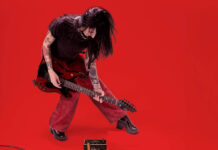
Image: Press
New Noise
Being in a new place altered his approach to the guitar too. “It made me want to play some simple chords, because until then I was really focused on being the gnarliest shredder in town,” he recalls, adding that he tried to write “honest” songs when he turned 16. His limited life experience at that time made this difficult, so Truman started to make instrumental math-rock on his computer.
As his teenage years progressed, he played with the alternative act Fat, Evil Children, and later founded the beloved emo outfit Frat Mouse. Truman even produced four of the latter band’s albums from his bedroom. “It was as simple as it gets,” he reflects, adding that he already knew how to record sample drums. Using a laptop, a Focusrite Scarlett 2i2, mic, stand and Vox AC15 amp (which he still uses daily) he “tried to make the songs awesome”.
Learning how to record guitar educated Truman from a technical standpoint, he considers. “I would try the verse riff 100 times, and that would make me a lot better, because then I could play and listen to it and decide if it was good enough.” His attitude towards the instrument also evolved: “it’s deeper than just the guitar, it’s the spirit you put into it, what you’re trying to do, why you’re trying to do it, and how it makes you feel”.
With his passion abundantly clear, Truman decided to study music production at the University of Southern California. To increase his experience, he set out to work at a studio. Thankfully, Truman met Grammy-winning producer Dave Sardy who, having worked with Oasis and Johnny Cash, gave him a great opportunity. “He said ‘you can be the runner, but it’s on you’,” Truman recalls, describing Sardy as a “really tough, old school” boss. “He’d say ‘if I tell you to do something, don’t ask me, just go figure out how to do it and come back with it done’.”
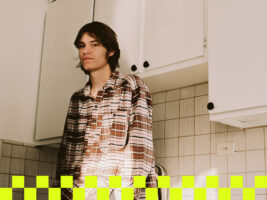
Image: Frank Lookinland
The Real Deal
As Sardy’s assistant audio engineer and producer, the first band Truman worked with was Modest Mouse. “I was really scared because I love them but they were very kind to me.” Social Distortion visited the studio soon after: “Mike Ness brought upwards of 45 ‘70s gold top Les Pauls in a vault”, Truman beams, adding that it was “so crazy” to unload them.
Having previously spent his spare time scrolling Reverb.com, Truman was living his “guitar dream”. Instead of looking online at all the different ones that exist, he was playing “priceless” guitars on a daily basis. “It’s like a museum,” he says. “He’s got everything, and he’s one of those dudes who genuinely has a real appreciation for gear, vintage and new.”
Witnessing Sardy at work was hugely inspiring, especially because “everything he makes is handmade; that dude can make a G chord sound better than anybody else on the planet”. This, perhaps unsurprisingly, is exactly what Truman now aspires to: “I’ve always been into making a bass drum guitar mix sound insane, and he’s the master.”
Despite their contrasting profiles, Truman found the similarities between his and Sardy’s processes particularly interesting, especially because of their different set ups. “I realised that what we do is largely the same, but being in a studio requires so much work to keep that sacred bubble working,” he ponders, drawing a comparison of when he’s in his own room working on songs. “No-one wants to bother me, I sit and record on my Nash-S57, sing into my microphone and use a little drum machine,” Truman shares of his creative process.
“I just do my thing, but when you’re a massive artist and you go into a studio, everybody wants to bother you. There are a million things you could do, and you’re all stressed out,” he suggests. Truman is keen to make clear that this wasn’t a problem for artists and bands who passed through Sardy’s studio while he was there: “he’s been able to create a space where they feel like they’re in a room and can just play.”
Image: Ryan Gomez
Shifting Perspectives
Immersing himself in such an environment altered Truman’s perspective on the guitar even more: “I used to think that gear didn’t matter and that it was more about how you play.” While Truman still thinks this is true, he learned that every guitar sounds different, especially in terms of tone and tuning. “I found that, largely, what people want is what I had in my room — freedom. It all comes back to the simple stuff and the music, how something sounds; half the time, these big artists aren’t using the most expensive thing, they’re using the thing that is in tune, solid and sounds great.”
Subconsciously undergoing “exposure therapy”, as Truman describes it, impacted his own approach to songwriting. “It made me relax and use the gear that’s around because, at the end of the day, they’re all like tools.” Watching some of his favourite songs being made in Sardy’s studio on “the simplest thing” inspired him to pick up his acoustic guitar and “know that I wasn’t really missing anything and that I could do it all here in this very confined world,” he suggests.
“Because the music that I love is pretty simple but sounds awesome, the majority of my songs are no more than four chords,” Truman says, adding that his main focus is the melody and rhythm. To this end, he feels that his music “comes from a very free and fun place”. Maintaining this ethos requires him “having control over it”, so much so that he wrote, produced and recorded all the songs on his 2025 EP American Recordings. “I think I’m a bit of a control freak, which I’ve never admitted,” he laughs, “but it’s a valiant reason of mine. I think there’s something about doing it yourself that keeps it real and natural.”
In a similar vein, Truman is particularly passionate about being able to make the music that he wants to make. “I’m always worried about having it not be mine, so it’s for me,” he attests. “I am very aware that no one wants me to make anything that I think they want to hear,” he considers. “I can’t guess what somebody likes. I just have to make what I think is fucking sick and if I’m making something in my room that I think is cool then that’s good enough for me.”
Despite now being a solo artist, Truman plays with a band. “I don’t think I would feel like myself if I wasn’t doing that,” he says, having recently supported Courtney Barnett on a two-month tour. “Playing music loud in a group is one of the many fruits of life, so I’ll always do that,” he continues.
While it’s a different experience, Truman loves performing solo, on his acoustic guitar, too. “It feels like you can really drive everything. You’re making split-second decisions,” he adds. “Any choice you think of, you can just do it and then see what happens. There’s a freedom that’s super fun and addicting, but at the same time playing with the band is so powerful,” he considers. “There’s something really special about figuring out an arrangement with your band that you all know and love and are tweaking slightly every night. That’s its own thing, so I feel really happy to be doing both.”
Truman’s new single 4th of July is out now
The post What self-taught emo-folk guitarist Truman Sinclair learned from years as studio engineer to Grammy-winning producer appeared first on Guitar.com | All Things Guitar.
Source: www.guitar-bass.net