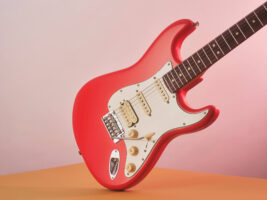
What’s the point of painting a guitar anyway? And does it make any difference to the sound?
I recently had an argument with a friend who was remodeling their kitchen, and they decided to paint over their beautiful hickory cupboards. As a longtime woodworker, I love the look of woodgrains. Each piece is unique and has character – painting over it with a solid latex color seemed to me to be a real shame.
READ MORE: This is how your guitar’s truss rod actually works – and here’s what you’re doing wrong with it
But then I had to catch myself – I don’t love the look of wood so much that I’ve stripped all my guitars back to the grain, have I? I love the look of a guitar with a stunning colourful finish on it, but should I? The whole argument brought to light one question I had never actually asked myself… what’s the point of painting guitars, anyway?
Wood is beautiful. A nicely figured slab of maple or a clean piece of swamp ash is arguably prettier than anything you could spray over it. So why do the overwhelming majority of guitars leaving factories today get finished in something that obscures this entirely, or at the very least buries it under a thick coat of clear lacquer?
The short answer is that a guitar finish does three jobs at once – protection, looks, and, arguably, tone – and the industry has been tweaking the balance between those three since long before most of us ever plucked a string.
Image: Adam Gasson
The Boring Answer
Let’s start with the boring answer, which also happens to be the most important one. Wood moves. A guitar body is organic material, and left to its own devices it’ll absorb moisture from the air and from your hands, warp with humidity, and gradually soak up every drop of beer sweat that lands on it.
A finish seals it. Whether we’re talking about a thick coat of polyester on a modern Squier or a wafer-thin layer of nitrocellulose lacquer on a Custom Shop Strat, the coating is a barrier against moisture, dust, skin oils, UV light, and the general indignities of being played.
Guitar finishes as a category have evolved in roughly chronological order – from barely-there oils and shellacs that protected very little but preserved the wood’s feel; to French polish, which Martin used for more than a century; to nitrocellulose lacquers starting in the 1920s and ’30s; to polyurethane and polyester from the late 1960s onward. Each step up the chain trades something. Thinner finishes let the wood breathe and feel more organic under your hand but scratch easily and age quickly. Thicker ones form a glossy armor that shrugs off pretty much anything you throw at it.
Hiding Place
The second reason for painting a guitar is one the marketing department won’t put on the spec sheet. Paint hides things. Bodies, especially at the affordable end of the market, are often made from multi-piece blanks, woods with inconsistent grain, or cuts that wouldn’t look particularly impressive under a transparent finish.
An opaque color – Fiesta Red, Olympic White, Surf Green – does the double duty of looking fantastic and politely ignoring whatever’s happening underneath. This is why you’ll occasionally see an old refinished Fender stripped bare to reveal a body that was clearly never meant for the spotlight. A solid color lets a manufacturer use more of what comes in the door.
Image: Adam Gasson
Standing Out
Which brings us to the third reason: identity. When Leo Fender started offering custom colors in the mid-1950s, he wasn’t being precious about tonewoods – he was looking at car dealerships. Detroit’s postwar boom had turned the automobile into a symbol of personal style, and the paint codes pouring out of DuPont’s catalog offered a shortcut to that same glamour.
Fender’s custom colors were, quite literally, car paints. Fiesta Red came from Ford. Lake Placid Blue from Cadillac. Daphne Blue, also Cadillac. Sonic Blue was lifted from a ’56 Cadillac color chart. In fact, Fender’s only truly in-house mixes during the 1950s and ’60s were sunburst, blond, and eventually Candy Apple Red – everything else was borrowed from the automotive world, mixed by DuPont under the Duco (nitrocellulose) and Lucite (acrylic) brand names, and sprayed onto guitar bodies at a five percent upcharge.
The Real Impact
Which leaves the question everyone wants answered: does paint actually affect the sound of a guitar? I would imagine that this is the section of the article that will inspire the most debate because for decades now, musicians have been divided on it.
The traditional claim – that nitrocellulose lets the wood “breathe” and therefore resonate better – is mostly myth, at least on solidbody electrics. What actually matters is thickness. A thin finish, whether it’s nitro or a carefully-applied poly, interferes less with the wood’s vibration than a thick one.
Early poly finishes on Fenders and other production guitars were laid on heavily because it was cheaper and more efficient, and those thick plastic coatings probably did dampen things a bit. According to most luthiers I’ve spoken to, modern polys, applied in properly thin layers, are largely indistinguishable from nitro in practice.
On an acoustic, where the top’s vibration is the whole engine of the sound, finish thickness matters a lot more – which is why Martin spent more than a hundred years using shellac and why boutique builders still obsess over the thinnest lacquer they can get away with.
On a solidbody, though, the finish’s effect is minor compared to the pickups, the wood itself, the strings, and your hands. That’s why the long-running “nitro sounds better” debate is mostly about feel and aesthetics. Nitrocellulose checks, yellows, and wears into the patina vintage buyers chase. Polyurethane and polyester stay looking brand new for decades. Both ideas are completely defensible.
Image: Adam Gasson
Personal Preference
Personally, when I build necks out of roasted maple, I don’t finish them unless it’s requested. I use a combination of wax and oil to protect the neck – but that has to be re-applied a couple of times per year. I do like the feel of it, but the real reason I do that is that I customize the neck shape to the player, and if at any point the neck needs to be reshaped, I can do it without having to reapply a finish that needs to cure. So even the decision not to use poly or nitro has a practical purpose, not necessarily a tonal one.
So when someone asks what the point of painting a guitar is, the honest answer is all of it, at the same time. It keeps the wood alive. It hides what you don’t want to see. It signals the brand, the era, and the player you want to be associated with. And then, in some small percentage of cases, it might even nudge the tone – though far less than the folklore suggests. The next time you pick up a guitar and admire the finish, you’re not just looking at a coat of paint. You’re looking at a century of trade-offs between chemistry, craftsmanship, and the car industry.
The post What’s the point of painting a guitar anyway? And does it make any difference to the sound? appeared first on Guitar.com | All Things Guitar.
Source: www.guitar-bass.net