Which guitar brand has the better headstock design – Gibson or Fender?
There are dozens of micro-decisions that go into building a guitar: wood choice, neck joint, fret size, pickup height, and on and on. Most players never think about them. But one design difference that sits right at the end of the neck generates more debate than almost anything else among luthiers and guitar nerds: headstocks.
READ MORE: Answered: more technical guitar questions you were too afraid to ask
There are so many different designs and approaches to building a peghead, of course, but broadly they can be put into one of two camps – a Fender-style six-in-a-line or a Gibson-style three-a-side (not now, Ernie Ball 4+2!).
You probably know which style you prefer cosmetically, and let’s not pretend that doesn’t matter of course, but many of us still don’t fully understand what’s actually happening mechanically with the different methods. Understanding a little about what these different designs and the elements that make them up do to your guitar can help you understand why you might prefer one over the other.
The Headstock Angle
On a traditional Gibson, the headstock tilts backward relative to the fingerboard. On a Fender Strat or Tele, it doesn’t. That one difference cascades into a whole set of tradeoffs that touch on structural durability, string geometry, and – depending on who you ask – tone.
The word “better” gets thrown around a lot here. Personally, I hate the word “better” when it comes to design – really, the designs are just different, but knowing the mechanics of each design will help you decide which one is best for you.
When a string travels over the nut, the angle at which it bends downward toward the tuner post is called the break angle. A steeper break angle means more downward pressure on the nut slot, which in theory improves string seating and reduces the chance of open-string buzz.
The key thing most people miss is that you don’t need a pitched headstock to generate break angle – you just need the string to drop below the nut once it clears it. The question is whether you achieve that through geometry carved into the wood, or through hardware. This is the fundamental divide between the big two guitar brands and their approach to headstock design, and it’s been there since the 1950s.
Fender’s Headstock Design
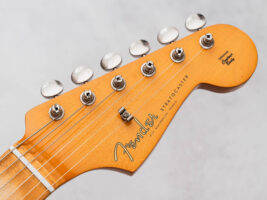
Leo Fender’s approach to guitar building was all about making things as straightforward and easily replicable as was possible, and this is perhaps why Fender’s headstocks traditionally sit essentially flat. The face of the peghead runs in the same plane as the fingerboard, with no backward tilt. Break angle is instead created by the height difference between the nut slots and the tuner posts, which sit lower down below the fretboard.
On the bass strings, that vertical drop is usually enough break angle, but on the treble side, it isn’t. The inline tuner layout means the high E and B strings don’t get enough downward pull on their own, so Fender added string trees: small metal guides that press those strings down toward the headstock face. It’s a hardware solution to a geometry problem.
The break angle for a Telecaster or Stratocaster is roughly six degrees from the nut to the tuning post – this is, of course, dependent on a lot of factors and can vary, but six degrees is a common reading I get on many Fenders.
The structural benefits of this approach are real and underappreciated. Because the headstock isn’t angled back, the wood grain runs more continuously through the neck-to-headstock transition. There’s no sharp break point, no short grain exposed at a stress concentration zone – this means it’s more durable as a result.
If you drop a Strat headstock-first, you’ll likely walk away with a damaged tuner at worst. Do the same with a Les Paul and you’re looking at a painful and costly neck repair. Now, Gibson’s own VP of Product recently claimed that claims about Gibson’s headstock design were “misinformation”, but the fact that these repairs have become so routine that any good tech will be able to fix a snapped Gibson headstock invisibly tells its own story.
Fender’s bolt-on neck is worth mentioning here too, because it compounds the structural advantage. If something goes wrong, you replace the neck. The whole repair philosophy is modular in a way that suits the flat headstock perfectly. It’s a very mid-century production mindset: simplify, standardize, make it serviceable. Leo Fender wasn’t a guitar player. He was an electronics man who thought about instruments like machines. That perspective shows in every detail of the Strat’s construction.
Gibson’s Headstock Design
Gibson’s approach is the opposite in almost every respect. The headstock is pitched back – historically 17 degrees on most production models, though some years in the late ’60s through early 2000s saw 14-degree angles.
That pitch builds the break angle directly into the wood. All six strings get consistent downward pressure at the nut without any additional hardware. The string path is cleaner, geometrically. There’s undoubtedly an elegance to solving the problem at the construction stage rather than compensating for it afterward.
Gibson still creates their necks out of one solid piece of wood, even though it costs considerably more than if they would simply use a scarf joint, they do this at great cost, because they believe that it directly influences the instrument’s resonance. Whether that’s measurably true is contested, however.
What is unequivocally true is that a properly executed scarf joint can be structurally superior to a one-piece angled neck, because the joint can be oriented to run with the grain rather than against it. Many boutique builders use scarf joints for exactly this reason. Gibson’s preference for one-piece construction is more about tradition and brand identity than engineering necessity – but there’s unquestionably value in that, too.
The tuning stability complaints that follow Gibson-style headstocks around are worth addressing, because they are usually blamed on the wrong thing. The angle itself isn’t the primary culprit. The bigger issue is lateral string pull – on a 3-per-side tuner layout, the G and D strings travel outward at a significant angle to reach their posts, which creates sideways friction in the nut slot.
A well-cut, well-lubricated nut eliminates this issue. Aftermarket fixes like the String Butler exist to straighten that string path further, and they work, but they shouldn’t be necessary on a properly set-up guitar.
Which Headstock Design “Sounds” Better?
This is the big question and one that ultimately has no real answer beyond listening with your own ears. Plenty of Gibson fans will tell you that the back-angled three-a-side headstock is not only a more elegant and balanced solution, but is one that allows the wood of the guitar to resonate better. There’s certainly something to be said for solving the issue using the geometry of the woodwork itself rather than delegating it to a piece of metal.
There are definitely ways to get around this on the Fender side though – slightly angling a Fender headstock, or using staggered-post tuners will improve the break angle and remove the necessity of string trees. Fender uses the latter for their American Ultra guitars.
Personally, I appreciate the Fender method for its engineering strength and simplicity, but I still don’t discount the logic and cleaner design of Gibson’s method either. As usual with guitar, it’s all subjective – the right answer is the one that inspires you most.
The post Which guitar brand has the better headstock design – Gibson or Fender? appeared first on Guitar.com | All Things Guitar.
Source: www.guitar-bass.net