
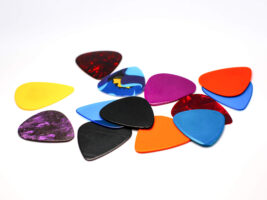
Your choice of plectrum can make a huge difference to your guitar playing – this is why it matters
Pursuing the sounds we hear in our head, be it an avenue like sprawling pedalboards, vintage guitars or handwired tube amplifiers, can feel like an endless journey. While effects and preamplifier circuits can have a huge effect on our sound, of course, they’re also merely processing their input.
Good technique, choice of strings, pickups and the guitar’s wood itself have a more drastic effect than any pedal or amplifier, the auxiliary effects serving as tools to augment our good playing, rather than fix it.
READ MORE: I was wrong: I’ve been building my own guitars for over a decade, and here’s the most important lessons I’ve learned
One overlooked tool is your choice of plectrum, be it the factory manufactured plastic and nylon picks many of us use today, or found picks like Brian May’s sixpence coins. There’s more special-use picks like the felt options for use with ukulele, as well as a growing number of companies producing boutique guitar picks.
Like the addition of a new pedal or a different amplifier, the choice of material has a drastic effect on the sound the strings produce when struck, and as such, the resulting sound as it travels through pickups, tone pots, pedals and amplifiers is also radically effected.
Many of us have a go-to pick selection, but understanding why we like it and how it affects our tone can be really helpful to performing different songs, styles and techniques.
Material Matters
Many modern plectrums are made from various types of plastic including nylon, delrin and celluloid. More esoteric options include metal, carbon fibre and even wood.
Dunlop’s Tortex is one of the most widely used materials – a proprietary acetal-based invention that closely mimics the texture and feel of tortoiseshell picks. Yes, back in the day people actually used to use plectrums made from the shells of the endangered Hawksbill sea turtle. As well as being morally wrong, making picks from real shell has been banned since the 70s, and so alternatives have been developed such as Tortex.
Tortex provides a consistent picking experience, sounding similar regardless of where the pick strikes the string, whereas nylon and cellulose provide a warmer sound as long as you’re picking correctly. The edges and sides of cellulose can be used to create a scratchier sound, which can be used to great effect or expose bad technique.
Nylon picks are generally softer and more flexible, even at the thicker end of the range, and provide a little attenuation to the brightness of your guitar for a more rounded sound. Because of the zingy, bright character of steel string acoustic guitars, nylon picks are a common choice for players to help balance out the tonality on the whole.
Metal picks, as you’d expect, provide a metallic zing that really demands pick control at the mercy of scratchy, noisy playing, and otherwise provide little to no resistance from the pick. Great for some styles, but not for all!
Felt picks are common for classical guitar and ukulele that both have nylon strings, and provide a nice, muted tone. While they’re entirely usable to great effect on an electric guitar, they won’t last long up against a nickel or steel string, so they’re often just used for a specific sound, technique or moment in a song.
Many guitarists find themselves coming back to same style or pick, having built their technique around the feel of it, though it can be good practice to experiment with different picks, you’d be surprised what a big difference they make to the resulting tone— even with a handful of choice pedals distorting and processing your sound!
All of these materials are available in different thicknesses that provide different levels of resistance, allowing you to further control the dynamics of your playing, which leads me to the next point in choosing your pick.
On bass guitar, for example, your pick can be used to great effect to balance out your playing like a compressor would. With a thinner nylon pick, picking harder causes the plectrum to fold and bend more, ultimately attenuating the resulting sound. Softer picking retains dynamic, but as you begin to dig in, the loudest notes are saved from being picked overtly hard, acting like a soft limiter to balance out of your tone overall.
All Out Attack
While we’re on the subject of having some different sonic options at our fingertips, they’re the next subject. Fingerstyle guitar isn’t always the right choice for every genre, but our fingers also provide a warm and balanced response, even capable of popping and slapping for more attack. Like softer materials, fingerstyle picking can tame the brightness of a steel string acoustic guitar, or warm up a bass part.
Slapping and plucking your bass yields an entirely different attack than a pick does, falling somewhere between the warmth of fingerstyle and the punch of picked sounds. Guitar players like Brian Setzer switch seamlessly between chicken pickin’ and more articulate picked stuff, Setzer himself tucking the pick away with his thumb when he switches to fingerstyle, ready for when he jumps back to picking.
All in all, your choice of plectrum is as important as your choice of guitar, pickups, strings and technique. While effects and amplifiers can do a lot to change and process the incoming signal, they’re only able to process what they’re fed, and you can do a little or a lot to process that on the way through.
A sound really is the sum of all its parts, a huge piece of that coming before there’s even an amplified sound. Pedals are fun, as are amps and circuits, but their input can be changed drastically by your technique as well as the pick itself. Different materials yield different timbres, and even influence the way you play and feel out notes. A go-to option is great, but a handful of alternatives to build on a great sound will help to round out your sound.
The post Your choice of plectrum can make a huge difference to your guitar playing – this is why it matters appeared first on Guitar.com | All Things Guitar.
Source: www.guitar-bass.net