Milkman/Benson The Amp review: “a compelling solution for players looking to replace a traditional tube amp”
$899/£949, milkmansound.com
Collaborations are everywhere these days. But for every collab that the world seizes on with Nike x Skims enthusiasm, there’s plenty more that go down about as well as Issey Miyake’s much-maligned iPhone sock.
READ MORE: Neural DSP Quad Cortex Mini review: “this is the most universal Quad Cortex yet”
It’s a risk, is what I’m getting at here: not every partnership can be Lennon and McCartney, and when collaborations go wrong, they can damage both brands. A project lacking in any real purpose beyond trying to pull in fans, and comes across as a cringe-inducing cash grab that leaves you with one lingering question: why? Yes, I’m looking at you, The Flintstones & WWE: Stone Age SmackDown.
Luckily, everything makes a lot more sense with this recent collab between two of the boutique amp world’s most respected names: Benson and Milkman. Benson’s amps have rapidly built the sort of clientele that much bigger brands would kill for: from St Vincent and Jason Isbell, to Joe Bonamassa and Joey Landreth. Tim Marcus’s Milkman creations are similarly revered in the pro world, with the brand’s tube-based floorboard amps earning special affection from a wealth of pros and civilians alike.
As well as both being respected boutique amp builders, both Tim Marcus and Chris Benson have in common a shared set of values: building amps with a distinct sonic identity, that also offer the sort of rigorous build standards that make them such a hit with big name artists.
With both brands sporting wait-lists that would make Analog Man blush, the prospect of them coming together, well that’s a match made in heaven, right?
Image: Jason Mays
Milkman/Benson The Amp: what is it?
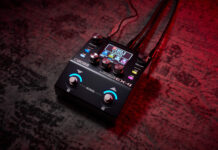
The foundation of this collaboration is Milkman’s hugely popular The Amp series of products. The amp is a 50-watt compact guitar amp that features a single 12AX7 tube in the preamp section, alongside a tube-driven EQ. As well as sporting a very pretty and sleek design that’s equally at home on a desk or on a pedalboard, The Amp quickly won fans for its authentically tube-y tones, and its familiarity to those of us who prefer our amps to have glass bottles in them. It was a perfect pedalboard/desktop amp for the sort of people who want no part of modelling, both sonically and in terms of usability.
There have been various iterations of the amp over the years, including a 100-watt and Stereo versions, but this is the first time that the platform has been re-voiced around the design philosophy of a different amp builder.
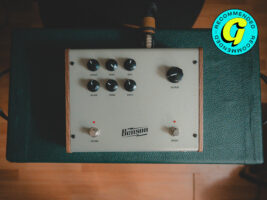
The new version features a circuit that is modelled on the preamp of Benson’s Chimera and Monarch amps. Like its siblings, you can pump that sound out via a traditional speaker cab, or go direct via the balanced XLR output or the impressive internal headphone amp.
The switchable cab sim on the XLR has been voiced by Chris Benson to sound nearly identical to the ceramic speakers he uses in his Benson cabs, and they’ve also added a Room control to make things feel more, well, room-y: adding a sense of depth and spatial realism when you’re going direct or your cabinets are close-mic’d. Like the original, you get onboard reverb and a boost control, both of which are footswitchable.
Image: Jason Mays
Milkman/Benson The Amp: usability and sounds
I’ve been using a Benson 2×12 vertical cabinet for a while now, and alongside my trusty Jazzmaster it seemed like the sensible place to start here. Plugged in and powered up, I couldn’t help but gasp at just how much chime the clean tone had on tap. Chords ring out beautifully, and at no point does it feel sterile or overly “solid-state” in character.
The onboard reverb is a drip machine. It never comes across as cold or lifeless and feels far more tube-like than many competing designs in this category. The Room knob might be the hidden MVP of the entire amp. The idea of controlling early reflections is something you don’t realise you need, until you start experimenting with it. Then suddenly it clicks.
Through the cab, the Benson is impressively loud and dynamic. And speaking of dynamics, let’s talk about the Boost switch and the edge-of-breakup tones this little box can produce.
With the boost engaged, the Benson captures an edge-of-breakup tone that feels astonishingly tube-like – arguably the most convincing I’ve heard from a solid-state device. Clean tones lean slightly dark, while the Treble and Bass controls seem to accentuate the amplifier’s inherent character rather than behaving like a traditional EQ. This approach allows the natural voice of your pickups to shine through. I found this especially useful with brighter pickups, where the amp retained clarity and sparkle without ever drifting into harsh or shrill territory.
Things get particularly interesting once you start adding drive. Pairing the Benson with the Chase Bliss Brothers AM yielded results that encouraged me to crank the volume and experience this amp the way it’s meant to be played: loud.
Chords roared with enough grit to give many full-tube amplifiers a legitimate run for their money. That said, there’s a delicate line between bass and mud here, and dialling in the perfect balance requires a bit of experimentation.
Given its pedigree as the boutique pedalboard amp de jour, you’d expect it to be a good companion to a gigantic pedalboard, and unsurprisingly, the Benson retains its status as a wonderful pedal platform.
Running it with various reverbs and granular effects produced some genuinely staggering results. At no point did the amp collapse into that dreaded “wet blanket over a cheap starter amp” sensation where effects feel like a muddy afterthought.
Image: Jason Mays
Milkman/Benson The Amp: should I buy one?
Benson’s take on The Amp offers a compelling solution for players looking to replace a traditional tube amp – or for those seeking an alternative to the current wave of digital modelers.
It manages to retain a remarkably authentic tube-like feel without ever dipping into the sterile territory that plagues many hybrid designs. Yes, it does require players to think carefully about speaker pairings. But that extra bit of forethought often rewards you with a tonal identity unique enough to put many boutique amps costing considerably more on notice.
Whether the Benson sound is worth the extra hundred bucks over the regular Milkman model is a matter of taste, certainly for me it is well worth it. It’s still not cheap compared to a lot of digital amp pedals of course, and it’s more expensive than some of its boutique competition too – but when it sounds this good, it’s hard to argue.
Image: Jason Mays
Milkman/Benson The Amp: alternatives
If you want some more sonic options but keep your pedalboard amp all-analogue, the DSM Humboldt Electronics Simplifier X ($469 / £425) is an impressive piece of kit – just don’t be scared off by all the knobs! More in common with the Milkman is the great-sounding Tone King Imperial Tri-tube Preamp ($599 / £599). If you don’t mind going digital but want to keep the simplicity, then Strymon’s Iridium ($399 / £379) sounds fantastic on record and in headphones – you’ll need to go direct or buy a power amp to run it with a traditional cab, however.
The post Milkman/Benson The Amp review: “a compelling solution for players looking to replace a traditional tube amp” appeared first on Guitar.com | All Things Guitar.
Source: www.guitar-bass.net