Taylor Next Generation 324ce review: “this could easily be your forever acoustic”
$2,699/£2,975, taylorguitars.com
Since its arrival in 1994, the Grand Auditorium body shape quickly became Taylor’s most iconic and best-selling acoustic guitar design, striking the right balance between the larger, boomier dreadnought and the smaller Grand Concert.
READ MORE: Taylor Gold Label 510e review: “Taylor’s return to the dreadnought is crying out for some big pick energy”
Over the preceding three decades, the design has remained a key pillar of the brand’s offering, and has evolved in myriad ways under the hood as this most innovative guitar company has continued to push things.
For 2026, however, the model has received some of the most significant and meaningful new innovations since the arrival of V-Class bracing back in 2020 – it’s time to explore the Next Generation.
Image: Adam Gasson
Taylor Next Generation 324ce: what is it?
The Next Generation Grand Auditorium is Taylor CEO and master guitar designer Andy Powers’ ground-up re-imagining of the whole concept. The body shape and general look of the guitars might have stayed broadly the same, but under the hood it’s all change.
For starters, the guitar sports Powers’ latest take on his revolutionary V-Class bracing system. The new scalloped V-Class promises to offer the same impressive intonation and clarity that the bracing has been known for, but with more warmth and richness than the original version.
Another new addition is perhaps the most noticeable visual departure. For well over a decade now, Taylor guitars have sported the three discrete rubber knobs of the ES-2 pickup system on their top shoulder. The brand new Claria system not only does away with that, relocating the controls to the soundhole, but also promises a more straightforward and easily dialled-in, plugged-in sound than its predecessor.
Finally, making a jump from the Gold Label series – and indeed acoustic guitar design in general – is the Action Control Neck. It’s another impressive bit of Powers engineering that truly lives up to the Next Gen name. It delivers the ability to micro-adjust your guitar’s neck angle and action in seconds, without even having to detune the instrument itself. It’s not only super easy and quick, but this is usually a job that would usually need to be left to professional techs only.
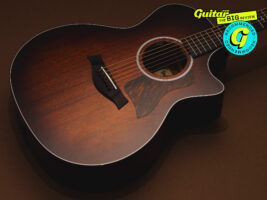
The Next Gen moniker has been given to an entire gamut of new US-made GA models, from the premium Builder’s Edition all the way to the standard line, of which this 324ce is the second most affordable on the log. The two in its nomenclature means it has a Neo-tropical mahogany top with sapele back and sides and a mahogany neck. It’s all stained in deep brown, with a subtle edgeburst to the top.
Image: Adam Gasson
Taylor Next Generation 324ce: build quality and playability
Upon removing this 324ce from its supplied hard case, it’s hard not to be impressed with the general build and finish of this instrument. Taylor guitars might not be everyone’s cup of tea visually, but surely any of us can appreciate an instrument where the effort and workmanship that has gone into it is evident in every detail; ensuring it feels pristine, precision-engineered and generally flawless.
Personally, I also think this particular Taylor is especially handsome in the grain – the red tinge to the stain goes extremely well with the firestripe pickguard and the black and white binding, while the ornate but understated weathervane inlays that run up the board and onto the peghead add a lovely visual flourish.
This is a guitar that also wears its gloss finish very well – it looks pretty without feeling so delicate you’re afraid to play it, perhaps because of the darker shade to the whole affair. By most measures, this is not a cheap guitar, but it certainly feels and looks expensive in the best kind of way.
It’s a nice touch that the Standard Carve neck itself has been spared the gloss treatment, however, combined with a familiar 25.5” scale length, it makes for a graceful and comfortable playing experience that, in typical Taylor style, veers towards the slimmer end of the acoustic scale. If you’re used to playing electric guitars, this offers a very comfortable transition.
Image: Adam Gasson
The West African Crelicam ebony fretboard is smooth and the fretwork is meticulously finished – the frets themselves are bright and smooth and invite you to think beyond cowboy chords, such is the easy fluidity with which you can bend the strings.
As is usually the case with Taylor, the action is low out of the box, though not so low as to elicit any string buzz. If it wasn’t to my taste, however, the new Action Control Neck could have me setting my ideal playing height in seconds. At least… that’s the theory.
It’s a little frustrating that Taylor has trumpeted how easy it is to use the ACN and then failed to supply any tools in the case to try it out. I’ve seen Andy Powers demonstrate the trick using an adjustable screwdriver, so I got one in to try it out… only to discover that metric socket sets and the imperial-sized bolt on the ACN don’t quite match up well enough to replicate Powers’ magic trick.
The guitar’s setup is flawless as is for my tastes – but it’s a little frustrating that Taylor couldn’t include some sort of tool or adapter in the case to let users try it out. It’s a two and a half grand guitar, after all…
The case the guitar came in, however, is another real plus point – yes, you’d expect a quality hard case at this price, but Taylor’s one is a beautiful thing, all brown tolex and pink innards. You’d have a lot of faith that this thing could take a hammering without damaging its precious cargo.
Image: Adam Gasson
Taylor Next Generation 324ce: sounds
Taylor guitars traditionally have a sound that, by its own admission, you either like or you don’t. While the Gold Label series has attempted to expand that tonal palette somewhat, broadly speaking a Taylor guitar in the core line is expected to have a clarity and precision that sets it apart from the likes of Martin and others.
The Next Gen GA however, certainly feels like an evolution of that Taylor sound into something that, while unlikely to win over any old-fashioned dreadnought aficionados, certainly has a much more balanced tonality than other Taylors I’ve played.
Perhaps it’s that new bracing pattern and the mahogany top, but whatever it is, it really seems to shine. The ‘G chord test’ is usually a solid benchmark by which to compare the tonal profiles of different acoustics with one another. The Next Generation 324ce offers a notably powerful projection in the lower registers, but one which doesn’t overpower the midrange or the highs.
The frequency spectrum is balanced, so whether you’re strumming or fingerpicking chords in the lower registers of the fretboard, or playing more intricate leads further up, the Next Generation 324ce never feels out of its depth.
This being a Taylor, of course, special mention must be made about the 324ce’s top-end. A clear, sparkly high-end has a tendency to make an acoustic guitar sound more ‘expensive’, and that’s definitely the case here. It’s a hi-fidelity treat for the ears, and one which has had me lost in playing for sometimes hours at a time.
Taylor’s Expression System was an impressive technical feat that used magnetic in-body pickups to try and replicate the authentic sound of the guitar. It was a powerful system and one that the company refined with the Expression System 2, but one that could be quite tricky to dial in. The new Claria system is an attempt to enhance versatility and user experience.
A more conventional piezo-based system feeding into a proprietary preamp, the Claria ditches the two-band tone-stack for a single tone control and a mid-contour control positioned just inside the soundhole edge. The theory is that with these two controls, you can more effectively and efficiently tweak the frequencies that matter to suit the amp, room or desk you’re plugging into. Visually, it’s a lot more covert too.
We’ve probably all reached the point now where we accept that, most of the time, a pickup isn’t going to have the warmth and timbre of a mic’d up acoustic – but the Claria is still an impressive system.
Whether plugging into a Roland Cube or going direct into my audio interface, I found it very easy to use those two tonal controls to shape your sound and get something that sounds warm, vibrant and pleasing to the ears.
Taylor Next Generation 324ce: should I buy one?
There’s no escaping that here in 2026, spending $2,699 on any guitar is no small investment for the vast majority of players. But almost from the first note you play, it’s abundantly clear that this could easily be your forever acoustic. Compared to the US-made competition, it’s pretty decently priced for what it is, too.
The previous GA was a fine guitar, but there’s no doubt in my mind that the refinement that the Next Generation brings will make guitars like this 324ce more compelling for a broader spectrum of players. With a more balanced sound and a pickup system that offers impressive plug-and-play usability, the next generation of Taylor is clearly in good hands.
Taylor Next Generation 324ce: alternatives
If the price of the Next Gen 324ce is a bit on the steep side for you, the US/Mexico hybrid build 314ce Studio ($1,999 / £1,799) that I reviewed last year is a serious guitar for the money, even without the Next Generation upgrades. Larry Breedlove got his start at Taylor, and so there’s some shared DNA in the small-bodied Breedlove Roots Concert E Mahogany ($2,899), while the Larrivée LV-24 ($2,999) is another more modernist take on the acoustic guitar.
The post Taylor Next Generation 324ce review: “this could easily be your forever acoustic” appeared first on Guitar.com | All Things Guitar.
Source: www.guitar-bass.net