What’s the point in a fanned fret guitar anyway?
If you hand most guitar players a fanned fret instrument for the first time, their first reaction is probably to recoil in horror – after all, the way the frets gradually tilt forward on the fretboard as you move up the neck looks like something designed to confuse and confound your tried and tested muscle memory. And yet, more and more guitarists – especially those at the technical end of the spectrum – are using fanned frets. So what gives? Well, the answer is actually quite simple.
READ MORE: What are pots anyway? A working guide to the knobs on your guitar, and what they actually do
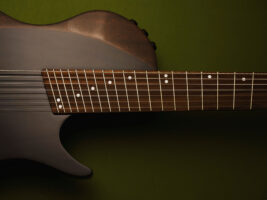
In traditional guitar construction, the frets on the neck run perpendicular to the strings, parallel to each other from nut to heel. A fanned fret guitar is built differently. The frets sit at an angle, splayed out like the ribs of a folding fan, usually with the nut and bridge slanted to match. The proper name for the design is multiscale, and that name explains what is actually going on: each string gets its own scale length.
On a conventional guitar, every string shares one scale length (with slight variation at the bridge, of course). A Les Paul is 24.75 inches from nut to bridge on every string. A Strat is 25.5 inches on every string. On a multiscale instrument, the bass side is longer than the treble side. A common spec on a modern multiscale 6-string is 25.5 inches on the high E stretching to 26.5 or 27 inches on the low E. Strandberg’s standard Boden 6 runs a subtle 25 to 25.5 inches. Dingwall’s 5-string basses go much further, spanning 34 inches on the G string out to a 37-inch low B. Because each string has its own scale length, the frets need to be laid out according to that scale length, so they have to fan.
Image: Rachel Billings for Guitar.com
Why Scale Length Matters In The First Place
String tension is a function of three things: pitch, string mass, and vibrating length. Tune a string to the same note on a longer scale and the tension goes up. That’s the entire reason fanned frets exist.
Every guitarist who has tuned a 25.5-inch guitar down to drop A has met the problem. The low string turns into a floppy noodle. You can fight it with heavier gauges, but heavy strings on a short scale bring their own trouble: stiff, thumpy attack, sharp fretted notes because the string deflects so much when you press it, and inharmonicity in the overtones that makes low chords sound blurry. Piano builders solved this centuries ago by giving bass strings dramatically more length than treble strings. A concert grand is, in effect, a multiscale instrument.
The obvious fix on guitar is a longer scale, which is why baritones exist. But if you stretch the whole instrument to 27 or 28 inches, you’re trading away the treble side. Bends get stiffer, the plain strings lose some warmth, and the fret spacing in the lower positions gets wide enough to annoy anyone with average hands. One scale length is always a compromise between what the low strings want and what the high strings want.
Fanned frets seek to end that compromise. The wound strings get the length and tension they need for a clear, focused low end. The plain strings stay at a familiar length where bends and vibrato feel normal. That’s the purpose of the design.
Image: Rachel Billings for Guitar.com
Where The Idea Came From
Fanned frets are, contrary to popular belief, a very old concept. The orpharion, a wire-strung cousin of the cittern built in England in the late 1500s and credited to luthier John Rose, used slanted frets and an angled bridge to give its bass courses extra length. A patent for a fanned fingerboard was filed by E. A. Edgren as far back as 1900.
The modern version belongs to Ralph Novak. Working as a repairman and builder in the 1980s, Novak wanted the sweet, warm treble response of a short scale combined with the piano-like bass of a long scale on one instrument. He filed in 1988 and was awarded U.S. Patent 4,852,450 in 1989, the same year he founded Novax Guitars. Novak trademarked the term Fanned-Fret, which is why big manufacturers say multiscale instead. Charlie Hunter’s 8-string Novax hybrids were the design’s most visible early ambassadors. When the patent expired in 2008, the concept went from boutique curiosity to production reality. Ormsby, Dingwall, Strandberg, Ibanez, ESP, Jackson, Schecter, and Cort all build multiscale instruments now, and the design rode the extended-range metal boom of the 2010s into the mainstream.
Image: Adam Gasson
What It Feels Like
Somewhere in the middle of a multiscale neck sits the neutral fret, the one that remains perpendicular to the strings. Builders typically place it between the 7th and 9th frets, and its location determines how the fan is distributed. Frets below it lean toward the nut on the bass side; frets above it lean toward the bridge.
There is an added ergonomic benefit to fanned frets too. In the first position, the slanted nut end roughly matches the natural angle of a fretting hand reaching for an open chord. High up the neck the angle reverses, which suits the way the wrist rotates as it travels toward the body. Most people adapt to it with relative ease. The genuine trouble spots are big barre chords near the extremes of the fan.
There are real costs to building this way, which is why I’ve done so few of them myself. Fretwork, nut cutting, and pickup makers have to offer slanted or individual-pole designs to track the string angle properly. None of this is exotic anymore, but unless you’re building your own custom pickups, it can limit your options. For many, the benefits outweigh the costs, and that’s why we see so many fan-fretted guitars out there today.
Image: Adam Gasson
Who Actually Needs Fanned Frets
In modern settings, guitarists who play a 7-string, 8-string, or heavily downtuned 6-string are the core audience. This is because the low B, F#, or drop G is where a stretched bass scale earns its keep. Bassists chasing a tight, articulate low B are arguably served best of all, which is why Dingwall owns that conversation. If you play a standard-tuned 6-string, fanned frets solve a problem you do not have. Tension balance and intonation improve slightly, but the payoff is modest. The lower you tune and the more strings you add, the more sense the fan makes.
You’ll also occasionally see very high level acoustic guitar players – the sort who are not playing cowboy chords – using fanned fret instruments because there really is no hiding place for intonation when you’re playing virtuosic acoustic guitar!
The post What’s the point in a fanned fret guitar anyway? appeared first on Guitar.com | All Things Guitar.
Source: www.guitar-bass.net