Why your guitar’s fretboard radius matters more than you think
Every guitarist, in time, will develop guitar specs that they prefer, one of those specs, regarding playability, is the fretboard radius. Radius has more to do with how a guitar feels under your fretting hand than almost any other spec on the sheet, and it decides how low your action can go before your bends start dying.
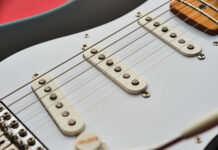
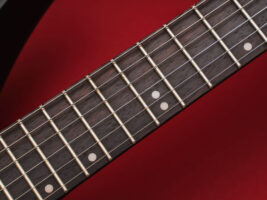
So what is fretboard radius? Well, first of all, I’ll bet that some of you reading this didn’t even realise that the wood of your guitar’s fretboard probably isn’t perfectly flat, but actually has a very subtle curve running across its width.
READ MORE: This is why your guitar’s scale length actually matters
And that’s what fretboard radius is talking about – it’s a measurement of the way in which the wood of your fretboard is curved. Still not following me? Picture a circle, and then slice a thin strip out of its edge and lay it across the neck.
That arc is your fretboard surface, and in order to measure this surface, we use the radius of the circle that you took that thin slice out of.
The bigger the radius number – and the bigger the circle you’re pulling from – the flatter your fretboard will be. So, for example, a vintage Fender guitar would have a radius of 7.25 inches, meaning that the slice comes from a relatively small circle.
Modern Fenders run to a flatter 9.5 inches, while Gibsons are generally flatter again at 12 inches. PRS sits in the middle at 10 inches. Ibanez’s Wizard necks are very flat in the 15.75-17-inch range, while a classical guitar has no radius at all and is completely flat (sometimes called “infinite radius”).
Image: Adam Gasson
The Bending Debate
The biggest question you might be having is why are most guitar necks radiused at all? Radius was added to the guitar design long ago to adapt to the fact that your hand isn’t flat.
Wrap your fingers around a barre chord and they form a natural curve. A rounder board matches that curve, which is why cowboy chords and barre work feel so easy on old Fenders.
Flat boards make chording feel like pressing strings against a table. It’s fine for a classical player with proper left-hand position and the neck up at 45 degrees. Less fine for someone playing an open G with their thumb hooked over the top.
But there is a potential trade-off there, and that’s to do with bending strings further up the neck.
When you bend a string, you push it sideways across the board. On a curved board, sideways means uphill. Bend the high E at the 15th fret and the string travels toward the crown of the arc, where the frets sit higher relative to the string’s straight path from your fingertip to the saddle. If your action is low, the string loses clearance over the frets ahead of your finger and the note chokes out.
This is a famous issue that many players have found with Fender’s preferred vintage 7.25-inch radius. These guitars feel wonderful for chording, when you attempt a full-step bend above the 12th fret dies on the fret in front of it.
The fix is raising the action, which trades one problem for another. Flatter boards suffer less from this because the crown is lower. A 12-inch Gibson board will take noticeably lower action than a 7.25-inch Fender board before bends choke.
Now, there are plenty of eminent guitar experts who will tell you that a properly set up 7.25-inch radius guitar will take whatever you can throw at it. There are few men more obsessive about the minutiae of electric guitar design than Paul Reed Smith, and he dismissed the idea that you can’t bend on a vintage Fender as “new internet lore”.
He’s joined in his fight by John Mayer who dismissed the idea that his PRS Silver Sky was somehow problematic for having a vintage Fender radius, claiming that, “The difference between 7.25” and 9.5” is less significant than your strap being an inch higher or lower. I’ll fight anybody on that.”
As with most other things in guitar, the debate never stops!
Image: Adam Gasson
What About The Compound Radius?
In 1978, a luthier named Denny Rauen was refretting a Stratocaster for a customer who wanted his Strat set up with the same low action as his Les Paul. Rauen got the action down, tried a bend, and hit the choke problem head on. His solution was a fretboard with more than one radius – one that’s round at the nut, where you generally chord, and flat at the heel, where you’re generally adding bends to a solo.
He called it the multi-radius fingerboard and published the idea in American Lutherie and String Instrument Craftsman in the mid/late 80s rather than patenting it. Warmoth picked it up, renamed it the compound radius, and the term stuck. Today Jackson and Charvel run 12 to 16-inch compounds as standard, Fender’s American Ultra line goes 10 to 14, and Warmoth still cuts its classic 10 to 16.
Now the part that gets muddled in forum threads. A properly made compound radius board is a section of a cone. Your strings aren’t parallel. They splay outward from a narrow nut to a wider bridge, and each one needs to travel in a straight line at a consistent height over the frets. A cone is the one surface that lets every string in that fan lie flat along it. Rauen understood this from the start, which is why he also called his invention a conical fingerboard.
The distinction worth knowing is between a true conical board and a blended one. CNC-cut boards from good makers are genuine cone sections, with the radius opening up continuously from the first fret to the last. Some cheaper boards and plenty of hand-modified ones are really two or three cylindrical sections sanded together at the transitions. This requires some careful fret leveling to get right. I’ve done it myself and admittedly, I’ve screwed it up a time or two before I got proper jigs.
Image: Adam Gasson
So Which Is Best For You?
The obvious answer is that if you are playing chords, get a rounder radius, if you want to do bigger bends, get a flatter radius. For shred, flat or near-flat is what you’ll want. Wide legato stretches, tapping, and sweep picking all reward a board where every string sits at an identical, minimal height. That’s why Ibanez has kept the Wizard neck up around 17 inches for decades and why so many extended-range and metal builds push flatter still. The cost is that first-position chording feels slightly alien, which is a price most shredders happily pay – nobody pays to see Yngwie Malmsteen play cowboy chords, after all.
Two practical notes before you go shopping. First, your saddle radius should follow your board. Set a flat saddle arc over a 9.5-inch board and your middle strings sit too low. On a compound board, set the saddles slightly flatter than the last fret’s radius. Second, if you love your vintage-radius guitar but hate the choking, a good tech can level the frets with progressively more fall-away above the 12th fret, effectively cutting a compound into your existing fretwire. It’s a $100 fret dress instead of a new neck, and on a 7.25-inch board, it’s the single best playability upgrade money can buy.
Regarding radius, my advice, as always, is to play as many guitars as you can. Radius is one spec, but it is not a spec that exists in a vacuum – there’s also neck contour (the shape of the back of the neck), neck width, string spacing, etc – all of which can have a subtle effect on a guitar’s playability and feel. So play on, and when you find something you like, figure out what that is and stick with it.
The post Why your guitar’s fretboard radius matters more than you think appeared first on Guitar.com | All Things Guitar.
Source: www.guitar-bass.net