
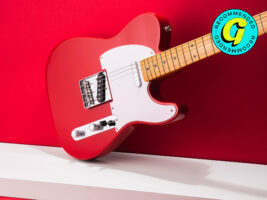
Fender Vintera III Late ’50s Telecaster review: “this guitar has really surprised me”
$1,249/£1,069, fender.com
It’s been 75 years since Leo Fender came up with what many still believe is his crowning achievement – the Telecaster. In the seven decades and change since, the Tele has proved itself to be a remarkable chameleon of a guitar, finding a sonic home in every genre you can imagine.
READ MORE: Fender Vintera III Mid ’60s Jazzmaster review: Mexican-made vintage-style offset bliss
Part of what makes it such a consistent success is the genius simplicity of its design. It’s effectively a plank of wood with some pickups on it, and that makes it endlessly adaptable in a way that more involved instruments cannot so easily manage.
The simplicity of a Tele also means that it’s quite easy to dismiss how tricky it can be to get one right. Yes, any idiot with a drill and a guitar kit can put together a functioning and usable T-type guitar, but a good one is its own sort of magic.
Which makes this new Vintera III Late 50s Telecaster such an interesting proposition – is it really $400 better than the impressive Player II Tele? Or more than twice as good as a Squier Classic Vibe? Or is it trying to be something a little different and more specific than both?
Image: Adam Gasson
What is it?
There’s a very strong argument to be made that there was not a whole hell of a lot wrong with the Vintera II guitars that were launched just a few short years ago, and while other guitars in this range may have been redressing historic blindspots with Fender’s vintage-focussed Mexico-made line, you can never accuse the Big F of neglecting or shirking its Strats and Teles.
That being said, the 50s-style Telecaster that was offered in the Vintera II was very much focused on the earliest models – to the extent that it was actually called a Nocaster, in reference to the transition period between the first Broadcaster guitars and their rebrand as Telecasters where the guitar briefly had no model name on the headstock.
That meant blackguards and sunbursts, so it’s interesting that the Vintera III range here takes inspiration more from the guitars that came out towards the end of the decade, as the transition to the more interesting (and colourful) 60s began. In basic terms, that means that in addition to the unavoidable Butterscotch, we also get the much more exciting options of Sherwood Green Metallic and this rather fetching Dakota Red. All three finish options come with a one-piece maple neck and a single-ply white pickguard.
Elsewhere, it’s very much a classic Tele – the Butterscotch option comes with the welcome return of ash to the range, while the other two are both alder. You get a vintage-style ashtray bridge complete with three uncompensated steel barrel saddles, a pair of the new Vintage-Style Late ’50s Pickups and the usual two knobs and a three-way control layout.
It shouldn’t be worth noting that for your $1,249 you do actually get a gig bag here – unlike most of the other guitars in Fender’s Mexico-made ranges – but as usual it’s not one you’re going to be wanting to entrust your guitar’s safety to. Despite Fender calling it a “Deluxe Gig Bag”, it feels about as deluxe as the toilet paper in a dive bar – presumably the non-Deluxe version would just be a piece of string tied to a trash bag?
Image: Adam Gasson
Build quality and playability
Whatever people might think about Fender as a business at the moment, there’s no avoiding the fact that when it comes to making guitars – especially at the more affordable end of the market – it really does know what it’s doing.
You can argue about whether a twelve hundred dollar Mexican Telecaster can even be classed as the “affordable end” of anyone’s market any more, but it doesn’t change the fact that this is a very impressive and well-sorted instrument straight out of the box.
The guitar hits bang in the weight sweet spot at exactly 7lbs, and close inspection reveals a very well put-together instrument. The Dakota Red finish is expertly applied to the body, the single-ply pickguard is expertly cut and attached, while the neck pocket is a snug and reassuring fit without any movement or worrying gaps. Granted, it’s pretty hard to get a Telecaster wrong, such is the simplicity of its construction, but it’s not easy to do it well either – and this ticks all the boxes.
Fender claims this Tele comes with a Late ’50s Soft V-shaped profile, and while you can feel a little bit of the V in the shoulder, you almost have to be looking for it – it’s not really noticeably that different from a generic C-shape. Maybe that’s a good thing in the grand scheme of things, but if you read the description and were expecting something that feels properly old-school, you may want to brace yourself for disappointment.
The neck itself is nicely finished with a tinted gloss poly – it’s not too sticky out of the gate, and adds a nice caramel tint to the maple, though there is a bit of overspray on the bone nut. Speaking of that, my initial inspection led me to wonder if those slots had been cut too narrowly – it’s a very tight fit. In practice, however, the strings move through the slots without any sticking points – though I’m not sure if that would still be the case if you upped the gauge from the supplied .009s.
The neck is straight and true, with no truss rod adjustment needed out of the box, and with intonation rock solid all the way up – that’s good news, because being a vintage-style guitar, we’d have to pop the neck off to adjust the damn thing. The split-post vintage-style tuners are smooth and responsive, and keep things in check without any fuss.
The action is about as low as you can get away with on a guitar like this, and it makes for a very slinky player. The 21 vintage tall frets are shiny and well dressed, and as has become the norm for Mexican Fender guitars, the fingerboard edges are nicely rolled to make for a very comfortable player.
There are people who will tell you that bending a string with a 7.25” radius is some sort of impossible labour of the kind that Hercules would have turned tail and run from. Despite this, and no doubt in part because of the well-done fretwork and low action, two- and three-fret bends can be executed without any hassle, and we don’t really get any hint of choking out until we’re troubling the very top of the fretboard – and there’s no money up there anyway.
Image: Adam Gasson
Sounds
You know what you’re in for with a vintage-style Telecaster, but before we get into the weeds of how this guitar sounds, a note about those saddles. The vintage-style three-barrel steel arrangement here might be vintage-accurate, but there’s a very good reason why so many players opt for brass instead of steel because it does temper the inherent high-end nature of the sound somewhat. Here, however, it’s the full-unvarnished spanky Telecaster experience – for good or for ill.
The bridge pickup is lively, piercing and unapologetically treble-forward, while you get a woollier and jazzy tonality in the neck, with the in-between sound offering a gently massaged take on the bridge pickup’s ferocity.
In practice, that means that you get wonderfully percussive, snappy responsiveness on the bridge pickup when running into a clean Deluxe Reverb, for example, or a wonderfully bratty and unapologetic piercing Pixies snarl when you lay on some gain.
The flipside of that is that the bass response is perhaps a little lacking. It does a lovely job of giving you that slightly woolly Seeker-esque crunch when you run it into a cooking Marshall Plexi, but if you’re looking for a fat-bottomed full-on distortion… this is still a vintage-voiced Telecaster.
And while that might be good for a great many things, the Vintage-Style Late ’50s pickups are designed to sound like, well, late 50s Telecaster pickups. That means they run the gamut from pristine country cleans to throaty 60s rock… and while they have plenty of utility beyond that definition, of course, these are impressively true to vintage Teles I’ve played in both their response and their overall character – limitations and all.
Image: Adam Gasson
Should I buy one?
I’ll end this with something of a confession: I’ve never really got on with traditional Teles. I think they look fantastic, I think they sound incredible in the hands of other people, and I absolutely think the Tele is probably the most important electric guitar ever made.
That being said, the only Teles I’ve ever really bonded with have been Deluxes, Customs or Cabronitas… for whatever reason, the classic configuration never really inspired me.
And yet spending a few weeks with this Vintera III has really surprised me – even outside of my play testing, I’ve found myself being drawn to pick it up more often than not, and have had an absolute blast while doing so.
Maybe that would have happened anyway, but I can’t help but think that the inherent quality of this instrument has managed to pull me in – it’s fantastic to play, accessibly lightweight, and has pickups that sound impressively and authentically like a vintage Tele. If it were mine, I’d probably chuck a set of compensated brass saddles on there to take the edge off some of the ice-pick sonic qualities, but that’s more personal preference than anything. This might not be the cheapest Tele around, but it’s one of the best.
Alternatives
If you want a Tele-style guitar that’s a little less on the vintage end of the spectrum, the Player II Modified Tele ($1,049/£939) brings Noiseless pickups and more modern player-focused appointments, while the regular Player II Telecaster (from $849/£769) is a really great guitar for the money with rolled board edges and some quality (if more generic-sounding) pickups. Some finish options also offer chambered bodies. If for, ahem, some reason, you wanted a T-type guitar that doesn’t say Fender anywhere on the headstock, there are some solid options in this price point. Chief amongst them is the Reverend Pete Anderson Eastsider T ($1,299/£999), though for something a little different, you should definitely check out the PRS SE NF 53 ($1,049).
The post Fender Vintera III Late ’50s Telecaster review: “this guitar has really surprised me” appeared first on Guitar.com | All Things Guitar.
Source: www.guitar-bass.net