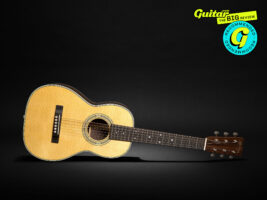
Martin 5-28 Terz review: great guitars come in the smallest packages
$3,599/£3,799, martinguitar.com
The stringed instrument that we now know as the guitar has a long and winding history that goes back almost as far as the history of the human race itself: the oldest depiction of someone playing a stringed instrument is an ancient Hittite carving that dates back over 3,500 years.
READ MORE: Martin D-X2E Molly Tuttle review: “if I closed my eyes, I really could tell myself I was playing a 1940s guitar”
Over the next few millenia, cultures across the world would conceive of various ways to make music through a combination of vibrating strings and wood – from the oud and the lute, to the vihuela and the cittern.
Even by the 1500s, when the proto-forms of what we now understand as a guitar started to become popular across Europe, there was a great deal of variety in terms of shape, size and the number of strings as makers and players experimented to work out what worked and what didn’t.
One of the most popular and important evolutionary forks is the Terz, which was extremely popular in the 1800s, especially in central Europe – often as an accompaniment to someone playing on a regular guitar. The Terz also has a special place in the history of Martin Guitars, as these are the sorts of instruments that Christian Frederick Martin Sr was building in his native Germany, before he emigrated to the USA.
For 2027, Martin has reintroduced the Terz guitar into the company’s standard line in the shape of the 5-28 – so what’s the deal?
Image: Press
What is it?
In essence, a Terz guitar is a small-bodied (Size 5) acoustic guitar where all the strings are tuned a minor third higher than E standard – G-C-F-A♯-D-G. “Terz” is the German musical terminology for a third, hence the name – in Francophone countries the guitars are sometimes called ‘tierce’ guitars for the same reason.
The Terz’s tuning gives the same effect as placing a capo on the third fret of your regular acoustic, but combined with the tiny body it gives a sweeter tone that makes it such a great accompaniment for a regular flat-top.
Over the years Martin has periodically made Terz guitars, and they’ve earned quite a reputation among artists over that time. Dolly Parton is without doubt the most famous and visible exponent of the Terz – for many years she used a 5-18 Terz as her primary guitar, but the guitar has also been used to great effect by the likes of Marty Robbins, Sting and even Billy Corgan.
This association has made vintage Martin Terz guitars very collectable – but they rarely come cheap. They were never mass-produced, and finding a clean vintage example is very tricky because the string tension of that added third is hard going on the bridge, top and braces.
Thankfully for those of us who have always been Terz-curious, the brand new 5-28 makes the experience a great deal more affordable and accessible – it’s still not a cheap guitar by any stretch of the imagination, of course, but at least you don’t have to be friends with a vintage guitar dealer to hope to see one.
As you’d expect from a Standard series guitar, you get premium tonewoods – a solid spruce top with solid East Indian rosewood back and sides, an ebony board, and 28-style flourishes including mother-of-pearl inlays and a multi-stripe binding around the body and the soundhole. The guitar comes with a hard case and is available for lefties, too – but what you don’t get is any onboard electronics: it’s a case of mic it up or get the drill out here.
Image: Press
Build Quality and Playability
The first thing that strikes you about the 5-28 is the size of the thing – it is a very tiny guitar, even by parlor standards. In fact, the 5-28 is the smallest guitar in the Martin catalogue at this time, unless you count the D-28 Christmas tree ornament, which only really counts if you’re a mouse or other musical rodent.
Despite its diminutive size, it feels every bit a Martin built by the craftspeople in Nazareth, Pennsylvania. From the top to the bottom of this tiny Terz, I could not find a flaw in woodworking, assembly, finish, fretwork or anything else – this feels like the sort of guitar that could become a family heirloom, something you can pass down through the generations, as has often been the case with historic Terz guitars. Thanks to the ageing toner on the guitar’s top, it already looks well-travelled.
The playing experience is certainly a lot more compact than a regular Martin dread – this is a 12-fret design, but the 21.38-inch scale length here is very noticeable, though the standard 1.75-inch nut width means that it at least only feels cramped in one direction. If you’re a bigger-handed, bigger-bodied player however, you may have to shake the feeling that you’re not having a Gulliver’s Travels moment.
Image: Press
Sounds
Considering the Terz is tuned 3-steps higher the sound is still surprisingly full and articulate with clean note separation all the way up the neck. You won’t achieve the bass notes or the rounded mids of a traditional D-28 or D-18, but the note clarity and fullness of tone exceed the series 5 body shape expectations.
For comparison I went back and forth between my Martin Bigsby D-28 and the Terz and although the pitch was higher with less bottom-end, the playability was very similar. The Terz sits in its own tonal space for sure, but there is a question about how useful it is on its own – you’d have to be sure your voice provided the right range to accompany it properly, or you’d have to be sure the band around you can provide some of the bottom-end fullness.
The smooth playability up and down the neck, combined with that compact scale length, does encourage ventures up the fretboard. Thankfully, I found the 5-28 to offer a tonality that was obviously higher in register, but never piercing or shrill – it’s actually rather rounded and lovely.
Image: Press
Should I Buy One?
If you are a tone chaser looking for different sounds than your garden variety Martin acoustic guitar, the 5-28 is a lovely instrument that adds a new sonic palette that you probably didn’t even know you wanted.
Given its small stature, it has more projection and focus than you might expect, but it’s going to struggle to be heard on a big stage or in an ensemble – the decision to not include a pickup feels odd in that circumstance.
Given its place in Martin’s history and the collectability of these instruments, it does feel like something that could be a musical investment – especially if more modern artists start to discover its charms now. From a practical perspective, its small size also makes it a much more realistic prospect as an airplane carry-on – its hard case would probably fit in the overhead locker of even the stingiest airline.
There are obviously some caveats to what is a niche instrument – you will likely have to rethink the key you sing in to be accompanied by the 5-28, and you’ll probably want some friends around to fill out the sonic spectrum too. Team it up with another acoustic guitar, mandolin or 12-string and it offers a really unique tonal texture in a separate frequency path.
But ultimately, the great thing about the 5-28 is that it will likely enable more players – like me – to spend some time with a Terz guitar and discover the unique magic these instruments offer. As a different kind of acoustic guitar experience, it’s up there with the very best.
Alternatives
Terz guitars are few and far between in the catalogues of most guitar brands, so you have to get creative. Martin is feeling the small-bodied bug at the moment, and the new 00L-16E ($2,499) is a less bijou guitar, but one with bags of character and great sounds. Gibson’s L-00 Special ($1,999) is another great parlor-sized guitar, with real Robert Johnson mojo. Another incredible US-made parlor is the Breedlove Roots Parlor E ($2,899), while the Larrivee P-03 Mahogany Recording Series ($2,149) used to be made in Canada, but is now built in California – it has a 24-inch scale and 12-fret neck join. String any of these parlors up Nashville-style (or stick a capo on three) and they’ll get you a little closer to the vibe of a Terz without actually being one.
The post Martin 5-28 Terz review: great guitars come in the smallest packages appeared first on Guitar.com | All Things Guitar.
Source: www.guitar-bass.net