How Taylor Swift’s debut album put the guitar at the heart of her artistry
The Taylor Swift of 2026 is a unique cultural force. A polarising pop billionaire whose chokehold on the modern music industry is pretty much unprecedented. In the last three years alone we’ve seen her Eras Tour redefine what an event tour could be. We’ve seen her Life Of A Showgirl album shatter records in sales, chart performance and streaming numbers. And her life has become such a matter of public interest she even managed to squeeze in the most talked about wedding of the century.
READ MORE: These are Taylor Swift’s six biggest guitar influences
But 20 years ago this week, before she became this monocultural force – long before the term ‘Swiftie’ had entered the public lexicon – a young girl released an unassuming country-pop album that she’d written in her bedroom on an acoustic guitar.
Origin myths about Swift’s breaking into the music industry abound, but the one that we generally agree upon seems to be that she persuaded her whole family to uproot from a Christmas tree farm in Pennsylvania to move to Nashville to try to make it as a country singer. At age 14, she turned down a development deal with RCA in favour of signing with a brand new record label called Big Machine, and the rest is history.
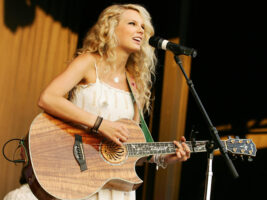
In the twenty years since, Swift has reinvented herself and her sound many times over, and the guitar has remained a core part of her live artistry throughout many of these eras. Even so, it’s easy to forget how important her guitar was to her music and her identity in those early days.
Drop In The Ocean
Listening back to her debut in 2026, you’re struck by how central the guitar is to everything she does – to the point where it’s explicitly the fulcrum of the track, Teardrops On My Guitar.
The third track on her debut is an early mission statement, that uses metanarrative details to describe her own process of turning pain, in this case, romantic rejection, into art. If you’ve never listened to Taylor Swift before, brace yourself for this stunning and oft-overlooked early highlight of her career.
A melancholic country moment of teenage melodrama, Teardrops… captures everything about Swift’s creative process. In a recent interview with the New York Times, Swift acknowledged the fact that a large portion of her fanbase fixate on the “paternity test”, i.e. what the song is about and who inspired it.
But in the line “he’s the reason for the teardrops on my guitar”, she positions the man as the muse, while Swift’s pen and her own guitar create something beautiful and artistic out of hurt. At the centre of this image? Her trusty guitar was the only thing she could use to spin what she was feeling into a compelling story.
Now that she’s the most famous musician in the world, it’s easy to forget that Swift’s early success was hard-won, and based on real graft with her guitar. She’s spoken on several occasions about turning up to writing sessions with seasoned professional writers with a guitar in hand, songs half or fully written.
Practical too, was the guitar when showing off her music to impress industry folks. She handed out CDs, yes, but in the early days she’d literally play her music to anyone who would listen. The promotional cycle for her debut largely revolved around a mammoth in-person tour of radio stations where Swift would perform live on air, and she didn’t need a band or a backing track to do it.
This self-reliance helped build her brand as a young star with creative control, an important distinction which has carried through to the later years of her career.
But more so than just practicality, the image of the guitar represents something bigger and stronger in the wider Swift universe, especially in those early years. It is the instrument and her devotion to it, that allowed her agency, something which sets her apart from her peers.
Creative Control
We weren’t in the boardrooms; we will never truly know whether Swift was the first teenage girl popstar who was given full creative reign over her career, but it would be disingenuous to pretend that she was the first one sold to us as such.
Her most prescient predecessor, Avril Lavigne, was positioned as the anti-Britney and her attitude, her “I know who I am/anything but ordinary” stance, was a big part of that. Quite how much of that was just spine… well. The credits behind Lavigne’s smash debut Let Go have been contested in the years since, and Avril made no secret of the fact that it wasn’t exactly the album she wanted to make (sophomore goth-rock effort Under My Skin was much more in line with her actual tastes, and did not resonate as strongly)
Lavigne’s later career has been somewhat burdened by this, in a way that Swift’s early success and material hasn’t. There was something about the way Swift carried herself from the very beginning that made you think she knew exactly what she was doing, and what she wanted.
It’s the sort of confidence and artistic focus that made people want to take a gamble on her – an unwavering competency, dedication and self-belief which seemed to come from within, rather than a marketing campaign.
There was never any doubt that these were her songs, this was her career, and she was in charge of all of it. So much of this was communicated by her guitar, the symbol of authenticity, of ownership, of her songwriting prowess.
That realism – of being a confident, guitar-toting songwriter who wasn’t following the mainstream trends of that moment, resonated strongly with a generation of young people. It felt like we were watching our own stories play out in an authentic and relatable way.
Return On Investment
As someone who was a kid obsessed with pop music around this time, Swift’s agency felt revolutionary to me at that moment. You felt the authenticity of it, because it felt like she was in charge of her music, and in charge of how she wanted to be presented to the world – as a musician, not simply as a singer. That made it easy for teenagers to invest in her music not just in a passive, listening sense, but in more active ways as well.
The image of Swift on a bed with a guitar abounds, in the music video for Teardrops… and in countless early photoshoots and remains central to her iconography. That made it all the more natural for fans to make playing the guitar part of their own exploration of her work – there’s a reason why Swift is often cited as one of the most influential modern guitar players.
As Swift has ascended to the very top of the modern musical pantheon, her muse has regularly pushed the guitar out of the focal point. On Life Of A Showgirl the maximalist pop production of Max Martin and Shellback feels about as diametrically opposed to that enduring image of Swift as a young girl, shut up alone in her bedroom crafting songs straight from her journal entries as you can get.
Even when she leans back into moments that centre the guitar more overtly – such as the recent Toy Story 5-tie in I Knew It, I Knew You – it’s usually her more guitar literate producers like Jack Antonoff or Aaron Dessener actually picking up a six-string on record.
Yet the guitar remains an essential part of the Swift mythos to this day. The Eras Tour showed her relationship with the instrument remains strong – the carefully chosen guitars she used on stage are clear evidence of that. What’s more, Taylor’s signature Swift Baby Taylor model remains a constant part of the brand’s signature line-up, while her official store sells tie-in Epiphone acoustic guitars emblazoned with her album covers – reminding us all what an essential part of her artistry the acoustic remains.
The mixed reaction to Showgirl from fans and critics alike presents an interesting moment for Swift as she marks 20 years since she first charmed us as that girl in her bedroom with an acoustic guitar. Predicting her next move is never easy, but if her next Era finds her back with a guitar in hand again, it would be a canny move that would remind us of the innocence, but also the power and singularity which came with the early days of one of music’s most legendary and impactful careers.
The post How Taylor Swift’s debut album put the guitar at the heart of her artistry appeared first on Guitar.com | All Things Guitar.
Source: www.guitar-bass.net