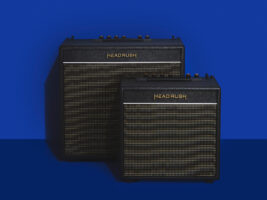
HeadRush FRFR-12 and FRFR-8 Cab review: “looks and feels like a real guitar amp”
$399 & $499/£279 & £366, headrushfx.com
You have to give HeadRush credit where it’s due; the company realised very early in the game that the rise and rise of high-end modelling was going to necessitate something through which people were going to want something that you could plug it into in order to make some noise.
READ MORE: Positive Grid Spark Pedal review: The Spark ecosystem welcomes another box of tricks
Being early to the party has made HeadRush synonymous with the full range, flat response cabinets that many players favour for attempting to recreate the experience of actually moving air in a live setting. The original FRFR 112 and 108 Cabs were a hit, without a doubt, but they were quite a difficult sell for a lot of guitar players.
A big part of this was probably down to their looks and form factor. While there was something sensible about the original FRFR Cabs being shaped like a monitor wedge, and for having the same rugged plastic build and vibe of a PA speaker (no doubt informed by the experience of parent company InMusic, which owns a bunch of DJ- and producer-adjacent brands like M-Audio and ION), it looked a little out of place on stage for a guitar player.
In the last year or two, perhaps driven by the entry of Fender’s Tone Master FR-12 into the market with its classic Fender combo amp looks, FRFR cabs have been getting a lot more amp-like. A perfect moment then, for HeadRush to enter with its brand-new and overhauled FRFR Cab range of two models – which have a much more classic look.
What Is It?
While HeadRush still sells the original wedge-shaped FRFR cabs, this new version comes in two similarly spec’d solid-state flavours – a 750-watt version with a 12-inch main speaker, and a 480-watt with an 8-inch main speaker. Both have the same 1-inch compression driver, and 90° conical horn, and while the FRFR 12 Cab pushes out a whopping 130dB-SPL, the FRFR 8 Cab is no slouch either, rating at 125dB-SPL.
Unlike the previous generation of HeadRush cabs, these new models sport closed-back wooden cabinets with amp-style tolex coverings and a classic Marshall Bluesbreaker-style split tolex/cloth speaker grille.
The top-mounted controls are similarly Bletchley-flavoured, with a black brushed metal control panel paired with classic gold amp knobs, plus a chunky rubber handle and two rack bumper guards at either end of the panel to protect your knobs in transit – a nice touch. The control panel is identical across both amps, and sports an XLR combi input, plus EQ controls for treble, middle and bass, plus a separate hi-cut control.
The other controls on top are for a master volume and a separate volume for Bluetooth audio – you can of course pair your phone or other device with the FRFR Cab and use it as a powerful wireless speaker, or to run backing tracks, etc.
Round the back, you’ll find an XLR line out so you can run directly into the desk/PA if you’re just using your cab for monitoring/stage volume purposes, and there’s a ground lift if you’re getting any unwanted hum. Power is provided by a standard three-pin IEC kettle lead.
HeadRush FRFR-12 Cab. Image: Adam Gasson
Build Quality and Usability
The original FRFR Cabs were notable for their rugged and uncompromising build quality, and that has been fully transferred over to these new wood-cabineted versions.
In both 12 and 8 formats, the general feeling is that they’re built for the heavy potential wear of stage life – the tolex is well-applied and feels hard-wearing, the wood of the cabinets dense and unyielding. Combined with the bumper guards to protect the top panel and chunky rubber feet on the bottom, I have no doubt that this thing could take a hard life on the road in its stride.
That tank-like build has a downside, however, and that’s unfortunately tank-like weight. FRFR cabs are rarely light things, but these push the boundaries of acceptability somewhat. While HeadRush rather optimistically describes these as “lightweight”, in reality they tip the scales at 24.2lbs (11kg) for the eight-incher, and a whopping 40.79 (18.5kg) for the 12-inch version
That is a lot, frankly – the FRFR Cab 12 weighs barely 2lbs less than a Fender Deluxe Reverb tube amp, so if you’re thinking that these cabs will streamline your load-in, think again. It looks even worse when you put it alongside the hugely popular Fender FR-12, which weighs 25.6lbs (12.5kg) – why does it weigh barely 2lbs more than a cab that’s half the size, and nearly 40 per cent less than its 12-inch equivalent?
Such is the weight, you might think twice about using the Fender-style tilt-back legs on either side to angle it towards your head, but in practice these things are very sturdy and reliable – they do the job very well and add real utility.
Some players are put off the powered cab thing because they’re worried that it will be fiddly or tricky to use, but the FRFR Cab makes it as streamlined as possible. Simply turn off your cab sim/IR on your modeller or ITB amp sim of choice, plug into it using either jack or combi lead, and then tweak your tone to taste using the onboard controls.
Bluetooth pairing is fast and stable, and the ability to balance volume with the guitar sound at the twist of a knob is really handy. Less reassuring is the carry handle, which despite looking robust, doesn’t feel it in practice – it feels unbalanced when you carry it, and only adds to the sense that these cabs weigh too much.
HeadRush FRFR-12 Cab. Image: Adam Gasson
Sounds
Given that these things are designed to provide a flat frequency response for your modeller’s IRs, the ‘sounds’ aspect of an FRFR cab review is always a tricky one to get to grips with, but we’ve found there is definitely quite a difference between the models on the market in this department, and there are some things to be aware of here.
Both cabs do a really good job of delivering a clear and faithful recreation of the sound of the modeller I was plugging into it – whether that was Headrush’s own Flex Prime or a more high end Neural DSP Quad Cortex.
There was a time when it seemed FRFR cabs were often aimed at heavier styles of music, and you can see a little bit of that genealogy here in the overall sound. While there’s plenty of overall bass response, it’s tight and focused – presumably designed to keep things from getting too messy when paired with high-gain sounds and extended range instruments.
The flipside of that is that the cabs lack a bit of fatness to the bottom end, and both can get a little boxy as you turn the bass up to compensate – though that’s to be expected when you’re dealing with compact, closed-back cabs like this.
The midrange is a real standout here, and you can tell that it’s been voiced to reflect the wider range of guitarists now using these cabs for all kinds of musical styles. It’s clear and strident, while the hi-cut provides the ability to tame any excesses easily.
No physical speaker can truly be a ‘blank canvas’ no matter how much they might say that it does, but the colourisation of the sound here is broadly minimal and enhancing – which is what we all really want.
HeadRush FRFR-8 Cab. Image: Adam Gasson
Should I Buy One?
The FRFR cabinet world is clearly changing to become more mainstream than it was when HeadRush first entered this sphere, and it’s a very sensible move to revamp the range to reflect what guitar players want – which is a cab that looks and feels like a real guitar amp.
It has done this without losing much of what made the original FRFR Cabs so popular – they sound really good, they’re built very well indeed, and they’re very simple to use. There are some downsides, most notably the sheer weight of these things in comparison to some of the competition and the disappointing carry handle.
But otherwise, it’s clear that HeadRush has learned a lot of lessons by being one of the first names in the game with full-range, flat response amps. It’s keenly priced compared to its competition, and looks great – and in the world of sometimes ugly FRFR cabs, that’s a huge bonus.
HeadRush FRFR-8 Cab. Image: Adam Gasson
Alternatives
The current king of the castle in the ‘powered cab that looks like an amp’ stakes is the Fender Tone Master FR-12 ($699), which even comes in classic tweed covering for the ultimate stealth FRFR experience. Blackstar’s FR Artist ($469) offers a similar stripped-down amp experience, but only delivers 100w and has no compression driver. IK Multimedia’s TONEX Cab ($799) has a very similar look and feel to the HeadRush, but lets you swap out the speaker grilles to change up the look. Finally, Positive Grid’s Spark Cab ($279) is well-priced, not just designed for Spark products but all modellers, and offers a lot of onboard tweaking.
The post HeadRush FRFR-12 and FRFR-8 Cab review: “looks and feels like a real guitar amp” appeared first on Guitar.com | All Things Guitar.
Source: www.guitar-bass.net