Answered: what’s the point of a guitar’s string tree anyway?
String trees are one of those bits of guitar hardware most players have never given a second thought to – that little metal disc or bar pinning the high strings down behind the nut on your Strat. Some guitars have one. Some have two. Some don’t have any at all. And if you ask the average player what it actually does, you’ll usually get a shrug and a vague mumble about “keeping the strings down.”
READ MORE: What’s the point of your guitar’s vibrato system anyway?
String trees (also called string retainers or string guides) are about as simple as guitar hardware gets, and they’re routinely ignored until something goes wrong, at which point they get blamed for tuning drift, tone loss, and general bad behavior. Sometimes fairly, sometimes not. So here’s what they actually do, why some guitars need them, and why some don’t.
A Simple Solution to Headstock Design
The whole reason a string tree exists comes down to physics, and the angle at which the string crosses the nut. Once the string crosses the nut on the way to the tuner, it has to angle downward sharply enough to stay seated in its slot. That downward bend – called the break angle – is what keeps the string seated, keeps it ringing cleanly, and keeps it from popping out of the slot when you dig into a bend.
On a Gibson-style headstock with its angled-back design, somewhere in the 14- to 17-degree range depending on era and model, every string gets plenty of break angle and there’s no need for a string tree.
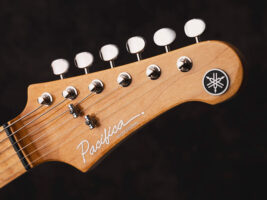
On a flat, Fender-style headstock, things get more complicated. The plane of the headstock sits roughly level with the back of the neck, which means the strings have to drop down to the tuner posts across a much shallower angle. The low E, A and D strings are usually fine – their tuners are close enough to the nut and their posts low enough that they generate adequate break angle naturally. But the G, B and high E strings, depending on layout, often don’t. The break angle of those strings is usually somewhere between 3 and 6 degrees without a string tree.
Image: Adam Gasson
So What Does a String Tree Actually Do?
A string tree is, mechanically, the simplest possible solution to this problem. It pins the offending strings down between the nut and the tuners, forcing them to make the bend the headstock geometry isn’t providing. With the tree in place, those strings sit properly in the nut, ring cleanly, and stay put when you bend.
Without one – and you can try this if you ever pull a tree off – the high E and B will buzz in the slot, lose volume, or in some cases actually skip out of the nut altogether under pressure. This is why Leo Fender added them in the first place. The original 1954 Stratocaster shipped without a string tree, but it didn’t take long for Fender to spot the problem and add a single round retainer for the high E and B. By the late 50s, the little disc-style “butterfly” tree had become standard issue. Telecasters got them too, for exactly the same reason.
Image: Adam Gasson
Why Do Some Guitars Have One Tree and Others Have Two?
Walk through a guitar shop and you’ll notice the variation. A vintage-spec Strat will usually have a single round tree pinning down the high E and B. A ’70s-style Strat or many modern American models often have a second one – usually a bar-style retainer – sitting further down and pulling the D and G strings into line as well.
The reason comes down to tuner post height. Vintage Fender tuners had relatively tall posts, which kept the strings sitting higher above the headstock face. As post heights got shorter on some models, and as headstock geometry shifted with the larger ’70s headstock, the D and G ended up needing their own retainer to maintain consistent break angle across the whole nut.
Fender’s modern answer has been staggered tuners: each post is a slightly different height, getting shorter as you move towards the high strings. With a properly staggered set, you can often get away with a single tree, and in some configurations no tree at all. EVH-style headstocks and a lot of boutique builds use this trick to clean up the look and cut down on friction points.
Tuning Stability
Here’s where string trees earn their reputation as a necessary evil. Every contact point between the bridge and the tuner is a potential source of friction, and the string tree is no exception. When you bend a string or work the trem, the string has to slide back and forth under that retainer. If it sticks – even for a moment – your tuning suffers. You’ll hear it as that familiar pinging sound when a string suddenly releases, and feel it as a guitar that won’t quite settle back to pitch after heavy whammy use.
Today, we have so many aftermarket solutions. Graphite-impregnated retainers, roller string trees, Graph Tech-style synthetic versions, and PTFE-treated trees all aim to reduce that friction. A few drops of nut lubricant under a stock tree will often do most of the same job for free. If you’re a heavy tremolo user on a Strat, this stuff is genuinely worth attending to.
Image: Adam Gasson
Do String Trees Affect Tone?
Strictly speaking, the length of string between the nut and the tuner doesn’t vibrate as part of the speaking length, so the tree itself shouldn’t have any direct tonal influence. But it does affect things indirectly. A string with insufficient break angle over the nut can sound dull, lose sustain, and sit unevenly in volume against its neighbours. The tree doesn’t add anything to the sound – it makes sure the string is doing its job properly, which is a tonal contribution in its own right.
I will admit that I am one of the aforementioned critics of string trees. But after trying to re-engineer a Strat neck myself, I can see why Fender opted to use string trees as a simple solution. Some builders out there, like Lucky Dog, make Fender-style guitars with an added headstock angle. When I’m building Fender-style instruments, I do this too, and prefer a 12 degrees angle, but it does require a lot more attention during the building process than a flat headstock. Simplicity is key, and as long as your tree is well lubricated and smooth, it’s a great solution for mass-produced guitars, and has kept Fender guitars stable and in-tune for decades.
The post Answered: what’s the point of a guitar’s string tree anyway? appeared first on Guitar.com | All Things Guitar.
Source: www.guitar-bass.net