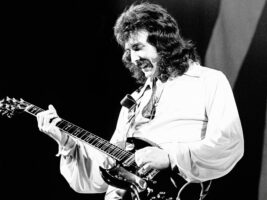
Birch Guitars made guitars that powered Black Sabbath, Slade and scores of others – 40 years later, the brand is making a comeback
“Birch guitars were the forerunners to having guitars that were different to those by Fender and Gibson,” affirms longtime Slade guitarist Dave Hill. “And for years there weren’t a lot of guitar makers on the local scene. Most people would order something from America like Cliff Richard did, when he bought a Fender Strat for Hank Marvin because he couldn’t get one in England.
READ MORE: “We can experiment, have fun and get a little wild”: Martin’s new 16 Series invites you into a colourful playground
“You couldn’t go walking around to loads of shops that had loads of guitars. They were rare. You had to go to Birmingham or Denmark Street in London and all those places where they were selling guitars. So, when John Birch came onto the scene, people took an interest in that. And they basically occupied that market space.”
Hill’s connection with Birch Guitars stretches way back to the early 70s, when the pioneering English guitar maker first built Hill’s famed custom ‘SuperYob’ guitar in 1973. Founded by John Birch, Arthur Baker, and John Diggins in 1970, Birch Guitars built custom guitars for a number of high-profile guitar playing artists; from Roy Orbison to Manny Charlton of Nazareth to Black Sabbath’s Tony Iommi.
In fact, Iommi’s custom John Birch SG was the guitar behind the guitar tones on the Black Sabbath albums; Technical Ecstasy (1976), Never Say Die! (1978), Heaven and Hell (1980) and 1981’s Mob Rules.
Iommi had first approached Gibson asking to have a 24-fret SG purposely made for him, but after Gibson declined, Iommi approached John Birch who took on Iommi’s request, in the process building him a black SG with 24 frets, with cross inlays, ebony fretboard, and fitted out with two John Birch Magnum pickups.
A Birch guitar. Image: Press
Back In Business
Birch Guitars would cease operations in 1980 with Diggins having already branched out on his own several years earlier starting up Jaydee Custom Guitars, continuing to build custom guitars. In 1993, John Birch resumed making guitars again until his death in November 2000.
Now, after more than forty years the Birch Guitars brand is being reactivated under new owner Peter Francis, together with original Birch co-founder John Diggins and his sons Michael and Andrew. First cab off the rank is a custom-made Dave Hill signature guitar.
“A lot of other people got signature guitars made for them, like ZZ Top, yet while I was with Slade nobody ever asked us to have a signature guitar,” says Hill. “The guitar companies never seemed to approach us. Nod [Noddy Holder] said to me a few months ago, ‘Nobody’s ever done a signature guitar for us.’ So, now Peter Francis, the new owner of Birch, is finally making me a signature model with my name on it and my signature.”
An integral element that comprises the tonal feature of a Birch guitar sound, comes down to its custom designed pickups. With standard pickups, the magnets used are generally made from either Alnico or Ceramic materials.
Birch’s Magnum pickups instead employ magnets made from cobalt steel. The magnets are then overwound, the purpose of which increases the output signal, leading to a decrease in the high-end whilst boosting the low end and mid-range frequencies.
Hill believes John Birch’s inventive spirit was such that he would always experiment with the tonal features of a guitar pickup in his quest to discover some new tone that would stand Birch apart from their competitors.
“Birch created this type of stereo system for pickups where he wanted to get the pickups to be in stereo or something like that,” he says. “I don’t know how it worked but it was like a broader sound, where you would get the sound either side. He was doing that. I had heard that even Brian May went to visit Birch one time. I’m not sure if he wanted to go the route of what John Birch was doing because Brian had got a unique guitar sound so he probably didn’t want that messed with.”
Hill explains that a lot of guitar manufacturers tend to use the same pickups on their guitars and in doing so, their guitars tend to sound uniformly the same, which is why the after-sale market for custom pickups continues to flourish today.
“You can walk in a shop now and quite honestly, every guitar is perfectly made, and it’s not different to any other,” says Hill. “You get a row of Fenders, you get a row of a lot of things and the pickups are exactly the same ones on every guitar you buy.
But guitars from the generation of the 60s were unique in the way the pickups were wound, which is why they’re worth a fortune today. Many would not sound the same because one might have more winding on one guitar to the next one. Which is why guitarists like Eric Clapton or Mark Knopfler or Hank Marvin have an individual sound.”
Dave Hill. Image: Press
Late Than Never
In October at the age of 80, Hill issued his first ever solo album Dirty Foot Lane. Upon first listens, the album showcases a side of Hill not heard outside of Slade. Introspective and autobiographical, the material runs the gamut from blues and folk to even atmospheric sonic landscapes.
Many of Hill’s musical influences such as The Shadows and Tom Petty shine through in his guitar playing, which is all underscored by the same energy that fuelled many of Slade’s classic material. The album is produced by Django Holder, son of Noddy Holder, who played a pivotal role in the making of the album.
“Django was very good for me because he was very calm,” says Hill. “He’s different from his dad, but he is very talented in his abilities to play, and he’s played some stuff on the tracks too, and he was very good with them, because a lot of my songs are quite emotional.”
Looking back over his career with Slade, Hill is pleased with what he and the group achieved during the lifespan of the band. And while commercial success always eluded them in the USA, Hill believes Slade made a huge mark in another way; by influencing and setting the template for a generation of American rockers that followed.
“While we really didn’t crack it, and we weren’t that big on sales, we seemed to be big in the business of influencing other groups,” affirms Hill. “Groups like Kiss, Aerosmith and all those similar groups have stated that they were all influenced by our albums, especially the most famous one of all, Slade Alive!”
The post Birch Guitars made guitars that powered Black Sabbath, Slade and scores of others – 40 years later, the brand is making a comeback appeared first on Guitar.com | All Things Guitar.
Source: www.guitar-bass.net