Boss XS-100 Poly Shifter review – even better than the squeal thing?
$349.99/£299, boss.info
It is possible to talk about the Boss XS-100 Poly Shifter without mentioning the ‘W’ word… but the elephant in the room would be so big it’d probably shatter the floorboards and fall into the cellar. Because this is Boss making a direct play for the market currently occupied almost exclusively by DigiTech and its Whammy range of foot-controlled pitch shifters.
READ MORE: DigiTech MonoNeon Whammy review: “This is the most innovative Whammy since the original”
Well, you don’t have to be the first to be the best, and Boss reckons its new offering – along with the compact XS-1 – has enough “groundbreaking technology” to make a real difference. So has the world’s most famous guitar pedal manufacturer found a new product category to dominate?
Image: Adam Gasson
Boss XS-100 – what is it?
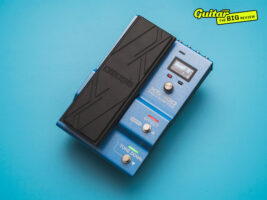
Let’s pretend for a moment that we live in a universe where the Whammy doesn’t exist. Pretty dull universe, isn’t it? But Boss is here to liven things up with a polyphonic shifter that’s split into two parts: a treadle-operated pitch bender for Floyd Rose-style downward swoops and impossible upward screeches; and a footswitch-operated transposer for doomy down-tuning and ‘virtual capo’ effects.
Now, in the real universe we have the Whammy DT, which does pretty much the same thing. But as well as being slimmer and a whole lot more classy-looking, the XS-100 raises the stakes with a preposterously wide shifting range of eight octaves – four up and four down. And it does this using new algorithms that should, in theory, make it sound more natural and free of glitchy digital artefacts than anything that has come before.
As with the Whammy DT, there’s also a ‘detune’ setting for chorus sounds. But the Boss’s LCD screen allows for all sorts of deeper editing possibilities: you can tweak the response curve of the pedal, slow down its reaction for more gentle sweeps, blend in any amount of dry signal, and even store up to 30 user presets.
The pedal can be set to come on automatically with a firm toe-press, like a wah, and the back panel opens up the options further with MIDI in/out ports, an input for an assignable expression pedal, and a dry-through output for sending the untreated signal to a second amp. It all sounds very promising – so let’s get a shift on.
Image: Adam Gasson
Boss XS-100 – is it easy to use?
It’s a pedal with a screen, and that might already have you scrambling for the factory presets… but actually, the basic operation of the XS-100 is so simple that you can get on fine without them. That screen is titchy but it tells you all you need to know: the top half shows the shift interval for the pedal, the bottom half the one for the switch. Press the encoder knob to flip between the two, and turn it to change the value.
There are also two buttons for getting into the aforementioned deeper editing – and that’s where the limitations of the screen size really show. Boss has clearly struggled to get all the necessary information across with such a meagre allowance of pixels, and navigating this part of the XS-100 is no fun at all; but at least it’s responsive, applying changes as soon as you twist the encoder.
The ergonomics of the two bypass footswitches are interesting: they’re quite close together and vertically aligned, but the one for engaging the pedal is raised up by about 2cm. The result is that each one is easy to stomp on without snagging the other, but hitting both together to go in and out of presets mode can be a challenge unless you’ve got three legs.
Image: Adam Gasson
Boss XS-100 – what does it sound like?
Let’s go straight in with the most extreme test possible: setting the pedal to four octaves up and the footswitch to four octaves down, engaging them both together for a net-zero shift and seeing if what comes out still sounds like a guitar. And… it does! All that processing does inevitably add a small latency delay – which you’ll really notice if the attack of the strings is audible in the room – but it’s workable, and the body of the sound itself is impressively un-mangled.
Flip to something a little more useful in the real world – let’s say an octave up for ‘whammying’ and four semitones down for instant shifting – and the results are even better. The action of the treadle feels totally natural and it’ll sweep gleefully up and down with no distracting artefacts. The switch is just as good, enabling seamless transpositions in either direction.
Yes, chords do sound ever so slightly processed, and there’s always a sliver of latency that you can feel rather than hear, but all that becomes negligible once you run the XS-100 through some heavy distortion – which is surely how most people will use this unit. You might also detect a hint of background weirdness when it’s tracking big string bends, but I suspect that won’t detract from the good stuff for most people. It’ll even do a good ‘receding ambulance’ impression if you set the switch to three semitones down and tap it on and off while gradually pulling up on the treadle.
Is it worth delving into the screen menus to play with settings? Undoubtedly – if only to try the ‘detune’ effect, which feels a bit incongruous amid all these pitch leaps but is great for pure 80s chorus tones. You can tweak this by altering the wet/dry balance, which is also where you’ll open up harmony effects. These track extremely well… and with an up-octave sitting fairly low in the mix, you can even pretend (just about) that your BC Rich Warlock is a Rickenbacker 12-string.
Image: Adam Gasson
Boss XS-100 – should I buy it?
On paper, this thing has three advantages over any Whammy: more octaves, more options and more audio purity. The first one, while admittedly cool, is more about oneupmanship than adding anything genuinely useful – there simply is no use case for a four-octave shift, unless you want to confuse dogs. The second is more substantial, but it’s offset by the fact that these options are so fiddly to access.
So it largely comes down to the XS-100’s ability to change pitch without audible latency and without digital scratchiness. It’s not perfect on either count, but it does feel like a step forward from anything I’ve used before.
Boss XS-100 alternatives
The XS-100’s closest rival in terms of functionality is the DigiTech Whammy DT ($449/£249), but see also the DigiTech MonoNeon Whammy ($329/£269) with its three-octave shifting range. Or just buy an Electro-Harmonix Pitch Fork ($198/£169) and plug in an expression pedal.
The post Boss XS-100 Poly Shifter review – even better than the squeal thing? appeared first on Guitar.com | All Things Guitar.
Source: www.guitar-bass.net