Córdoba Abasi Stage 7 review – this 7-string, fanned-fret nylon has quickly become my favourite guitar
£1,469/$1,499, cordobaguitars.com
There’s a good chance ‘nylon-string’ hasn’t been part of your guitar vocabulary for years. If you’re like me, you took your first guitar lessons on a downsized sub-£100 nylon-string acoustic, and when you upgraded to your first electric guitar, it was consigned to the back of the closet to collect dust.
READ MORE: Why Tosin Abasi created the wildest nylon-string guitar ever: the Stage 7
However, no longer reserved for classical or flamenco playing styles as it once was, the nylon-string now routinely finds itself in some of the most contemporary progressive music. Listen to Polyphia’s Playing God to hear how a nylon-string can sound when put through its paces in a progressive-minded instrumental band.
Thanks to the influence of cutting-edge modern players like Tim Henson and Tosin Abasi, a nylon-string resurgence is in full swing. So, perhaps it’s time to dust off that old beginner model that hasn’t seen use in years. Or, if it’s gone missing, invest in something that pushes the envelope…
Image: Adam Gasson
What is it?
Enter the Abasi Stage 7, a wildly experimental seven-string acoustic-electric guitar from the mind of Animals as Leaders mastermind and guitar designer Tosin Abasi in collaboration with the world’s foremost maker of production nylon-stringed instruments, Córdoba.
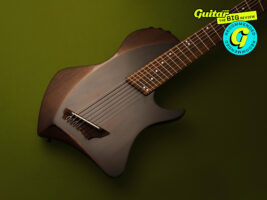
An evolution of Córdoba’s popular thinline nylon-string, the Stage, it’s about as far from a conventional nylon-string guitar as you could imagine, with eyebrow-raising features including 24 fanned frets, seven strings, a thinline body with a cutaway in the lower bout, a side-mounted soundhole, Fishman electronics, and narrower string spacing, offering a familiar feel for electric guitarists looking to experiment with nylon-string playing.
“We wanted to design this as a midpoint for the electric player who wants to get into nylon-string playing in contexts that aren’t solo classical guitar,” Abasi told me earlier this year.
The Animals As Leaders founder’s design resume includes his own namesake brand, Abasi Concepts – under which he’s conceived radically forward-thinking designs like the Larada and its double-cutaway sibling, the Ēmi – and the Kaizen, arguably the most exciting shred guitar on Ernie Ball Music Man’s books right now.
So what happens when you take one of the most forward-thinking guitar designers around right now and put him in a room with the biggest nylon-string instrument manufacturer in the world? As I find out: a match made in heaven…
Image: Adam Gasson
Build quality and playability
The Abasi Stage 7 is one of the wilder-looking guitars you’ll lay your eyes on, but beneath all that aesthetic eye candy lies a masterclass in ergonomic design. The guitar borrows the body silhouette of the Abasi Concepts Larada, with body cutaways both in the conventional position on the side, plus on the lower bout to allow for a more upright classical playing position.
If, like me, you’re the kind of curious electric guitar player Tosin’s aiming at with the Stage 7, there’s a good chance your experience playing in a classical position is limited. But you’ll be surprised how quickly you take to it with the right instrument in your lap, and discover it is, in many ways, the more natural way to play guitar.
The wildest design element of the Stage 7, though, has to be the 24-fanned-fret fingerboard. Given fanned frets are more commonly associated with electric shred guitars, on the surface, they seem like a wild choice here. But five minutes with the guitar makes you wonder why every guitar isn’t multi-scale.
As Tosin told me in our recent conversation, and as I discovered for myself, fanned frets suit the natural movement of your arm as it moves across the fretboard. Your elbow doesn’t stay static as your arm moves perpendicular to the neck; instead, your forearm rotates in a fanning motion about the elbow. And this is particularly exaggerated in a classical seated position.
“This fanning motion is more in line with mechanically what’s happening in the first place,” he said. In the case of the Stage 7, fanned frets mean reaching any note across all seven strings and 24 frets simply feels easier.
The thinline chambered mahogany body is super lightweight and comfortable, too – perfect for long and fatigue-free practice sessions – while the ergonomic cherry on the cake is electric guitarist-friendly narrow string spacing, plus a low action across the length of the neck for effortless fretting.
Ultimately, this isn’t a guitar you have to fight. Quite the opposite: every design element feels like it’s been thoughtfully and ergonomically considered, the result being an instrument that gets the hell out of your way so you can let your creativity run riot.
Image: Adam Gasson
Sounds
A thinline body and a huge cutaway in the lower bout – what acoustic guitar blasphemy is this? Such design choices suggest a significant sacrifice in terms of unplugged acoustic tone, and sure, while it doesn’t have the low-end projection of a full-size dreadnought acoustic guitar, it’s not supposed to.
The tonal character of the unplugged Stage 7 provides a perfect sonic playground for practice and musical exploration. My colleagues regard me as the resident shredder on the team, but even I soon found myself experimenting with flamenco and other styles of playing outside my usual remit. It’s true that different instruments can inspire us to play in ways we didn’t know we could, so for that reason alone the Stage 7 is a worthy addition to your guitar collection.
The fact it’s got seven strings is one of the key selling points of the Stage 7, but nylon-string guitar tends to want to be played on a clean setting, so playing low notes on the E string obviously doesn’t sound the same as it does on a seven-string electric guitar with gain. As a consequence, in practice, I don’t find myself venturing to the lower registers of the fretboard all that much.
Having an instrument that could deliver a reliable tone with limited feedback was literally the main reason Tosin Abasi started designing the Stage 7, so it’s no surprise its Fishman-powered plugged-in tone is nothing short of fantastic.
While you’ll most often want your plugged-in tone to be an accurate recreation of the guitar’s unplugged tone, the Stage 7’s electronics offer side-mounted volume, EQ and the ability to blend the body sensors with the undersaddle piezo.
On the whole, you can crank the volume through an acoustic amplifier and the guitar’s bespoke Fishman Stage electronics ensure the subtle nuances of its nylon-string character remain unaltered. Just note that these electronics are active, so you’ll need to get yourself a 9V battery…
Image: Adam Gasson
Should I buy one?
A multi-scale nylon-string seven-string is pretty niche, but this currently has no competition for filling that unusual gap in a tonal palette. For that reason alone the Abasi Stage 7 is worth consideration for certain players. It can be easy to think of yourself as an electric or acoustic guitar player through and through, but it can be a limiting belief if it stops you from exploring guitars which could unlock a new avenue of creativity.
That said, if your collection is exclusively six-string electrics, you might be better off getting a seven-string electric guitar first, or an upmarket six-string nylon-string like the original Stage. Then again, doing so could simply be adding extra steps between you and your new favourite instrument…
The Abasi Stage 7 is not for everyone, and if you’re a guitar purist normally allured by vintage instruments or mainstream models like the Stratocaster or Les Paul, your money is probably better spent elsewhere. But if you’ve got an eye for experimentation and trying something different, it could be the perfect instrument.
Image: Adam Gasson
Alternatives
Cordoba Stage Artist ($1,299/£999): If you’re looking for something that’s a little more traditional but still has the thinline electro-nylon experience, the Stage Artist shares much of the same DNA, with a thinline body and Fishman electronics, but without the fanned frets, seven strings or the radical body shape.
Ibanez TOD100N ($1,899/£1,669): The upmarket version of Tim Henson’s nylon-string signature is the first nylon crossover signature for a metal guitarist, but compared to the Abasi it’s almost traditional with its S-type shape and six strings. Don’t let appearances deceive you, however, it’s a lot of guitar.
Godin MultiAc Grand Concert SA ($2,399): Robert Godin was one of the innovators of the whole nylon crossover thing, and the MultiAc remains a very fine example of the form today – it’s also made in Canada.
Yamaha SLG200NW ($979/£741): Yamaha’s Silent Guitar remains just as polarising visually as it was 25 years ago, but for many it remains the benchmark of sound, feel and playability for plugged-in nylon-string sounds.
Image: Adam Gasson
Specs
tktk
The post Córdoba Abasi Stage 7 review – this 7-string, fanned-fret nylon has quickly become my favourite guitar appeared first on Guitar.com | All Things Guitar.
Source: www.guitar-bass.net