Kemper Profiler Mk II review: “the most accurate amp profiling I’ve ever experienced”
$1,549/£1,349, kemper-amps.com
If you want to come to play in the world of high-end amp and effects processing here in 2026, you’ve pretty much got to have some sort of amp profiling technology in there. So normalised has the capturing process become that it’s easy to forget that it’s only been 15 years since Kemper invented the whole thing, and revolutionised the world of digital guitar technology in the process.
READ MORE: Positive Grid Reactor review: does your guitar amp really need an AI chatbot?
The original Kemper Profiler was such a game-changer, within a decade bands both big and small were regularly eschewing the hassle of real amps and cabs in favour of the distinctive green lunchboxes. It’s been bad news for amp makers, and even worse news for chiropractors.
Over the decade and a half of its life, Kemper has been gradually improving its technology to the point where unerringly accurate profiled guitar sounds are no longer something to be marvelled at. However, in the last five years the brand has started to show its age as new contenders have entered the arena.
Chief of these has been Neural DSP and its various Cortex units – not only did Neural’s capturing tech give Kemper a run for its money in terms of sonic fidelity, but it all came wrapped up in a sleek, high-tech unit with intuitive touchscreen GUI, wifi-enabled tone sharing and downloading, and a thriving online community of sound-sharers.
Truth be told, the Quad Cortex made the Kemper feel like a Nokia 3310 in the age of the iPhone. In the years since other brands like Line 6, IK Multimedia and Headrush have brought out their own capture technology, wrapped up in similarly slick presentations. We’ve been waiting for a response from Kemper, and here it is; the Profiler Mk II.
Image: Adam Gasson
Kemper Profiler Mk II – what is it?
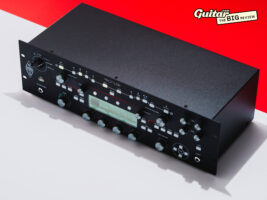
From a visual standpoint, you’d be forgiven for asking if anything has changed really – those hoping that Kemper would follow the trend and develop an amp with a full-colour touchscreen and all the modern bells and whistles are going to be disappointed.
Because aside from spraying the control panel black instead of the light grey of previous Kempers, well… it’s pretty much identical. Ok, it’s a little sleeker, the chassis itself is a little lighter, but other than that, it looks like a Profiler.
The most significant upgrade is under the hood with the processing engine. Something which Kemper claims provides faster performance and quicker boot times. Processor power is a big deal in the digital world as, among other things, it determines how many effects can be run simultaneously, and just how complex your signal routing can be.
The Mk II has seriously upped things in this regard, meaning that you can now run a whopping 20 different effects simultaneously – all of which run with zero added signal latency. The recording time of the onboard looper has also doubled to two minutes.
The increased power also helps deliver the new profiling software: Profiling 2.0. This next evolution of Kemper profiling promises to capture an amplifier’s “unique behaviour” with exceptional precision, moving far beyond traditional “amp snapshot” territory, resulting in, so Kemper claims, “the most organic and authentic amp tone possible, preserving every nuance of your amp’s sonic character”.
This is achieved by analysing 100,000 individual frequency points and additionally determining the actual amp gain, which is then applied to the Kemper’s gain control knob. You can also select a “Target Amp Model” in the profiling menu that mimics the target amp’s EQ and gain knobs, enabling you to treat the profile like the actual amp (provided your amp has been listed in the menu).
The routing options remain extensive, with balanced and unbalanced inputs, two balanced outputs, two balanced monitor outs, two line outs, an effects loop, SPDIF input/outputs, and headphone out jack. USB audio capabilities have been enhanced by doubling the number of audio channels when using as an audio interface (for eight channels in total).
Image: Adam Gasson
Kemper Profiler Mk II – usability and build quality
Back when the Kemper was introduced, the front panel presented a twisted familiarity in that it was a broad representation of a guitarist’s physical rig. Very little has changed on the second iteration – the top layer of buttons corresponds to the signal flow of a physical guitar rig: your input, followed by four effects slots (for pre-amplifier effects such as overdrives, wah), amp and cabinet buttons, and four post-amp effects, including modulation, delay and reverb.
There are then 14 other rotary controls, including a noise gate, master volume, dedicated knobs for delay settings, and four directly below the screen, which have a multitude of functions, including the bass, mid, treble and presence controls.
The chickenhead control selects the unit’s operational mode. ‘Browser’ allows you to browse all the ‘rigs’ stored on the unit; ‘Profiling’ takes you to the profiling menu; and ‘Perform’ mode allows you to store five different rigs in a performance slot (comprising of five slots), which can be navigated using an external footswitch for live use.
Kemper promises the upgraded horsepower would lead to a smoother experience, and booting up certainly bears this out – it takes less than a minute to power on from cold, which is substantially quicker than its predecessor.
In ‘Browser’ mode, you can navigate through the various rigs stored on the profiler, though it’s far more intuitive to hook it up to a laptop and use Kemper’s software editor, Rig Manager, which allows access to ‘Rig Exchange’ – the online library of rigs uploaded by Kemper users. A smartphone app is also available, should you prefer.
Kemper’s rack-based Profiler has become a feature on some truly massive stages, and it’s borne out in the general build of the Mk II – it’s rock solid, dependable and rugged.
Image: Adam Gasson
Kemper Profiler Mk II – sounds and in use
Existing users of the Profiler will have become familiar with the huge library of user-created profiles to download and audition yourself. As Profiling 2.0 is only available on the Mk II, the library of 2.0 profiles available is significantly smaller – you can still use the original ‘Classic Profiling’ sounds on the Mk II, of course, but that’s rather defeating the purpose of the upgrade.
Despite the understandably smaller library we’re working with here, the Kemper comes preloaded with a bunch of Profiling 2.0 sounds, including ones created by the likes of established names Michael Britt and Tone Junkies.
The Britt Marshall JMP amp profiles are quite sensational. They are so organically accurate and inspiring that you are completely unaware that you aren’t playing through a mic’d up amplifier. The array of studio-quality effects onboard helps elevate the sound even further, and using a spring reverb in conjunction with a Deluxe Reverb profile sounds as stunning as the amp itself.
The array of onboard effects is extensive and covers every conceivable base, from Tube Screamers to tape delay and everything in between – they’re not noticeably any better than those on the Mk I, but there was absolutely nothing wrong with them in the first place.
The proof of the Profiler is in the profiling, however, and so the best way to truly assess whether this is a step forward is to start profiling my own amps.
Image: Adam Gasson
Before I get into all that, though, I want to talk about ground loops: audible, low-frequency buzzing or hum. Ground loop happens when two or more pieces of connected gear (e.g. your modeller and a tube amp or computer) have multiple paths to the electrical earth, causing competing currents to leak into your signal path.
To help mitigate this, many manufacturers provide a ground lift, which is supposed to disconnect the audio signal ground from the electrical safety earth/chassis ground in your connecting cable.
Both the Kemper and the Quad Cortex have ground lift buttons which are designed to help eliminate the dreaded ground loop. However, the ground lift on my Quad Cortex does not provide any noise relief. Indeed, the noise is quite unbearable when profiling any amp with a substantial amount of gain.
Miraculously, though – and for reasons I can’t explain – this noise has no effect on the quality of the profile! The downside is that you need to audition the tone you wish to profile before connecting to the unit. Alternatively, it is often recommended to put a hum-cancelling device on the chain, but such a device also has a significant effect on the accuracy of the profile.
This same unbearable noise appears the moment we connect the Kemper to the amplifier, but when we engage the ground lift, the noise completely disappears! That’s a huge plus in the Kemper’s favour.
The first amp I profile is my Mesa/Boogie Mark IV through a Marshall 1960a cabinet. I dial in a moderately high-gain heavy rhythm tone on its lead channel. In front, I have a Royer 121 ribbon mic powered by a Warm Audio preamp, which is fed into an input at the rear of the Kemper. You can of course just plug a mic into the back of the Kemper and use the onboard preamp. I also record some guitar into my DAW, which I will later use for comparison purposes.
Selecting ‘Profile’ brings up the profiling menu in Rig Manager. I select ‘Distorted guitar’ profile and look to see if my amp is in the ‘Amp Matching Section’, but it unfortunately isn’t.
Image: Adam Gasson
In just under 70 seconds the profiling is complete. On first audition, the sound is instantly recognisable and reacts to my playing exactly as the amp does. Had this taken place 15 years ago this paragraph would be littered with exclamation marks but profiling an amp is not the wonder it once was, indicating just how spoiled we have become! I take the opportunity to profile the exact same amp settings using the Quad Cortex (itself already on its second generation of profiling software) for comparison. Surprisingly, the profiling takes nearly seven minutes on the Quad.
I record some guitar into my DAW from both units to compare with the original recording from the Royer. Both profiles are close to the point of being almost indistinguishable, although there is a tad more compression on the Quad profile. In comparison, the Kemper profile is a little more open-sounding, with slightly more detail in the top end. Much the same as the Royer recording.
In fact, the Kemper sounds better than the original. That’s right, better. There are numerous hisses and groans when recording a mic’d amp, but these are all eradicated when profiling.
I also mic up my Morgan AC20 and begin profiling. This is such a simple amp, but one where its charm lies in the dynamic response to your individual playing. The profile created and paired with a plate reverb is sumptuous, and digging in yields a similar response to the actual amp, as does rolling off the volume a little. Profiling 2.0 is the most accurate profiling I’ve experienced and I’m looking forward to profiling every amp in my little collection.
Kemper Profiler Mk II – should I buy one?
The quality of the sounds then makes this seem like an absolute home run – but the elephant in the room here is that user interface. While many existing users are happy enough to have a new product to use that feels instantly familiar and intuitive to them, there’s an argument to be made that Kemper is pandering too much to that user base at the expense of making it more widely appealing.
Even if you wanted to keep things broadly familiar, you could do that while also updating the user experience to offer a more intuitive ride that’s more in line with the rest of the market. For this product to ship in 2026 with the same 1980s calculator LCD screen as its predecessor feels pretty poor, frankly.
That being said, it’s not dramatically harder to use than its flasher rivals, and if you want to have a more intuitive graphical experience, the phone/laptop editor offers that. It’s still a big swing to bet that users will be happy to roll with the current set-up on a $1,500 modeller.
At the time of writing there aren’t huge numbers of 2.0 profiles available, but the library of third-party profiles is growing, and this is a very exciting prospect indeed because the newer profiles really are exceptionally detailed. Given Kemper provides regular updates to their firmware, with its increased processing power there is no limit to what can be made available in the future.
But the main selling point here is the sound – it’s a clear advantage. Profiling 2.0 is the most accurate profiling software I’ve ever experienced, and the new feature that mimics the amp gain and EQ structure, first introduced with liquid profiling in 2023, means that Kemper has upped its game by offering modelling capabilities. For now, the German company has recaptured its position as king of the profilers – whether that’s enough in 2026 is open to debate.
Kemper Profiler Mk II – alternatives
The cock of the proverbial walk here is the Neural DSP Quad Cortex ($1,799 / £1,549) – it can profile amps and dirt pedals with incredible accuracy, while the overall user experience feels streets ahead of what the Kemper offers. If you really want one thing to do everything, Line 6’s Helix Stadium XL ($2,199 / £1,980) is a bewilderingly comprehensive piece of kit – a multi-FX digital amp modeller, studio-quality audio-interface, modeller, DAW, with the facility to connect to stage lighting and live mixers. It’s also recently added profiling capabilities to its bow, and they’re rather good indeed. IK Multimedia’s TONEX One ($/£199) offers a slightly less slick route to tone capture than either Kemper or Neural, but it’s very good and impressively cheap.
The post Kemper Profiler Mk II review: “the most accurate amp profiling I’ve ever experienced” appeared first on Guitar.com | All Things Guitar.
Source: www.guitar-bass.net