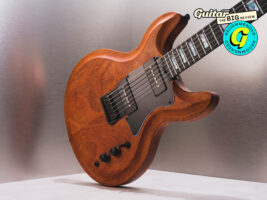
Klang Guitars DC review: an aluminium neck guitar for the masses?
£1,045, klangguitars.com
The niche of aluminium-necked electric guitars has long since diverged from the handful of classic rock players who picked up a Kramer or Travis Bean at some point. Now it has its own mythology, a discrete pantheon of players ruling over a much heavier tonal landscape. In 2026 the aluminium universe most often sounds like noise rock and doom metal, plus all of the weird, heavy, downtuned shit that exists in the space between those two pillars: the sparking electrical cable of Sunn O))) strung between Shellac and the Melvins. Klang, a new arrival on the aluminium-necked scene, is acutely aware of this fact, and today I’m taking a look at one of its first guitars.
READ MORE: Fender Made In Japan Traditional 60s Jazzmaster review: “this visually polarising guitar is anything but traditional”
As I write this review, it feels appropriate that Neurosis have just announced their surprise return, fronted by new member Aaron Turner of ISIS, Sumac and Old Man Gloom. Combined, Turner and Neurosis’ heady, post-everything sludge metal is a pretty good indicator of where a lot of modern aluminium fans’ heads are at: there are exceptions, but guitars and necks from modern aluminium brands such as Robot Graves, TTTides, Obstructures, DNG and, of course, Electrical Guitar Company (also the modern inheritor of Travis Bean’s designs) are much more commonly found in the hands of musicians drawing on some strain of weird, noisy, heavy stuff.
So this is the world that Klang is launching into, and it’s absolutely not shying away from this influence. Its website mentions both Shellac and The Jesus Lizard as inspirations for starting the project, not that you need it to, given the brand name – Klang is pretty good onomatopoeia for the signature sounds of Steve Albini and Duane Denison, both players who leaned into aluminium’s angular, clanking character and crafted tones resembling plastic bags of broken toasters being thrown down concrete staircases. So Klang is very much a brand rooted in the “culture” of aluminium, as much as you can define such a thing.
Image: Adam Gasson
Who are Klang Guitars anyway?
Klang announced its launch last summer, with a fairly unique business model. It’s a UK-based company, with manufacturing outsourced to China – necks are machined and anodised at a third-party facility, before being assembled into full guitars in Klang’s own luthier’s workshop, then imported. Production runs are small – you sign up for a slot ahead of time, and join a run with the guitar of your choice. The streamlined model means, all going well, a wait time of two to three months for your instrument.
That’s lightning-fast for the world of niche custom stuff like this. The other result of the approach is the price, which starts at a rather affordable £990 for a full guitar. To put things in perspective, before aluminium-neck specialist Baguley Guitars shut down, its bolt-on necks alone were in the €650-750 range, with the full guitars running into in the multiple thousands – and even with those prices the operation shuttered in 2024 due to financial insolvency.
US luthier Electrical Guitar Company is perhaps the biggest boutique name in modern aluminium guitars. Their full instruments also cost around three grand, while bolt-on necks from EGC and other USA aluminium makers tend to stay in that $750 range. And so Klang’s prices are affordable for semi-custom full guitars in general, let alone aluminium ones.
The price of the guitars and the bespoke import model Klang is offering has led to a mix of excitement and trepidation from aluminium guitar communities. On paper, this sort of hybrid model can be extremely effective – import guitars have only gotten better and better over the last decade or so, and Klang’s founder, Will, seems to know both his audience and the business. However, the guitar is a fraction of the price you might expect to pay – so can it be too good to be true?
Image: Adam Gasson
Klang Guitars DC – what is it?
If my review guitar is anything to go by, Klang’s model works. It’s not a totally perfect thing, but it’s a damn good instrument for the money, aluminium or not, and it’s got a load of really interesting things going on that I’ll get into now.
Klang’s guitars are semi-through-necks, taking a similar approach to some of the vintage Travis Bean instruments. The aluminium continues from the neck into a block that the pickups get mounted to. It then returns to the surface of the body to become the bridge, so it’s all one piece along the string length. The wooden portion of the body then sits around this assembly, sandwiched in place with an aluminium plate. This means that the available body shapes (the DC and JM) are the same guitar from string to nut – it’s just the wooden portion that’s changed out.
This is very cool to see for around a grand – the fact that the entire string length is supported by the same solid block of metal is for some, kind of the point of using aluminium in the first place – rather than bolting an aluminium neck to a bunch of soft wood.
Another unexpected thing about the Klang is the presence of a truss rod. For some, this was a bit of an eyebrow-raiser when Klang arrived on the scene – a lot of other aluminium necks don’t have truss rods because, well, they essentially are truss rods – relief is just set by ensuring you’re using the right string gauge to provide enough tension when you inevitably tune down to drop A.
My Klang arrives with a set of 12s on it, wound G included (another indication the brand knows its target audience – I was keen to tune it down to C standard anyway), and so as I get it tuned up, I do find that it could do with a little more relief in the neck. I give the heel-access rod a tentative quarter-turn, which does the job just fine.
This flexibility is not a luxury I have with my other aluminium necks, with which I just use thick enough strings to keep the neck in relief with my chosen tuning. If you happen to like a particularly stiff or loose playing feel, a truss-rodless neck’s preferred tension might not accommodate that – but with the Klang, you’ve got more flexibility in that regard.
The look of the Klang DC has a no-nonsense, minimal character to it – the aluminium is anodised satin black by default, and the body is stained mahogany. Since the first run, Klang has moved to a model that offers a ‘pro’ spec, with a polished chrome finish for the aluminium and a nitro finish on the body, while the ‘standard’ keeps the combo of dark wood and anodised black.
The headstock design is modern and angular as opposed to rounded and vintage – I want to call particular attention to its use of its negative space to draw an exclamation mark, a very neat piece of branding that distinguishes it from the otherwise similarly quadrilateral Electrical Guitar Company headstock.
The body design is a little more of an explicit nod to that of the Travis Bean 1000/1000A’s, although a deep German carve does reintroduce some pointiness to the cutaway horns.
Image: Adam Gasson
Klang Guitars DC – build quality
While its overall look is perhaps a result of the more affordable price-point – compared to something with a by-default mirror-polish and curly koa top – I think that it’s a really effective presentation, one very much suited for the modern aluminium world. It’s by no means an aggressive thing, it’s hardly a Jackson Warrior, but for me it’s at home within the styles of noise-rock and metal mentioned in this review’s introduction: raw, dark, industrial and heavy.
One thing I do want to note that might be divisive – the body’s stained-wood finish was starting to show pick wear after just a couple of weeks of me playing the guitar for review purposes. If you gigged this thing hard, it’d likely show pretty noticeable pick wear, buckle rash and other aesthetic dings fairly easily – this may be a positive, as, hey, easy relicing that’s authentically done by you – or you might prefer a guitar that shows a bit more aesthetic resilience.
Image: Adam Gasson
Klang Guitars DC – playability
Aluminium guitars have a reputation for shoulder-pulverising weight – and the Klang DC is no exception. Despite not being the largest instrument in the world, the DC still tips the scales at a whopping 9.8lbs – or ‘right at the heavier end of a Les Paul’s territory if you’re looking for a comparison.
This means you’ll certainly feel it in your back and shoulders after long playing sessions – but if you’re looking for a featherweight instrument, I probably don’t need to tell you that a guitar mostly made out of metal might be one to swerve.
Given the mass of the neck, aluminium guitars also have a rep for neck dive, but despite its considerable weight, the DC is an impressively well-balanced instrument. The heft of the body keeps things firmly in a good playing position when stood up, and the relatively small headstock and the amount of metal south of the heel seem to help in this regard.
Beyond the balance, the guitar is a generally enjoyable thing to hold and use – the deep German carve is also remarkably comfortable on the forearm, and the integrated bridge design features a smooth ramp to the walls either side of the saddles for a pretty nice experience on the side of your palm.
But put the Klang on, and the first thing you’re likely to notice isn’t anything to do with the weight or the forearm comfort – it’s the totally unique neck profile. The neck is incredibly thin, basically the same slim C-profile all the way from the first to the 22nd fret, with an unbelievable amount of access to the higher frets thanks to the deep cutaways and the lack of a neck joint.
It will likely not be a neck for everyone – if you like a baseball-bat-thick profile to reassuringly fill your palm, you’ll probably find it distractingly thin. As it stands, I really enjoy it, and the satin feel of the anodisation also makes moving about it comfortable.
You could, if you wanted to, set it up to be a shreddy thing for big silly bends and 200bpm sweep picking. For my low-and-slow purposes, however, I still find it a comfy and inviting experience. The stainless steel frets are also well-dressed and very smooth – and, in my view, essential for an aluminium guitar – this will not really be a standard refret job if it ever comes to that, so it’s best give the guitar as long a life as possible before you need to cross that particular bridge.
Image: Adam Gasson
Klang Guitars DC – playability
Klang’s instruments are by default loaded with P-90 pickups – or, P-90-sized humbuckers if you opt for them. This presumably keeps all of the body machining and mounting hardware interchangeable, and if down the line you want to swap out pickups, the standard soapbar P-90 format offers you a lot of choice for single-coils, noiseless pickups and humbuckers alike.
The inclusion of P-90s, in my view, does gel well with the overall vibe of the thing – it perhaps pushes it a little more towards noise rock than doom metal (to return to that arbitrary spectrum), but it’s still more than capable of both. In fact, the P-90’s incredibly bright character plus the inherent clang (there it is!) of the guitar leads to an articulate and responsive playing experience – even through a woolly Big Muff and a doomed-out Orange. Their hefty upper-mids do a great job of ensuring the sound remains cutting and present even with more extreme gain settings, like an always-on Rangemaster.
And, yes, I do my due diligence and play this thing through a Harmonic Percolator-style fuzz – and it’s a fantastic time, as you’d expect. With a vintage and weird fuzz like this, and other more sensitive fuzzes, the P-90s really make them come alive.
With that said, I would have perhaps liked to have seen at least the option for traditional wide-range-style humbuckers from the off – for me, wide-range humbuckers are the pairing with the bright sound of an aluminium neck, but I can see why the choice was made.
One quick sidebar on the wiring – this is some of the coolest and neatest wiring I’ve seen in a guitar of this budget. There’s a transparent window to view it through, and I can see why – the harness is all 90-degree angles, cloth-covered wire, full-sized pots and Mojo caps.
Image: Adam Gasson
Not perfect
There are some inevitable compromises dotted throughout my otherwise pretty faultless experience with the Klang DC. There are a couple slight fit-and-finish issues – one of the 12th-fret side dots, for instance, is drilled to a different depth to the rest of the dots. This is fixable, however, as the side-dots are in fact hex-head grub screws, so all I need to do is back it out a little with a very small allen key. Less fixable are the few spots where the anodisation hasn’t quite caught, leading to some marks that kind of look like fingerprints, but are in fact just there.
More notably there’s also a bit of a wobble in the transition from the fretboard to neck in the first position. Klang tells me this was actually a problem with the CAD files for the first five guitars made, mine included – everyone who got one of these first instruments was offered a replacement neck without the wobble, and the issue has now been fixed for future necks. Given the machining accuracy of the rest of the guitar, it makes sense for it to be a CAD problem rather than some failure in the actual process of milling the aluminium – it’s a little less than ideal, but after a while my thumb gets used to it – and I’m glad to see that the affected customers had the chance to make it right.
One more teething problem – my review guitar exhibited a strange issue where something within the assembly was grounding the hot lead of the neck pickup. After I took the pickup in and out of its cover a couple of times this issue went away. This was apparently unique to our unit, and given Klang’s response to the neck issue I’d presume a customer who had this happen would get a similar recourse – but it’s worth noting nonetheless.
Image: Adam Gasson
Should I buy a Klang?
Realistically, if you’ve been aluminium-curious for a while but put off by the high cost of entry, I’d say that a Klang is absolutely a great starting point. My sticking points with the guitar are some teething problems with the process that seem to have already been worked out. And even taking them on board, the guitar you get for around £1,000 is pretty damn remarkable. I also want to mention the fact that it comes with a near-bulletproof ABS hardcase with a custom foam route for another £60 – again, that’d be remarkable for an all-wood guitar!
My colleague Sam took a look at Rabea Massaad’s new affordable signature guitar recently – the £1,000 Sterling By Music Man Artist Series Sabre. I was reminded of what he had to say when I was reviewing the Klang. The Sabre, he said, was by no means bad – it just had nothing to really set it apart from anything of a similar price or vibe.
Point being – £1,000 is very easy to spend on a fairly pedestrian guitar these days, but the Klang DC is as far from pedestrian as you can get – it’s perhaps not to everyone’s tastes, sure, but it’s a well-executed guitar that really understands the needs of its target audience. And you can’t really ask for much more than that.
Image: Adam Gasson
Klang Guitars DC – alternatives
The Klang concept pretty much stands alone in terms of affordability and accessibility when it comes to aluminium-necked instruments. The aforementioned Electrical Guitar Company made good enough Travis Bean-alikes that the late great Steve Albini was happy to use them, and their similarly vibed EGC100A will set you back $3,250. If you just want the look of a Bean guitar without any of the aluminium stuff for some reason, then Eastwood’s ETB500 ($1,499) has the cut-out headstock thing, but on a conventional all-wood electric – albeit with a silver-sprayed peghead!
The post Klang Guitars DC review: an aluminium neck guitar for the masses? appeared first on Guitar.com | All Things Guitar.
Source: www.guitar-bass.net