Meet the little-known boutique builder who makes the secret weapons behind some of metal’s most brutal guitar tones
Sometimes, Michael W. Klein is tagged in posts filled with horrifying noises. They’ve been shared online by musicians fighting to contain the fury and chaos of his Oni pedal, a high-gain collaboration with God’s Hate and Twitching Tongues guitarist Taylor Young that’s capable of peeling skin from skulls. “I’m like a proud father watching their kid round the bases,” Klein says with a laugh when he brings up the videos. “God, that thing is nasty.”
READ MORE: Why Tosin Abasi created the wildest nylon-string guitar ever: the Stage 7
If he wanted to, Klein could field a whole baseball team of bench-clearing brawlers, having spent the past decade building a rep as an amp and pedal maker of particular renown among artists whose tastes run to these kinds of extremes. Alongside Young, also an in-demand producer whose Los Angeles-headquartered studio The Pit has become a hub for musicians seeking grimy, mosh-forward textures, his champions include Sammy Duet, of Goatwhore and sludge-metal comeback kids Acid Bath, Matt Harvey, main man of San Jose death metal veterans Exhumed, and thrash titan Gary Holt, who riffs in both Slayer and Exodus.
Sitting in his basement workshop as we talk over Zoom, Klein wears a cream Eyehategod shirt while surrounded by boxes of stuff – miscellaneous tools, screws, cables, stuff – that he’ll put to work in pursuit of noises that would terrify the average person on the street. “I hate to use the word craftsmanship,” he says, trailing off. But, in fairness, what other word is there? Klein’s approach is a fascinating marriage of creativity, technology and old-school trial and error – he will do the scut work of populating a circuit board by hand while contemplating what it means to devote love and care to something so outwardly confrontational.
“I’ve spoken with Taylor, Sammy, Matt about this – it’s almost like those guys and myself are philosophically grounded and driven,” he says. “As a fan of heavy music I tend to gravitate towards music that feels that way as I’m experiencing it. I’m into builders who are that way, too, like Dean Costello. When you hear his amps, and you see how he builds them, it’s so clear that there’s deeper meaning behind it. I’ve been fortunate that other nerds see that in my stuff.”
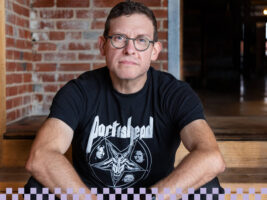
Michael W. Klein. Image: Kelly Powell, Elements Brand Haus
Don’t Quit Your Day Job
Klein is fully aware that he is never going to be a unit-shifter of any real note, and equally steadfast in his desire not to be. Based in Kansas City, he has a full-time job that he has no intention of quitting and his equipment is produced in small runs that are pored over in his spare time, reflecting a passion that has been there since he was a teenager studying the chugs on Metallica records. “A friend I used to jam with would tease me about how I spent more time trying to get my guitar rig to sound like [Sepultura’s] Chaos A.D. than playing together,” Klein recalls.
At the same time, the vibrant messageboard scene of the early internet opened doors in terms of starter-pack electronics knowledge and records that pushed his metal fandom towards more esoteric realms. When he emerged from college completely broke and minus all the gear he’d sold to buy food and other unfortunate necessities, Klein stopped short of replacing it. What if, he thought, instead of chasing gear that may or may not sound the way he wants it to, he made it himself? “It just built from there over time,” he says.
“One of the first tube amps I built was a 40-watt simplified Dumble circuit,” he continues. “I had never done anything from scratch quite like that. I remember finishing it, measuring everything, doing startup and it sounded great. That was a turning point for me. In my mind, there were so many legends about tube circuits, specific builders, and all this black magic. I realised there wasn’t anything special – if I could do it, anyone could.”
Image: Kelly Powell, Elements Brand Haus
Access All Areas
This punk commitment to accessibility is fundamental to Klein’s approach – he keeps his prices as low as possible, especially considering the labour involved, and is really only in it to help other people make the cool stuff he’s always liked. Once he realised he could do it, it was a short hop to thinking he’d like to bring some of the sounds in artists’ heads screaming into reality. A crucial moment arrived in 2015 when, following an Exhumed show, he wandered over to Harvey and offered to buy him a drink.
“I told him how much I appreciated what he does,” Klein remembers. “I was like, ‘I build guitar stuff, and if there’s anything you’d ever like to have, I would be honoured to build it.’ He had a pretty lofty idea – a preamp that had the distortion channel of an Ampeg VH-140C, a clean channel, and then built-in reverb that was assignable to either channel. At that time, I was making my circuit boards by hand, drilling every pad, etching them. That was a logistical nightmare to tackle, and it was also such a blast. That was the impetus for the word of mouth.”
Later, Klein approached Duet with a similar offer through Instagram, while Young was introduced to his work by his former Nails bandmate Leon del Muerte, who was himself introduced to Klein by Harvey, his former Exhumed bandmate. The circle, it spins. Now, having seen Klein in action, they’re all intent on hipping people to what’s going down in Missouri. “I really like working with DIY people,” Young observes. “And it doesn’t get more DIY than Michael’s ‘only-man’ operation.”
Oni pedal. Image: Kelly Powell, Elements Brand Haus
Oni Option
To make Oni, Klein was tasked with turning a “pedal chain of ridiculousness” into a box that Young estimates still gets used on 50 per cent of sessions at The Pit. “It was a combo of the original Slayer tone, an OD-1, Boss 10-band EQ and a RAT to get more grit and slime out of it,” Young says. “I floated Michael an idea for this chain as a pedal and he sprinted with it. We landed on modded versions of each pedal in one box, but each with their own individual low boost, and a switch to choose which is first in the internal chain.”
With Acid Bath playing stadiums alongside System of a Down thanks to a Crowbar-style TikTok glow up, plenty of eyes will also be resting on Klein and Duet’s Tube Screamer-esque Dybbuk pedal and their SPD100 amplifier, which both featured in Klein’s latest drop. Crucially, though, he’s not just slapping famous names onto things in order to glom some of their buzz. He’s making tools that are there to be used. “I like everything to make sense and have a purpose,” Klein says, and that extends to the process itself.
On one hand, each component finding its right place is about doing the job to the best of his ability, but on the other it’s also about how it makes him feel. “The thing I realised over time is that I was not only building and designing and modding stuff for this love of guitar tone, it was also a way of managing mental health issues,” Klein notes. “I’m dealing with depression and anxiety and suicidal thoughts, all this stuff.”
“It was a way for me to work with my hands and be creative in a way that helped quiet that stuff down, at least temporarily,” he continues. “I’m in a better place than I’ve been in a while. But that is still there. It’s crazy for me that people are interested in this thing I’ve done for myself, because I’m a hopeless nerd and because I have difficulties. If that interest suddenly stopped, I would still be down here in my shop building stuff because I need to. And, because it’s fun.”
The post Meet the little-known boutique builder who makes the secret weapons behind some of metal’s most brutal guitar tones appeared first on Guitar.com | All Things Guitar.
Source: www.guitar-bass.net