Vox AC15 Hand-Wired review – “all the things you’d hope for from a really good Vox amp”
£1,599/$1,999, voxamps.com
Aside from fellow Brit brand Marshall, there is no more iconic guitar amp manufacturer than Vox. The company that became an icon backing up the Beatles and countless artists since has the rare distinction of giving birth to a vernacular. You talk to a guitar player about “the Vox sound” and they invariably know what you’re talking about – jangly, chime-y, clear, and treble-focused – and it’s one of the staple sounds you’ll find on any modelling amp for that exact reason.
READ MORE: Lazy J x ThorpyFX The J review: “one of the best sounding, most tactile and responsive dirt pedals I’ve ever played”
Despite this almost unparalleled heritage, the Vox brand has endured a turbulent history. It had huge success in 60s, before the company cycled through a variety of owners in the 70s and 80s, ending up as part of Japanese music giant Korg in 1992.
In the last 30 years under Korg’s stewardship, the brand has undergone a period of renewal, innovation and expansion – including the hugely popular Valvetronix modelling amps, and a bunch of hugely popular Asian-made PCB versions of its classic valve amps.
For many players, however, there is nothing quite like an AC amp made using the classic point-to-point techniques that original Vox design genius Dick Denney practised when he was building the amps that powered Lennon, Harrison, May and scores of others to rock stardom. And for that, you need to look at the Hand-Wired range.
Image: Press
Vox AC15 Hand-Wired – what is it?
The Hand-Wired series is designed to replicate the original Vox amps as precisely as possible. They’ve earned a great reputation because of this, and that’s perhaps why they don’t get updated very often: it’s been 15 years since the last refresh.
But when it does tweak things a little, the results are well worth a look and listen – and so I’m checking out the refreshed AC15 here. Why the AC15, when the AC30 is of course the most iconic and beloved of all the Vox amps?
Well, here in 2026, the opportunities for many of us to blast an AC30 as designer Denney almost certainly never intended are few and far between. The AC15 offers a nice middle-ground.
It’s not nearly as back-breakingly heavy as its bigger sibling, nor as impolite in a small gig situation, but it offers a bit more clean headroom at higher volumes than the smallest amp in the Hand-Wired range, the AC10.
So what’s new with the HW this time around? Well, Vox describes these amps as a painstaking recreation of 60s-era British chime, but with modern refinements.
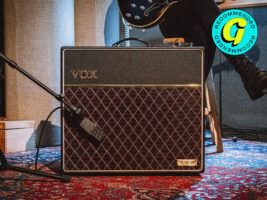
The biggest difference to the previous generation of Hand-Wired amps is the cabinet – fawn tolex–adorned amp of yore, and in its place is a cabinet that’s been meticulously recreated based on its 1963 counterpart.
The changes are not just skin deep either – the 12mm birch ply cabinet is a precise recreation of the 1963 model’s dimensions, and is designed to capture the three-dimensional feel of its vintage predecessor.
You’ll also find an era-correct copper panel on top, and like previous models, the innards are all hand-wired internal, and paired with custom-wound, vintage-aping transformers. Round the back you’ll find a single 12-inch Celestion Alnico Blue speaker (a Greenback version has also just been announced) – it’s a trusty and classic combination.
As is tradition, you’ll find two channels here. The Normal channel delivers a warm, midrange-forward voice, with a Bright switch for added top-end clarity. Then you have the iconic Top Boost channel, which gives you the more aggressive, edge-of-breakup side of the amp. Both of them are now complemented by a new tube-driven spring reverb tank.
Image: Press
Vox AC15 Hand-Wired – sounds
You know what to expect when you plug a Jazzmaster into a Vox amp – or I certainly do anyway – and running into the AC15 Hand-Wired is a familiar but no less grin-inducing experience. That clean jangle that has made so many records come alive is present and correct.
Dialling in a bit of the lovely new valve-spring reverb, and we get all the things you’d hope for from a really good Vox amp. It’s three-dimensional, articulate, and rich with midrange warmth that cuts through a mix.
Switching over to the Top Boost circuit delivers an edge-of-breakup tone that’s dirty yet sonically pleasing to the ear. It offers more grit without ever sounding muddy. But how does it react to full-on drive? Plugging in a new Strymon Fairfax, I can confirm it takes it like a champ.
The response is clear, articulate, and never feels compressed or overly sharp, while the midrange emphasis strikes a great balance between highs and lows without becoming boxy or wooden-sounding.
Arguably, where the AC15 hand-wired excels most is as a pedal platform. It sounds great by itself of course, but is a perfect clean bedrock to your NASA-sized pedalboard.
Running a Deluxe Memory Man–style delay through it is an easy reminder of why the AC15 has long been an auditory staple for players like The Edge. Further experimentation with pedals like the Microcosm by Hologram Electronics or the Lost + Found by Chase Bliss shows that the Celestion Alnico Blue is no slouch when it comes to handling the low-end, near–synth-like frequencies these pedals are more than capable of producing. It never once “flubbed out” in its low-end response.
Image: Press
Vox AC15 Hand-Wired – should I buy one?
So, is the new Hand-Wired a Mega Man X-style upgrade – one that meaningfully improves on the limitations of its predecessor? It’s an invariably subjective thing, but in my mind, you can feel and hear the improvements.
The new hand-wired series represents a bold step forward, offering a faithful recreation of one of the most historically significant amplifiers in rock ’n’ roll history. It delivers the chime, it delivers the dirt, and it noticeably improves upon the shortcomings of its predecessor.
Like most remasters, this isn’t about reinventing the wheel. But for players seeking authentic Vox chime, this is one of the best options you should consider.
Image: Press
Vox AC15 Hand-Wired – alternatives
The iconic nature of the Vox sound means that there are a wealth of rather impressive boutique versions that cost a pretty penny – specifically the Matchless Nighthawk 15 ($3,191/£2,995), Dr. Z Z Wreck Combo ($2,749) , and the Morgan Amps AC20 ($1,699). If you want the vibe without the vintage-style construction, the standard Vox AC15C1 ($999/£679) will certainly get you a lot of the way there. If you want the Vox badge but don’t mind trying a modelling option, the Vox VT100X ($679.99) is another option.
The post Vox AC15 Hand-Wired review – “all the things you’d hope for from a really good Vox amp” appeared first on Guitar.com | All Things Guitar.
Source: www.guitar-bass.net