Warm Audio Reamper review – the studio DI box to end all studio DI boxes?
$499/£431, warmaudio.com
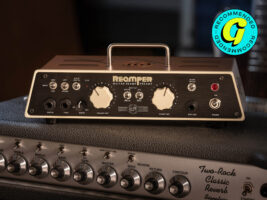
Today we’re talking about a DI box – wait, where are you going? Come back! It’s interesting, I promise! The Warm Audio Reamper is not your average black box with a couple of transformers in it. It rolls a hell of a lot of functionality into its retro-styled enclosure, being at once a reamper, a variable-impedance DI box with a switchable preamp, a 50-watt load box capable of recording a direct power-amp signal from a tube amplifier, and a studio-ready conversion solution to go between instrument and line signals with ease. So can Warm Audio make a DI box sexy?
READ MORE: Orange Outlowd ES3 review: is Ed Sheeran’s signature amp the best compact acoustic combo out there?
Image: Press
Build quality
Warm Audio has a (not uncontroversial) history of replicating other makers’ vibey hardware designs. This has, apparently, meant that it’s extremely well-poised to come up with its own in a similarly cool vein – the Reamper looks like something that you might find sitting in the corner of an RBMK control room, quietly monitoring röntgens. Its retro look is bolstered by an abundance of clicky toggle switches, and the pair of unique Bakelite-esque knobs for the line and preamp levels. It’s very pleasing to the eyes and ears – all the jacks and controls are sensibly laid out, and are clearly premium parts, emanating reassuring clicks and clunks upon use.
Another design point that’s good to see: power is delivered by a standard kettle (IEC) lead, ideal for both neatness and replaceability. The quirky design includes a handle on top of the unit, meaning it won’t slot neatly into a rack setup – but it will look extremely at home on the top of a tube head, which is one of the places you’ll want to put it anyway. It is a remarkable thing to have a DI box look anything other than purely utilitarian, and so hats off to Warm for that.
Image: Press
Usability
So, yes, this is ultimately a fancy two-way DI box that costs more than some amplifiers. Some of the price tag manifests in the above-described build quality and aesthetic beauty. The rest of it is evident in its extensive flexibility – the sheer number of actual ins and outs on the unit itself is a little overwhelming, so instead of just listing what every single jack does I’ll take you through a few use-cases that should hopefully demonstrate just how handy this thing is to have about.
First off – the titular reamping. This is done by using the line output to record a performance straight off your guitar’s pickups, with the variable impedance control ensuring the recorded signal stays bright and dynamic. The thru output lets you connect the rest of your rig as normal.
Switch a couple of cables around, and you can then send this dry audio back through amps and effects pedals to record the same performance, but with different tones. This allows you to get unique and layered sounds – but it’s also a good backup thing to have if your chosen tone doesn’t quite sit right in the mix, or anything else goes wrong. In essence – it gets you the flexibility of recording in-the-box, without having to lose the analogue joy of real, physical guitar amps.
Image: Press
In Use
The other thing this configuration allows is sending basically any other audio through pedals and amps, as the Reamper can convert a line-level signal to the instrument-level signal guitar gear is designed around. This opens up some great recording possibilities – during my testing I lose an afternoon running vocals through distortion pedals, and synths through an array of delays and reverbs.
You can also do the inverse, in a way – using the instrument input to connect a guitar to any rack gear that’s expecting a line-level signal, and then either record direct or loop the output back to the line input of the Reamper, and then use the instrument output to continue on to an amplifier. This is, of course, something you can achieve with other gear – but it’s remarkable to see it all done so extensively in just one place.
The Reamper also works with the speaker output of your tube amp. You can connect a speaker or other loadbox to the amp-thru as normal, but if you just connect a tube head, the Reamper provides its own 50-watt load to stop anything going boom. It then routes the raw power-amp signal to its line output, allowing you to load your own IRs/virtual cabinets within your DAW for manipulation at a later date.
This is a very cool thing to see and do – a sort of “re-speaker” box. It is a bit of a shame the internal load for silent recording tops out at 50 watts, though, particularly for the heavier crowd who might want to push the power tubes of a 100-watter without stripping the paint off the walls. It’s also not an attenuator – you can either run through the Reamper and pass the full power onwards to your normal speaker (or other loadbox), or use the 50-watt load for silent recording, using software monitoring to hear your amp through a virtual speaker. You can’t use it to lower the level of the signal that gets passed on to the speaker.
The resultant sound and feel is good, perhaps not quite as freakishly accurate as something like the Ox Box – however in that instance, the Reamper is actually the much more affordable option.
Image: Press
Should I buy one?
So the Reamper makes quick work of basically whatever routing trickery you might throw at it. Firstly and crucially, the sounds are all great, crackle-free and unmarred by any audible conversion losses. The optional preamp gain stage also sounds fantastic, and does a great job of adding a little life to your pure dry tone. Secondly, the actual process of reamping and/or doing any other routing is pleasing and tactile. While you might think the handled amp-top design would be annoying if you wanted to integrate it into a more permanent setup, it actually means that manipulating the Reamper as you re-route the required cables is a lot easier.
To answer the question of should you buy one – the answer is a resounding ‘probably’, unless you already have the pile of gear that the box itself replicates. Even then, having it integrated into this single package is still an undeniable quality of life improvement for home studio work. If you are a guitarist working out of a home studio with real, analogue pedals and amps – it’s more than worth its admittedly high price tag, given just how many things it can do. The dollar amount may be high, but the options-per-dollar make it far more appealing.
Alternatives
This is tricky – there aren’t really any single products that integrate quite as many routing functions as the Reamper. You could get something like the United Studio Technologies Replay Box ($299/£369) if you just wanted reamping, or explore the offerings from Two Notes and Universal Audio if you wanted the amp-loading capabilities – but to truly have an alternative, you’ll need a big pile of individual converters, preamps and loads.
The post Warm Audio Reamper review – the studio DI box to end all studio DI boxes? appeared first on Guitar.com | All Things Guitar.
Source: www.guitar-bass.net