“We can experiment, have fun and get a little wild”: Martin’s new 16 Series invites you into a colourful playground
When you picture an acoustic guitar in your head, you’re probably thinking of a Martin. America’s oldest guitar company quite literally created the standard for what we think of as an acoustic guitar when it invented the Dreadnought in 1916.
While it would take a while for the form to become the default for flat-top acoustic guitar design, its silhouette and aesthetics remain inescapable to this day – square-shouldered, wide-waisted, a natural-finished spruce top, elegantly simple paddle headstock, and of course, that iconic gold headstock logo.
The Martin 16 Series on the Guitar.com Cover. Image: Adam Gasson for Guitar.com
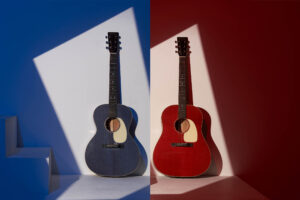
That formula has broadly held true in the 100-plus years since, besides the odd interesting diversion – the SC or Inception, for example. Which makes the new 16 Series all the more jaw-dropping. Not only is this revamped and reimagined range populated exclusively by body styles that are outside of Martin’s traditional heartland, most of them aren’t even available in a classic natural top – instead replaced with eye-grabbing colours like Cherry Cola, Blue Denim and Black Smoke.
It’s quite a bold move for a company rapidly approaching its 200th birthday – which was, in fact, part of the very reason for this pivot.
“Nomenclature is such a big deal for Martin,” explains Joey Osisek, the company’s director of product management. “When I say 15, you see a brown Martin. When I say 18, you think of a spruce/mahogany dread or 000. A 28 is spruce/rosewood, and so on. All those numbers mean something to guitar players.”
The Martin DSS-16E in Cherry Cola. Image: Adam Gasson for Guitar.com
The number 16, though, is a bit more… well… malleable. While the range has been part of the Martin catalogue since the 80s, the 16 Series has never really nailed down a strong identity. But that presented Osisek and the Martin product design team with an opportunity.
“There wasn’t ever a real consistent specification or build,” he agreed. “It changed a lot over the years. The blessing of that though is that if I make something and call it an 18 or a 28, then I have some very firm guardrails around what the guitar can be. But with a 16? We can kind of do whatever we want.”
“The 16 Series is a playground where we can experiment, have fun and get a little wild”
Shoulder To The Wheel
Doing whatever they want in this case, starts with the body shape. You’ll find no classic square-shouldered dreadnoughts in the new 16 Series, or even the more svelte charms of the 000/OM family, Martin’s ‘other’ iconic staple.
Instead, the 16 series comprises the more curvy charms of the slope-shouldered DSS and 00L you’ll see in this cover story, plus the Jumbo and the GPC (Martin’s small-bodied performance cutaway).
The first two, especially, are guitars whose silhouette that people might more closely associate with Gibson. But for those who think that Martin is simply copying a rival, it’s worth remembering that they have some history. “If you think about it, the first dreadnought was a slope shoulder 12-fret that we made for Ditson,” Osisek explains. “And that was a long, long time ago.”
The Martin 00L-16E in Blue Denim. Image: Adam Gasson for Guitar.com
The 00L is another guitar that has some history with Martin – while you don’t often see it in the line outside of the Custom Shop, it has been the basis for one of the most popular guitars designed by Martin’s former CEO (and current chairman of the board) Chris Martin IV.
“The reason that we picked that shape was because we used it on the CEO-7, which is our longest-standing CEO model – people love that guitar,” he says. “But that guitar’s got a very specific nut width, and it has an Adirondack spruce top – it’s not an inexpensive guitar, but there’s an affinity for it. So here was a chance for us to make a more obtainable option for folks.”
The DSS has been more recently seen in the Martin production range, as part of the 17 Series in its “Whisky Sunset” iteration, but again, the 16 Series gave the opportunity for some construction changes that better suits its target audience of singer-songwriters.
Image: Adam Gasson for Guitar.com
“One of the biggest differences with DSS-16 is the 24.9-inch scale length,” Osisek reveals. “It’s shorter, because a lot of feedback that we had gotten around the DSS-17 was that people who were looking for slope-shouldered dreads, the expectation was probably for a shorter scale because a lot of the folks that gravitate towards those guitars are singer-songwriters. They’re strummers, they’re banging out cowboy chords, it’s kind of that vibe.”
Another key tenet of the 16 Series was value. While these are by no means cheap instruments – nearly two-and-a-half grand is a serious investment – they represent the most affordable US-made, spruce-topped guitars that Martin makes. Bringing the barrier of entry down was important to the team.
“That was a big deal,” Osisek agrees. “And by pricing it where we were able to, it makes it an option when it might not have been an option for folks before.”
“We wanted to make sure that you’re still seeing the wood through the colour: it’s the best of both worlds”
Colour Theory
And then of course, there are the colours. For Martin to not offer most of the 16 Series in natural finish is one thing – to make the colour options a striking selection of red, white, blue and black is another altogether. But the 16 Series’ lack of identity left Martin free to simply try stuff, which the brand did with glee.
“If we were going to make a Cherry Cola D-18 or a Blue Denim D-28… I don’t know how that would go down!” Osisek chuckles. “People have such a firm opinion of what those models are, maybe we wouldn’t have had the luxury of experimenting there. But the thing that I was most proud of with the colours here is that they’re not opaque. A lot of times with painted guitars, it’s very different.
“And I love Johnny Cash; I still have a soft spot for a shiny black dreadnought. But I love that here they’re not that. Sometimes I think people are concerned that when you paint a top, maybe the manufacturer is trying to hide a lower grade, aesthetically, of spruce. But that’s not the case, it’s good Sitka! And so we wanted to make sure that you’re still seeing the wood through the colour – it offers the best of both worlds.”
Image: Adam Gasson for Guitar.com
Those who have been paying attention to the festival and stadium stages around the world over the last few years will also have noticed that painted-top guitars are having something of a moment. From Taylor Swift to Noah Kahan to Olivia Rodrigo and Phoebe Bridgers, the world’s biggest guitar artists are embracing acoustics that have a bit more of an individual aesthetic.
“I wish I could tell you that the decision on the coloured tops was that calculated!” Osisek responds. “It was just an opportunity for us to offer the players something unique from us that stands out. If you want that classic Martin tone and playability, reliability – all those things – but you wanted something that popped more, we can create an option for that player.”
Artists, it seems, are already becoming beguiled by the unique charms of the 16 Series. A host of diverse, contemporary artists – including British guitarist Jake Bugg, Grammy-winning songwriter Brandy Clark and Canadian country star Tenille Townes – took the stage at a glitzy launch event in Nashville earlier this year. For Osisek, the sweetest validation came from one artist in particular.
“At our launch event in Nashville, [Grammy-nominated Music Row legend] Jim Lauderdale must have spent 20 minutes just talking about each of the guitars and how he would love to take them on the road,” he enthuses. “And what we’re seeing also is that… I don’t want to say the younger artists are gravitating to the fashion aspect of it but, you know, they pop! And to pair that with someone like Jim Lauderdale getting excited about them, that feels like a huge win. We’re having our cake and eating it too!”
“Guitars are like paintbrushes: you shouldn’t own just one! Because they all do something different”
Cultured Palette
If the 16 Series proves anything, it’s that in 2026 the classic shapes and designs shouldn’t restrict the idea of what a Martin guitar is and can be – and the spirit and the DNA of a Martin should never be lost.
“It’s really hard to be all things to everyone in terms of what product you’re offering,” Osisek agrees. “But we’re at a point right now where, I think I’d have a hard time not being able to find you at least one Martin that you could fall in love with. And we’re really proud that the 16 Series is the latest part of that.”
And what about the Martin die-hards who might look at the 16 Series and can’t quite decide if they love or hate it? Well… there are no plans to stop making D-18s or 000-28s any time soon, and in fact, these guitars are just giving Martin fans an even bigger palette of sound and visuals to lean into.
Image: Adam Gasson for Guitar.com
“I always think guitars are like paintbrushes: you shouldn’t own just one!” Osisek says. “And you shouldn’t own just one acoustic guitar – you should own a couple. You need something that’s rosewood. You need something that’s mahogany. You should have a big box. You should have a small box. I know I’m blessed to work here, but I can’t see a reality where I ever own less than four acoustic guitars: because they all do something so drastically different.”
Different, it seems, is certainly the order of the day. After decades of the 16 Series lacking a strong identity, Martin has finally nailed down something that the company can run with long-term – and have fun with along the way.
“For us going forward, the 16s are a playground,” Osisek concludes. “If we want to experiment with colours or different body shapes, and we want to build it here in Nazareth, it doesn’t necessarily make sense to do that in the Standard series. But the 16s are where we can do those experiments, have fun, and get a little wild.”
The new Martin 16 Series is out now.
Words: Josh Gardner
Photography: Adam Gasson
The post “We can experiment, have fun and get a little wild”: Martin’s new 16 Series invites you into a colourful playground appeared first on Guitar.com | All Things Guitar.
Source: www.guitar-bass.net