What does it mean when your guitar’s pickup is “out of phase”? It’s not magic, it’s science…
Every few months, somebody shows up on a guitar forum absolutely convinced that Peter Green’s mythical guitar tone on those early Fleetwood Mac records came from some sort of magical property imbued into the pickups of his Les Paul.
READ MORE: This is how your guitar’s truss rod actually works – and here’s what you’re doing wrong with it
To hear them tell it, you’d be forgiven for thinking that the thing was wound by druids of blessed by a particularly divine roadie (shoutout to Fleetwood Mac tech Kevin Duggan – one of the best to ever do it!). All of this comes from the fact that, famously, Green’s Les Paul neck pickup was ‘out of phase’ – but what does that really mean?
In truth, out of phase is one of the most misunderstood terms in all of guitar, and it’s really not complicated…
Image: Adam Gasson
Phasing? What is it?
First thing: if your guitar has one pickup, you can stop reading. Phase doesn’t concern you. It only becomes relevant when two pickups are running simultaneously, because now you have two separate signals sensing the same string from two different physical locations – and those signals need to agree on which direction is “up”.
When they do, everything sounds normal and full. When they don’t, frequencies start canceling each other out, and you get that thin, nasal, hollow tone that sounds like your guitar is being played through a very indecisive wah pedal.
Now here’s where people consistently confuse themselves: polarity and phase are not the same thing. Polarity is magnetic – north or south. Phase, in practical wiring terms, is about the electrical relationship between two pickups when combined.
Both the magnet orientation and the coil wind direction factor into this. For two pickups to stay in phase, those two things need to match correctly – either both the same, or both opposite. Change only one of them, and you’ve got an out-of-phase situation.
This is exactly why a Stratocaster’s middle pickup is reverse-wound and reverse-polarity. That’s not an accident or an anomaly – Fender did that deliberately so positions 2 and 4 stay in phase and cancel hum at the same time. Reverse-wound, reverse-polarity does not mean out of phase. It’s actually the opposite: it’s the elegant solution that keeps everything playing nicely together.
Out of phase sounds quieter, thinner, and scooped in the low end, with an almost filtered quality in the upper mids. Depending on your perspective, it sounds either broken or brilliant.
If you’re wondering if you have an out-of-phase issue, the best test is to check and see if both of your pickups function properly on their own, but when they are both played at the same time, the sound gets thin. If that’s the case, that’s most likely a phase issue.
Image: Adam Gasson
How do you get an out-of-phase pickup?
That is also why simply rotating a humbucker in a Les Paul does not automatically cause the effect. Turning the pickup around changes its physical position, but it does not necessarily change the internal relationship that determines phase.
To actually throw a pickup out of phase, you usually have to change its wiring relationship to the other pickup or change its magnetic polarity relative to it. That is the real distinction: phase is not about what direction the pickup is facing in the body. It is about whether the two signals still agree when they are combined.
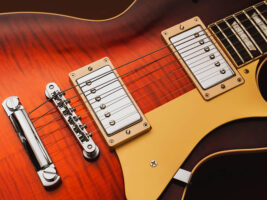
Which brings us back to Peter Green. Greeny’s famous middle-position tone is generally understood to come from the neck pickup’s reversed magnetic polarity (someone flipped the magnet), which puts the two humbuckers magnetically out of phase when combined- so when both pickups were selected together, the signal partially canceled and produced that distinctive hollow, vocal quality.
The individual pickups still sounded perfectly normal on their own. It was the combination that created the effect. That’s the whole trick. There is no magic. There is no secret winding. What likely happened, is that someone flipped a magnet, found out it sounded incredible, and the rest of us have been chasing it for fifty years.
The practical takeaway is simple: whenever you’re mixing pickups from different manufacturers, swapping a neck for a middle, or doing any kind of wiring experiment, phase is the first thing to check. It’s the difference between a great-sounding mod and a guitar that sounds like it’s arguing with itself – and losing. That being said, some like the sound of an out of phase pickup, so its all a matter of taste.
Fans of the out-of-phase sound often point to the “vocal” properties of that sound. Again, this isn’t any sort of divine phenomenon… it’s just physics. Two pickups do not hear the string from the same spot, so they are never producing perfectly identical information.
Some frequencies cancel more than others, which is why players hear that nasal, comb-filtered quality rather than total dropout. Some artists will use a circuit to filter out frequencies on the low end of the tonal spectrum. One good reason to do this is to allow the guitar to sit in its own lane better in a mix and not muddy up the bass and drum territory.
Image: Adam Gasson
When is a pickup NOT out of phase?
The Fender Jaguar is a good example of how people misuse “out of phase” as a catch-all term for any guitar sound that gets thinner or sharper. The Jaguar’s so-called strangle switch is not a phase switch at all.
It engages a capacitor that cuts low end, which makes the guitar sound brighter, leaner, and more cutting. That can resemble some of the tonal traits people associate with out-of-phase wiring, but the mechanism is completely different. Nothing is being phase-canceled between pickups there – the circuit is just filtering bass out of the signal.
Remember, “out of phase” is not shorthand for “weird, thin, or old-school.” It describes a specific relationship between two combined pickup signals. I would never discourage anyone from experimenting with polarity, or any other properties with tonal implications, for that matter.
You never know, you might run across a sound that works for you or the music you want to make. Don’t let anyone trick you into thinking that you have to sound like Peter Green – you don’t. Just follow your own ears. Hopefully, understanding the term phase a bit better will help you to get the sounds that you want out of your instruments.
The post What does it mean when your guitar’s pickup is “out of phase”? It’s not magic, it’s science… appeared first on Guitar.com | All Things Guitar.
Source: www.guitar-bass.net