What is a PLEK machine anyway? And can it really make your guitar play and feel better?
Chances are if you’ve bought a new guitar over the last few years, you might have read something about a “PLEK” machine and how (usually for a small fee) your shiny new instrument can be run through this process.
READ MORE: Does tonewood really matter? This is how the wood your guitar’s made of affects the sound
But what actually is it? Often, I see people who just ticked ‘yes’ without really understanding what it was – no harm in that of course, but it’s always worth knowing what something is before you entrust your new guitar to it!
In simple terms PLEK is a computer-controlled fret-processing system that scans a guitar neck, builds a detailed digital model of its geometry, and machines the frets to a target setup specified by the operator. In this article we’ll discuss what a PLEK actually does and whether it’s worth the money.
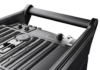
Image: Press
So what does a PLEK machine do anyway?
The PLEK was developed in Germany in the 1980s. The machines are built by A+D Gitarrentechnologie in Berlin, and the technology traces back to musician Gerd Anke and his partner Michael Dubach, according to Gibson’s own writeup of the process.
At its core it’s a CNC system (similar to the machines that often do a lot of the cutting work in modern guitar factories) bolted to a very smart scanner. The scanner maps the geometry of the neck and frets in microscopic detail, then uses a rotary cutter to remove only the material needed to hit the exact fret profile the operator has dialed in.
It scans under string tension, real or simulated, so it reads the neck the way it behaves when you’re actually playing rather than the way it sits flat on a bench with the strings off. That’s straight from PLEK’s product documentation.
Martin Guitars drops the finished guitar into a string tension simulator that makes the neck and truss rod react as if it’s strung to pitch before the scan even begins. This is in contrast to how I do it in my shop, which is to, essentially, take the strings off, get the fret leveler out and, guestimate.
The machine scans first, registering thousands of points to build a digital picture of fret heights, neck relief, and the surface of the fingerboard under each string. The software then runs what PLEK calls a Virtual Fret Dress, a simulation that shows which frets are high, which are low, how much material has to come off to kill any buzz, and what the neck will look like once the work is done.
A properly equipped machine will level and crown frets, plane a fingerboard, cut nut slots to precise depths, and handle saddle and bridge slotting on top of that. I visited the Gibson factory a few years ago and their version flags whether the truss rod needs a tweak before the process starts, then factors in string gauge, scale length, and neck curve when it cuts the nut.
Can a PLEK machine replace a guitar tech?
There’s a popular assumption that this replaces a luthier or tech – it doesn’t. It doesn’t decide anything about how your guitar should feel. A person sets the target action, the relief, the nut height, the fall-away on the upper frets, and whether the frets even need touching in the first place.
PLEK says as much in their own marketing – the machine can’t stand in for the judgment and hands of the person running it. Gibson, which runs all of its USA and Custom Shop lines through one along their journey to quality control, admits the cutter leaves machining marks that still need hand finishing to reach their standard. In short, a PLEK is a tool, and just like any other tool, it’s only as good as the person running it.
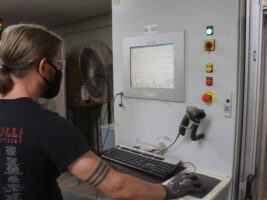
Image: Press
What can a PLEK machine do and not do?
The PLEK handles uneven frets, buzz from high or low spots, worn frets that still have enough meat left to level, sloppy factory fretwork, and precision refrets well. That’s the lane it lives in. But if the neck is badly warped or twisted, the frets are worn down too far, the truss rod is dead, the frets are loose in their slots, or the scale length is off, the machine can’t rescue any of that.
A factory-PLEK’d guitar isn’t automatically dialed in, either. Gibson, Martin, Taylor, and plenty of boutique builders run PLEK on the line, and it does raise the floor on consistency. But a factory sets a guitar up to a general spec, and that spec has no idea about your string guage, tuning, playing style, or how you prefer your guitar to be set up. The idea that a factory PLEK means you’ll never need another setup is simply wrong.
How much does a PLEK cost, and is it worth it?
A PLEK fret level and setup usually runs a couple hundred bucks, with most US shops landing in the $250 to $350 range. In Europe, it tends to be slightly cheaper there, depending on the shop – Thomann charges about £190 for a basic level and setup.
A fret level, crown, and polish from a tech typically costs between $100 and $250, depending on your location, instrument, and the tech. A tech can also do spot leveling if you only have a fret or two that’s bad and that’s usually only $25 a fret or so. In any case, stainless steel frets usually result in an upcharge of some sort because it’s a harder material to work with.
My advice to any customer is to spend the money if the guitar needs fret leveling anyway, if they’re already paying for a refret, if it’s an expensive instrument, or if they want unusually low action without buzz.
I’d tell them to skip it if the guitar just needs a standard setup, the frets are already level, or it’s a cheap beater where the service costs more than the guitar is worth. The rougher the fretwork going in, the bigger the improvement coming out.
The biggest misconception is that a PLEK somehow transforms an average guitar into a miracle instrument. It doesn’t. A great PLEK job simply removes mechanical limitations that were already there – so be aware and you know what you’re getting into!
The post What is a PLEK machine anyway? And can it really make your guitar play and feel better? appeared first on Guitar.com | All Things Guitar.
Source: www.guitar-bass.net