What’s the point of your guitar’s vibrato system anyway?
When you first learn to play guitar, you learn that you can bend fretted notes using your fingers to create a vibrato effect. At some point, the guitar industry introduced mechanical vibrato systems to aid in creating this effect. So, what’s the point of creating vibrato through mechanical means rather than using the most precious tool at a guitarist’s disposal – the fingers?
READ MORE: How strings, tension, tuning and intonation really effect your guitar’s tone
Players did not start wanting vibrato systems because their hands were incapable of adding expression. Finger vibrato, string bends, and blues inflection all existed long before anyone bolted a moving tailpiece or bridge onto a guitar. But, as anyone will tell you, a vibrato unit lets you move all the strings at once. That means chords, open strings, drones, and sustained intervals can all shift together in a way your fretting hand cannot really duplicate. But, bridge vibrato was never just a substitute for good fretting-hand technique. It was a different effect.
The basic idea showed up early. Clayton “Doc” Kauffman filed a patent application in 1929 for a device that would produce what the patent called “tremolo effects” (*wrong!) by mechanically changing string tension. What most players call a “tremolo arm” is really a vibrato system. Tremolo is fluctuation in volume. Vibrato is fluctuation in pitch.
Leo Fender helped cement the confusion by calling the Stratocaster’s bridge a “synchronized tremolo” in the 1950s, even though the mechanism changes string tension and therefore pitch. Fender itself now acknowledges the mix-up. The terminology was off, but the purpose was clear: create pitch movement by moving the string anchor point instead of manipulating the strings directly with the fretting hand.
Image: Adam Gasson
It’s About Doing Something More
That is the real beginning of the whole thing. Not “how do we replace finger vibrato?” but “how do we make the guitar do something a hand alone cannot do?” A fretting hand can make one note wobble. It can bend a string upward, maybe grab a double-stop if the setup and your fingers cooperate, and it can fake a little movement inside a chord if you are careful. What it generally cannot do is take a fully voiced chord and move the whole structure sharp and flat in one smooth gesture while keeping the intervals intact. It cannot easily do that while letting open strings ring either. In theory a vibrato system can. Now, there are some issues with a lot of vibrato systems in how they do that but for now, lets just say, that’s the goal.
It gave players a way to treat pitch as a property of the whole instrument, not just one note at a time.
Big Thinking
Bigsby is a good place to stop for a second, because it shows what players were after before the whammy bar became associated with dive-bombs and acrobatics. Paul Bigsby’s design, developed in the late 1940s and early 1950s, is generally treated as the first commercially successful vibrato system.
It did not give players some huge pitch range. That was not the point. It was smooth, musical, and particularly good for adding motion to held chords on hollow and semi-hollow instruments. Bigsby’s own history emphasizes that role, and players strongly associated with the unit have tended to use it the same way.
Then came Fender’s approach, which changed the feel of the instrument more dramatically. Leo Fender’s Stratocaster unit, patented in the 1950s, integrated the bridge and vibrato mechanism into one spring-balanced system. That design made the bridge itself part of the performance.
A vibrato system works by balancing string tension against spring tension. When the player moves the arm, that balance is disturbed, and when the arm is released the system is supposed to return to its neutral resting point. In practice, that depends on the strings moving freely across the nut, saddles, and other contact points. Guitar techs work very hard to make sure that vibrato systems are properly lubricated and balanced because if they’re not, it’s going to create issues.
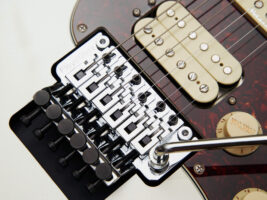
Different systems make different compromises. A Bigsby usually gives you limited range but a particular feel and look that players still love. A vintage Strat-style unit can be expressive and touch-sensitive, but it lives and dies on setup. Fender’s offset vibrato system, used on models like the Jazzmaster, approached the same problem from another angle and developed its own following because the feel is softer and less abrupt than a Strat unit. Then later locking systems, most famously Floyd Rose, attacked the stability problem more aggressively by locking the strings at the nut and bridge so more extreme pitch movement could happen without the guitar going out of tune.
Image: Adam Gasson
Benefits and Compromises
Each vibrato system has its pros and cons. For example, often times with systems like the Floyd Rose, Fender Floating Bridge, and Bigsby, is that all the strings get stretched at different rates because they are all being bent the same amount but each string is under different tension and stretched differently. So using the bridge vibrato, the chord wont be perfectly in tune as you bend.
Ned Steinberger is one of the most brilliant minds in instrument design, and he’s still challenging things we thought we knew about the mechanics of an instrument. He came up with the TransTrem, which later inspired the Washburn Wonderbar and the EverTune Bridge.
But for each system’s pros and cons, people still opt to use them because they are expressive and frankly, a lot of fun to play with. Divebombing a Floyd Rose creates a trainwreck of imperfect sounds, but it’s fun to do, and sometimes it’s the effect that fits best in the music you’re making.
So when you buy a guitar with a vibrato system, what are you really buying? Not convenience. Certainly not simplicity. If simplicity were the goal, fixed bridges would have won the whole argument and ended it decades ago. So, no matter what vibrato system you choose to buy, you’re buying a feature that isn’t perfect, but it is fun to use, and isn’t that the whole point of playing guitar anyway?
The post What’s the point of your guitar’s vibrato system anyway? appeared first on Guitar.com | All Things Guitar.
Source: www.guitar-bass.net