Gretsch Electromatic CVT Baritone review – long-scale downtuned heaviness from Gretsch hits the mark
A while ago I spoke to Gretsch EVP Jason Barnes about the revival of the Corvette, and, being the consummate professional that I am, I only let my personal musical tastes inform the direction of the interview towards the end of the chat. I mentioned that the double-cut, darkly-finished, and dual-humbucker’d Electromatic CVT seemed in part tailor-made for those who listen to a lot more Loathe and/or Electric Wizard than they do Bleachers and Taylor Swift, and Barnes was more than receptive. Despite Gretsch’s heritage skewing towards jazz and rockabilly, and modern usage skewing towards rock, indie and pop, Gretsch has been keeping a keen eye on those who have adopted its guitars – particularly its longer-scale offerings – for metal.
READ MORE: From vintage oddball to alternative classic: the Gretsch CVT’s remarkable journey
And there’s a lot to keep an eye on, in that regard – a few years back the Meshuggah fans of the world took notice of the downtuning potential of Gretsch’s dual (mini) humbucker Jet Baritone, and it got swept up in a new wave of metal – that G5260 was seen in the hands of both Loathe’s Erik Bickerstaffe and Sleep Token’s IV, both very different players with different musical aesthetics, but both driving a trend for innovative and ultra low-tuned modern metal.
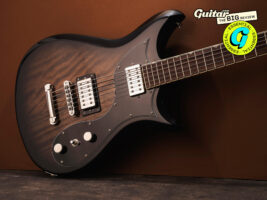
So today we’re looking at the logical conclusion of those observations: a baritone version of the Corvette, launched with a pummelling demo from Loathe’s Erik Bickerstaffe. It’s the same rather mean shape as the newly-designed CVT, with the same full-range Twin Six humbuckers – but gone is the wraparound, replaced with a standard tune-o-matic-style two-piece bridge, placed a little further back in the body to compensate for the increased scale of 27 inches.
Gretsch obviously has a long history with long-scale guitars, but the CVT isn’t really drawing much of this heritage. The Electromatic Jet Baritone, launched on the same day as this guitar, is a lot closer to a pure modern-metallification of an old-school Gretsch formula – the Baritone Jet is a single-cut 29.75” guitar, like it’s more vintage-styled forebears. That’s just 0.25” off the same bridge-to-nut distance as a Fender Bass VI, and so opens up tunings below E1 (or suspension-bridge tension when in the more standard baritone register B-B).
The new CVT Baritone, on the other hand, is 27”, which will be far less alien to those used to playing on 25.5” necks, or even 24.75”. Given that the Corvette shape has had a more sporadic, chameleonic history since its launch decades ago, there aren’t really many expectations to smash here about what it’s meant to sound like – other than those brought by the name on the headstock. So the question remains:
Image: Adam Gasson
Gretsch Electromatic CVT Baritone – what is it?
The baritone guitar has a long history outside of the heavy universe, and not every new long-scale launch is explicitly aimed at those who walk a more Iommic path. But the Baritone CVT absolutely is. Intentions and the noises made in demo videos may only matter so much, but, overall, the message sent by the guitar upon viewing it and/or its specsheet is that it’s built for metal. Downtuning is obviously a big thing across countless subgenres, but the aesthetics and specs do straddle the border between the classiness of Loathe’s whole gig and the more vintage-forward guitars of sludge and doom.
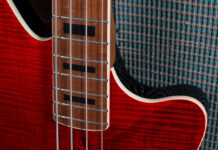
The finish is the first clue. The Baritone CVT exclusively comes in Bristol Fog – I presume that Gretsch does not mean the Bristol Fog that, on the afternoon of April 20th, rolls in all directions from Castle Park like an encroaching wall of aerosolised cannabinoids. Stoner associations aside, it’s still a dark, woodgrain-forward burst – no sparkle finishes or gold-trimmed vintage white for this launch.
The humbuckers are the next – the Twin Sixes are full-sized humbuckers, explicitly marketed as punchier and more full range than the mini-humbuckers, Broad’Trons and Filter’Trons you’ll find in many other Gretsches – these are far less likely to sound thin and underpowered through heavier gear.
The rest of the setup is essentially a minimalist dual-humbucker arrangement, with a master volume and tone. The wraparound of the standard-scale CVT is now a two-piece tune-o-matic style bridge, which is an unequivocally good change here – longer scale lengths require a lot more travel in the saddles for proper intonation, and I’ve also seen a couple of import wraparounds start to lean forward under higher tensions.
It’s been said that the CVT has more than a little Dunable Cyclops in its looks, with its two horns, long swooping pickguard and general ‘melted SG’ kind of look. The Cyclops and Dunables in general rely on a healthy amount of vintage cool being mixed in with their meaner, heavier looks – a combo that’s found particular footing in the post-, doom- and sludge-metal crowds. (A fun game at festivals like ArcTanGent is Dunable-spotting – drink every time you see one and you’ll be on the floor in no time). The Corvette shape is pretty perfect for achieving a similar visual feel, and so it’s good to see Gretsch work constructively with that aspect of the shape – metal doesn’t have to mean all pointy and satin black and glowing inverted crosses everywhere.
Image: Adam Gasson
Gretsch Electromatic CVT Baritone – usability and sounds
Can Gretsch translate its baritone heritage to something that’s deserving of the above implications? Are the noisy Loathe demo video and the Dunable comparisons earned? The answer, pleasingly, is a resounding yes – in my view, players seeking sharper, more metalcore-indebted tones and the low-and-slow doom crowd will find a lot to like here.
Let’s start on playability. The neck is not really for shred – but it is a fairly medium C, a profile Gretsch calls “performance C”. On top we’ve got a real rosewood fretboard – now pretty common again on affordable guitars, but no less good to see – with a 12” radius. The profile is a pretty middleweight one, perhaps a little evocative of the slimmer side of a bound Les Paul neck. It’s made somewhat slower by the rather sticky poly finish (nothing a scotchbrite pad and some elbow grease won’t fix), but it’s by no means an unwieldy thing. The neck joint is also pretty sculpted – no big square neck plate here – meaning that up at the dusty end (likely for dissonant stabs mid-breakdown more so than melodic showing-off) it remains very playable.
Frets here are medium jumbo. In use they are, a bit like the neck profile, fairly anonymous – neither massive nor tiny. But they play cleanly and comfortably – zero buzz or grind to be found. It’s also good that they’re not actual jumbo wire – we’ll come to further down-tuning experiments in a bit, but for now it’s worth noting that at lower tension, really tall frets can mean it’s too easy to push strings out of tune as you press down.
Despite the extra length of the neck, the balance is fantastic. Neck dive is always a worry on baritones, but not here, as Gretsch has adjusted where the bridge sits, rather than just shunting all of the mass north of the neck joint. Playing sat or stood is very comfy – this bridge placement means the fretboard presents to your left hand fairly well when sat down, and the strap button being on the horn keeps everything at a good angle when stood up. The bridge is also in a nice and natural position for your right hand – its extra distance down the body makes staying in a palm-muting position easy.
A 27” scale is pretty comfy for a baritone, requiring only a little bit of adjustment if you’re used to standard scale stuff. I also find the stock strings – 14-68s – to be ideal. They’ve got a wound third (as they should have!), and their gauge is more than heavy enough to make tension quite substantial at standard baritone B-B. Bluesy three-semitone bends are out of the question in this register unless you’ve borrowed fingers from an olympic weightlifter – but fast death metal riffs are tight, responsive joy.
Image: Adam Gasson
I also tune the guitar to where I normally hang out – drop F. This is, for a baritone less than 30” and with any strings other than Bass VI strings, quite a loose tuning – I’d say it’s similar in tension to tuning a Fender-scale instrument down to C with 11-52s. This transforms the playing experience quite a lot, from sleek, sharp and tight to loose and sludgy, but the CVT is up for the challenge: things stay relatively stable and articulate.
Importantly, at no point do I feel like strings are going to flop out of their saddles. A decent amount of neck pitch-back means there’s a lot of downward tension on the tune-o-matic-style bridge. It’s worth noting, however, that drop F is about as low as I’d take it with these strings – double drop C# would be a bit of a stretch without a much heavier gauge.
Helping with the articulation here are the Twin Six humbuckers, which work great in a heavy baritone context. Personally I find they’re voiced just right – full and deep through stacked meaty fuzzes, but still up for a bit of chugging when run into a tighter, more modern sound courtesy of the UAFX Anti.
For a cleaner tone, they’re perhaps a little boomy in full humbucker mode – but they can be split individually with push-pull pots. Their louder nature means that these tones are also quite hefty, but far better for cleans – as single-coils they more resemble P90s than they do spanky strat pickups, thanks to their strong output and midrange presence, but that’s no bad thing in my book.
The cleaner stuff may never really be the highlight or focus of a guitar like this, but the tones are by no means an afterthought – I had just as much fun making ambient and textural sounds on the CVT as I did trying to remember how to play At The Gates riffs. But for more traditional tic-tac/country baritone sounds, you might find yourself wanting a different set of pickups – the mid-forward nature of the Twin Sixes means it’s a little harder to get that spanky/scooped sound that, say, a set of Bass VI pickups do so well.
Image: Adam Gasson
Gretsch Electromatic CVT Baritone – should I buy one?
For many fans of down-tuning this will be the sort of guitar they were hoping Gretsch would release – accessibly priced, the right look, the right pickups, and a scale length that strikes a balance between playability and still being, well, a baritone. And the guitar, in my time with it, made good on all of its promises. I think the only thing I wish Gretsch did here that it didn’t would be offer a few more finishes. No shade on Bristol Fog, really, but I’m curious how the CVT would look in a version of the Jet’s Imperial Stain.
And on the topic of that guitar, it’s hard to say that Gretsch compromised on scale length here when a 29.75” alternative has also been made available for almost the same price. If you are looking to really explore the depths of registers below E1, I would check out that guitar, and indeed my forthcoming review of it.
As it stands, though, this is the more balanced of the two options. There’s a long history of mid-priced baritone guitars being adopted into moddable djent/doom darlings of the aftermarket (after all, Bickerstaffe himself didn’t wait until Gretsch’s lineup included a more obviously metal instrument, he just tuned a vintage-voiced baritone down to drop Z and blasted away), but the Baritone CVT has clearly been made with a more “out of the box” approach – and it’s worked.
Gretsch Electromatic CVT Baritone – alternatives
Aside from the really obvious one – the Jet counterpart – 2026 has been awash with interesting baritone guitars. There’s the new Squier Paranormal Baritone Jaguar, and the new Fender Player Fusion Baritone Jaguar, both made with a similar audience to the new Gretsches in mind. The Squier Classic Vibe Custom Telecaster is another interesting and mid-priced option – although for metal you might want to also order some blade pickups…
Beyond these there’s a new Orangewood Baritone, Ed Sheeran has a signature Baritone (although to play that in a metal context you’ll probably want to get it re-finished from the off!), Dunable’s relatively affordable (compared to its custom shop) DE line has launched a baritone, and, if you want to throw off the last vestiges of a vintage aesthetic, Hils has launched a new mid-priced baritone headless guitar.
The post Gretsch Electromatic CVT Baritone review – long-scale downtuned heaviness from Gretsch hits the mark appeared first on Guitar.com | All Things Guitar.
Source: www.guitar-bass.net