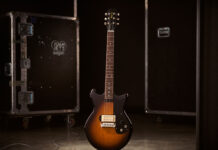

Why Tosin Abasi created the wildest nylon-string guitar ever: the Stage 7
The guitar industry can often feel slow to move. With the ubiquity of time-honoured designs like the Stratocaster and Les Paul – not to mention the percentage of the market dominated by close relatives of those two foundational guitars – substantial steps in innovation can feel few and far between. But if there’s one person hellbent on pushing the boundaries of guitar design, it’s Tosin Abasi.
The Abasi Stage 7 on the Guitar.com Cover. Image: Rachel Billings for Guitar.com
The mastermind behind prog metal heavyweights Animals as Leaders and an extended-range virtuoso, there’s no more fitting poster boy for radical instrument design. And since forming Abasi Concepts in 2017, he’s been on the cutting edge.
Tosin Abasi’s career as a guitar designer has flourished over the past 10 years, from the development of the Abasi Concepts catalogue with thoughtfully designed and brilliantly ergonomic instruments like the flagship Larada and its double-cutaway sibling, the Ēmi, to his partnerships with some of the industry’s biggest brands.
He’s specifically shown an interest in collaborating with bigger brands to bring his unique take on guitar design to the masses. Ernie Ball Music Man had Abasi to thank for the Kaizen, one of the most exciting and unique shred guitars out there, and now it’s the turn of Yamaha-owned Cordoba.
Image: Rachel Billings for Guitar.com
The world’s largest maker of nylon-stringed instruments has partnered with Abasi to create the Abasi Stage 7, a wildly imaginative seven-string nylon-string electric guitar that rips the rulebook for classical guitar design to shreds.
There’s plenty of Abasi Concepts DNA in the Stage 7 – which is a big part of why it’s unquestionably the most unique looking nylon-string on the market – but the form has function. It’s very probably the most ergonomic and comfortable classical guitar on the planet.
“If there’s a gap in the guitar space, this is a strong reason to create something there”
Pushing the boundaries
So why did one of the world’s foremost technical metal players decide to develop a nylon-string guitar? He had already dipped his toes into the classical world with Animals As Leaders, but he struggled to find a guitar that worked for him in a live setting. So he’d design his own.
“I’ve tried different acoustic-electrics for live shows, and there’s always this looming risk of feedback,” he explains. “We have a loud drummer, and there’s another guitar player playing electric. So my use of these nylons was always in a context that was not traditional. I realised that the more resonant the guitar was, the more feedback I’d get.”
Cordoba’s popular and impressive thinline hybrid nylon-string, the Stage, helped Abasi solve some issues. “If you turn down the contact mic on the body, you could get away with playing it pretty loud on stage without that feedback occurring,” he says.
Image: Rachel Billings for Guitar.com
The vanilla Stage became a trusted touring ally, but this is Tosin Abasi we’re talking about. Abasi Concepts had already been prototyping a nylon-string of their own, and the cogs inevitably started turning.
“I said, ‘I wonder if Cordoba would be interested in collaborating on making something like this, but with some changes.’ We aligned on a co-branded, co-designed acoustic-electric that didn’t exist.”
Abasi’s touring experience factored into the new instrument, but he also had homebodies in mind. “We wanted to design this as a midpoint for the electric player who wants to get into nylon-string, playing in contexts that aren’t solo classical guitar, and likely does a lot of home recording,” he explains.
“In progressive metal, everyone is becoming their own recording engineer, and the ability to plug something in, as opposed to having to set up a bunch of mics and pres – we wanted it to sound great direct, straight out of the guitar.”
Image: Rachel Billings for Guitar.com
Besides the Larada-inspired body shape, the wildest design element has to be the 24-fret fanned fingerboard. “What nylon-string guitar has 24 frets and seven-strings on it?” he laughs. Abasi has some words of reassurance for sceptical newcomers to fanned frets. “The actual string is happier,” he says. “The lowest strings benefit from that extra scaling… you get to add scale length so that the string is not floppy.” Meanwhile, a multi-scale length guitar retains the string tension of the higher strings as you’re used to. “The benefit is twofold: you retain the timbre of those treble strings, and you retain the tension that you’re used to.”
But Abasi also points to the ergonomic benefits of fanned frets: “Your elbow primarily stays still – it’s kind of alongside your torso – your hand naturally fans as it moves from the headstock towards the body of the guitar. This fanning motion is more in line with mechanically what’s happening in the first place.”
Also present on the Stage 7 is a cutaway on the lower bout, a stroke of design mastery present on all Abasi Concepts instruments, again rooted in Abasi’s personal preferences.
“Classical guitars don’t have this, but it helps for playing in a classical seated position,” he says. “It’s because most acoustic instruments don’t want to give up any volume, so the more body, the better… But because our instrument isn’t relying on the size of the cavity to produce its sound like a purely acoustic instrument, we were allowed to modify the body in a way that aided the ergonomics.”
“For a lot of guitar players, they see examples of nylon-string in a new context, and it puts a light bulb in their head”
A Match Made In Heaven
Nylon-string guitar and high-gain heavy metal music seem worlds apart on the surface, but both have roots in virtuosity, with technical chops a strong component of the appeal. Social media stars like Ichika Nito and Marcin have done a lot to bring virtuosic clean playing to the masses, while Polyphia’s Tim Henson has spearheaded nylon-string’s foray into the metal world, even launching his own more conventional Ibanez nylon sig. So is now the perfect time for the Abasi Stage 7?
“Tim did a great job of taking a nylon-string instrument and applying it to a completely unique context. Sometimes it just takes something for it to click for people,” Abasi says. “Animals as Leaders have had nylon-string guitars as far back as 2009… but for a lot of guitar players, they see examples of it in a new context, and it puts a light bulb in their head.”
Image: Rachel Billings for Guitar.com
He continues: “A young player might be listening to classical guitar music, but doesn’t realise there’s a tonne of very advanced technique, and you’re allowed to play fast. Social media is exposure to the fact that classical guitar often incorporates really advanced technique.
“And so, if you’re a kid who’s into shred or progressive metal, you have an appetite for that complexity, and you see someone like Marcin playing complex stuff, you go, ‘Woah, this sounds really elegant and cool…’ It was always waiting to happen – that exposure has occurred at the right time.”
“Big brands often don’t have permission to really push the envelope. There’s hostility if they try to do new things”
Going It Alone
Abasi can push the boundaries of guitar design so regularly in no small part to Abasi Concepts, the brand he founded as much out of necessity as anything else.
“By the time I was playing eight-strings, it was kind of an underserved sector for guitar,” Abasi, who was an Ibanez signature artist at the time, recalls. “If you wanted pickups or a guitar in general, you had limited options. There were things I felt could make the eight-string easier to play that I wasn’t seeing occurring.”
After convincing the Japanese guitar giant to let him design his own original body shape, the Larada was born. But Abasi felt the wheels weren’t turning fast enough.
“Ibanez is a great company, but they’re a very large company… every single change took a very long period of time to implement,” he says. “I eventually felt I wanted to take my original design and expand it beyond just a single eight-string offering with Ibanez. That’s how Abasi Concepts was born.”
Image: Rachel Billings for Guitar.com
In the nine years since, the brand has created a variety of different truly unique instruments, and that confidence at pushing the boundaries allowed him to come back to the mainstream world with Ernie Ball in 2022.
“It was the first time you could get something designed by me for under $1,500,” he reflects. “And it was exciting to be able to offer something for people who don’t have a lot of money to spend on really expensive guitars.”
Taking advantage of Music Man’s technological resources, Abasi was able to design a three-dimensional ergonomic instrument in a way that he might not have been able to on his own.
“They have an amazing engineering team and an amazing facility here in California,” he enthuses. “It’s incredible. They have robots and stuff!”
“Our whole thing is to make something distinct that solves a problem”
The Future Is Now
The common thread with all of Abasi’s creations is that they push things outside of the comfort zone that most guitar brands seem stuck in. Why do we have this tendency to play it safe?
“There isn’t a single answer,” he replies. “It just seems the case that guitar players are often a lot less open-minded when it comes to new guitar designs, and I think this is because most of our favourite music that was written on the guitar was written decades ago, and [instead of] creating new directions and blazing new trails, most people want to emulate their heroes.”
That discourages innovation in big manufacturers and legacy brands, he argues. “From the outside looking in, they often don’t have brand permission to really push the envelope. There’s hostility if they try to do new things. It feels almost like guitar players are a conservative, religious community.”
The Stage 7 is Abasi’s latest attempt to creatively challenge guitar orthodoxy – and an important business milestone as yet another successful partnership with a major brand. The next step, you’d expect, would be to scale up and expand even further, but Abasi is keen to keep things streamlined.
Image: Rachel Billings for Guitar.com
“You ever go to a restaurant and the menu is enormous, and you’re like, ‘Wait, what?’ It’s similar to guitar gear,” he says. “A bunch of options sounds good on paper, but sometimes it’s more of a mental load. We’ve been very deliberate about what we offer.”
The Stage 7 feels deliberate and exciting in every way – an instrument that meets an un-met need and recontextualises the most traditional type of guitar in a way that makes it feel radically futuristic. It’s a textbook Abasi design, and one that comes from a clear mindset.
“If there’s a gap in the guitar space, this is a strong reason to create something there,” Tosin says. “Our whole thing is to make something distinct that solves a problem, and where you couldn’t simply choose another instrument for the same role.”
The Abasi Stage 7 is now available.
Words: Sam Roche
Photography: Rachel Billings
The post Why Tosin Abasi created the wildest nylon-string guitar ever: the Stage 7 appeared first on Guitar.com | All Things Guitar.
Source: www.guitar-bass.net