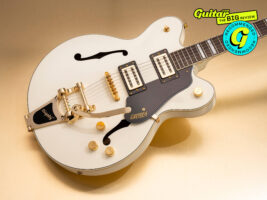
Gretsch G2622TG Streamliner Ltd Ed Center Block Double-Cut with Bigsby review: “there are a million and one songs trapped inside this guitar, impatiently waiting to be unleashed”
$739/£549, gretschguitars.com
Gretsch guitars have always stood in a fascinating corner of the guitar world. Even music aficionados without a guitar-playing background know what a Stratocaster is, what it does, how it looks, and the fact Hendrix played one upside down. Similarly, fans with a penchant for the heavier side of the rock spectrum know the Les Paul ‘Burst in the gifted hands of Slash and Jimmy Page.
Gretsch guitars, however, have always seemed to exist in their own lane. From George Harrison’s early Merseybeat-jangle, to Tom Petty & The Heartbreakers’ signature songcraft, and Neil Young’s raw, jagged riffs, Gretsch guitars have become the choice for players who prioritise character over familiarity.
Into this comes the new Limited Edition G2622TG Streamliner – a guitar that seemingly offers a very affordable route to that rich heritage, with visuals that lean towards the most famous Gretsch big-bodied guitars, but will the reality match up to the first impression?
Image: Adam Gasson
What is it?
The Streamliner designation of the ever-catchily named G2622TG means that it sits at the bottom of Gretsch’s three-tier production range after the Electromatic and premium Professional, but in truth you’d never notice from a distance. This is a beautiful instrument with the fancy elegance that has set the brand apart from the more utilitarian charms of its competitors.
In practice, that means a beautifully measured double-cutaway design finished in Vintage White (though the Midnight Sapphire option is also lovely), and paired with all the shiny gold hardware you could ask for. Some would say that a Gretsch is never fully dressed without a Bigsby, and here we get a lovely licensed B70 wobbler to pull the whole thing together.
The iconic “G” arrow logo on the control knobs never fails to make me smile, and the master volume knob includes a push/pull coil split option for extra Beatle-y twang when needed.
Image: Adam Gasson
Usability and build quality
When the G2622TG landed in my hands, before I even played a note, I had an immediate sense that Gretsch might have hit a home run. It looks, feels, and sounds far more premium than its asking price would suggest.
The laminated body feels solid, and is wonderfully resonant, providing that airy sound that semi-hollow body players expect. The soft ‘C’ shaped neck nests comfortably in the hand, and the 22 nicely finished medium-jumbo frets give a sense of familiarity to the fingers for long-time Gretsch-heads. Combined with a low, comfortable action out of the box, they never get in the way and are an ideal bed for a wide-style of approaches.
Then, there’s the golden elephant in the room: the Bigsby B70. Many guitar purists still shoot a side-eye towards the B70, and other die-cast, affordable Bigsby ‘licensed’ models. After all, the B70s are manufactured overseas and cost a fraction of their US-made B7 counterpart. However, as we sit here in 2026, I think the B70 and B7 are almost identical in use.
Yes, the B7 is a touch heavier, and feels a tad more solid, but I barely notice a difference when comparing the two. The fact that a vibrato of this quality is bolted on to the G2622TG at this price point is still staggering to me. That expressive wobble is synonymous with thousands of classic recordings and should not be seen as merely an afterthought. It provides exactly what you’d hope – some slight shimmer and movement, without turning tuning into your new full-time job.
The controls are laid out in the typical Gretsch fashion, which is to say slightly different to the classic Gibson four-knob method. What you get instead is a volume knob per pickup, a master tone knob, and the previously mentioned, and extremely welcome push/pull coil splitting master volume knob.
In practice this means that the two pickup volumes are only really needed for blending, or if you want to use the volume to roll some of the gain off a sound on one pickup. The master volume is likely all you’ll need for actually controlling volume.
Image: Adam Gasson
Sounds
This guitar’s tonal palette is fairly wide, whilst never sacrificing its character. That semi-hollow resonance instantly makes itself heard when plugging in – chords ring with authority, and lead lines are clear and articulate, with some satisfying snap about them in coil-split mode. To put it bluntly, this guitar sounds incredible. It just oozes Gretsch DNA and character.
The Broad’Tron BT-3S humbucking pickups are versatile, to a point, offering suitably punchy mids and predictably sparkling highs. Provided that you’re not going to push this thing into high gain territory, it can cover a lot of the rock-adjacent bases with aplomb.
The bridge pickup is clear, bright and spanky, with the sort of cutting midrange that makes it a usable clean twanger while also having plenty of ability to cut through when you start piling on the gain. Again, don’t expect to have your mind blown by the clarity and punch with excessive gain here, but everything up to this point sounds fantastic.
The neck pickup is a much thicker, more rounded affair that really shows its mettle when you add some distortion to proceedings – it’s chewy and meaty, and really suits bluesy lead lines.
The middle pickup offers a nice blend of both worlds that seems to be begging you to lean into the Hermanos Gutierrez vibes, add a bit of reverb and slapback, and start putting the Bigsby through its paces. It’s got a nice compressed quality when you add a bit of fuzz into the mix too.
Speaking of the Bigsby, provided that you don’t throw yourself too recklessly into extreme wangling, it stays in pitch nicely enough, though the nature of the beast means that its best suited to polite wobbles if you want to keep things in tune.
The coil-split does what you’d expect it to, bringing even more spank and twang on the bridge pickup, though you do lose a lot of the low-end – you have to be careful how and when you deploy it because there’s a real risk of things getting a little shrill here.
The middle and neck positions are more forgiving, and the blended sound in particular really opens up the sound, adding in some single-coil airyness to proceedings that can work really well as a contrast. Nobody is going to be mistaking this for a Strat any time soon, but it’s a nice extra option to have.
Image: Adam Gasson
Should I buy one?
The Gretsch G2622TG Streamliner won’t be for players angling for tonal neutrality, or an ultra-modern feel and aesthetic. Instead, those wanting to immerse themselves into the world of Gretsch, with an instrument that is bold in character and elegant in design, this is the guitar for you.
Above all else, this just feels like it has the raw materials to take you on a journey as a musician and a songwriter. It’s a cliche to say that this guitar feels like it has songs in it, but that was my experience every time I picked it up to play.
The quality of its tones, the playability, and the versatility here means that you can easily find yourself coming across fresh inspiration, and there’s something so refreshing about that – especially for a guitar that is so competitively priced.
The $799 outlay not only gets you a guitar that looks, sounds and feels high-quality, but also grants you a lifetime membership into the Gretsch players club. The G2622TG doesn’t just make you want to play it over and over – it reminds you exactly why you fell in love with guitar in the first place.
Image: Adam Gasson
Alternatives
The natural semi-hollow competitor for the G2622TG is, of course, the ES-335, and Epiphone’s version ($599/£599) is a very good guitar for the money. Another affordable take on the semi-hollow with bags of vintage pedigree is Guild’s Starfire I DC ($599/£659), while D’Angelico Premier DC ($799/£699) is another semi with a name from the annals of guitar history.
The post Gretsch G2622TG Streamliner Ltd Ed Center Block Double-Cut with Bigsby review: “there are a million and one songs trapped inside this guitar, impatiently waiting to be unleashed” appeared first on Guitar.com | All Things Guitar.
Source: www.guitar-bass.net