T-Rex RoomMate D’Luxe review – a trusty all-round reverb pedal is reborn for the modern era
$299/£249/€299/, t-rex-effects.com
Nobody really needs a reverb pedal – for authentic ambience, simply do all your guitar playing in an empty swimming pool or disused cathedral. There is, however, an obvious advantage to harnessing the power of digital processing to make reverb more practical, and one of the first pedals to do that successfully was the T-Rex Room-Mate.
READ MORE: T-Rex TwinBlaze review – one tube-driven pedal to cover all your rocking needs?
This tube-driven unit first came out around 20 years ago, but it’s been out of production for a while. Is that because it was struggling to keep up with rivals that came along later offering more modes, more controls and more dreamy epicness? Quite possibly… and so here, on a mission to fix those shortcomings (and remove a hyphen), comes the RoomMate D’Luxe.
What is it?
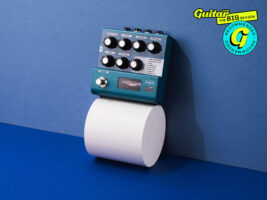
The hyphen has gone and the enclosure has changed from white to blue, but in some ways the D’Luxe model picks up right where the second version of the original Room-Mate left off. It’s still a fairly compact reverb pedal with stereo output and a full-size preamp valve at its heart. But the main difference is a significant one: a doubling of effect modes, from four to eight.
So you’re getting long and short springs, a plate, two rooms, two halls and – replacing the old ‘reverb plus chorus’ sound – a hall with octave-up shimmer. You’re also getting a new knob, marked ‘optional’, that does different things in different modes: it controls low-end damping for the two spring effects, adds a pre-delay in the next five, and sets the level of the octave in shimmer mode – something that can also be controlled using an expression pedal.
The other knobs are standard fare – decay time, reverb level, master volume and tone – plus input gain, for making sure you don’t overload the unit when it’s plugged in at the end of a mile-long chain of overdrives, fuzzes and boosters. Mind you, since when was overloading a tube something to be avoided?
Oh, one more point to note before we enter the virtual cathedral: while most T-Rex pedals these days are manufactured in China, this one – like newcomer the TwinBlaze that I’ve already reviewed and the FuzzTopia – is made in the company’s home country of Denmark. That doesn’t necessarily make it a better product, but it’s good news for the purists and anyone who’s not keen on outsourcing in principle.
Image: Adam Gasson
Usability and build quality
When a pedal has eight modes and six control knobs, the first thing you might be looking for is some sort of preset switch. With the RoomMate D’Luxe, you might as well look for a bottle opener, because this thing is strictly manual. Personally, I don’t think that’s a bad thing, as it’s a simple device at heart – and how many different reverb sounds does the average guitarist need to have at hand?
The control markers glow yellow when the unit is engaged, which will be easy to spot even on the darkest of stages, and the one above input gain turns orange when it’s overloaded. There’s also a warm glow from the JJ ECC83S valve, even in bypass, but this is actually coming from an LED at its base. Now, that might make you think it’s only there for show – not least as T-Rex doesn’t quote an operating voltage – but the pedal runs on a 12v power supply (included) and draws over 600mA of current according to the manual, so my guess is it’s cooking at the same 250v as the original.
Image: Adam Gasson
Sounds
Here’s a sizzlingly hot take for you: lots of people like to play guitar in stereo, but nobody likes to listen to guitar in stereo. I don’t know if there’s a solution to that paradox, but I am glad the RoomMate D’Luxe is stereo if only for the self-indulgent joy of plugging into two amps and basking in the gigantic space between them. And besides, it also has stereo inputs so it’s not limited to us guitarists and our silly little monophonic plink-sticks.
So let’s just get this out of the way: it sounds great in stereo, but I’ll be doing most of my testing in a one-amp setup because that’s how most people are likely to end up using the pedal. And luckily, it also sounds great in mono.
The spring algorithms are up first, and they’re both totally convincing. At matched settings there’s actually no obvious difference in decay time between the two, but the ‘long’ version is a little smoother and mellower. The plate is smoother still, as you’d expect, and this might be your first port of call if you’re not actively seeking the wobbliness of a spring: it’s just a really nice reverb, nuff said.
I’ve never really seen the appeal of room reverbs – who wants to emulate bad acoustics? – but the two here are certainly realistic. It’s in the three hall modes, though, that the fun really begins – and where you might well want to wheel out that second amp for stereo immersion. There’s no audible modulation on offer, so it never goes as richly celestial as something like the OBNE Dark Star Stereo or Strymon NightSky, but for pure hugeness this is all the reverb you’ll ever need.
The shimmer effect is on the assertive side, and can get shrill at times, but that’s easily fixed by dialling down the mix and/or the tone… and that brings us to the real strength of this pedal: its tweakability. T-Rex has put that high knob count to smart use, bringing total control over every aspect of the effect so you can get it sitting exactly where you want it in every mode.
That’s most strikingly true of the input gain. Keep this down around 11 o’clock for textbook clean effects, but if you slam it towards maximum the reverbs take on a pushy intensity that makes everything feel that much more exciting. And no, I never did get it to distort – but you can use the output volume for a nice boost on the way out.
Image: Adam Gasson
Should I buy one?
T-Rex has done what it needed to do to bring the RoomMate up to date with the 2026 reverb market. The result is a strong contender that covers all the key varieties while offering excellent audio quality and, above all, supreme tonal versatility.
This is not a dedicated ambient soundscaping tool – its heart lies somewhere more traditional than that – but it is a fine all-rounder, at a good price for something that’s been made in Europe by a company with real pedigree. If T-Rex really is going back to boutique, this is a very encouraging sign of what’s to come.
Alternatives
At the top of this review I mentioned rival reverb pedals with “more modes, more controls and more ethereal epicness” than the old Room-Mate. Well, let’s run through some of them. Among your most obvious options are the Boss RV-6 ($153.99/£169), Neunaber Immerse ($269/£269) and Strymon BlueSky V2 ($379/£359), while a relatively newer contender offering pristine audio quality is the UAFX Golden Reverberator ($399/£379).
The post T-Rex RoomMate D’Luxe review – a trusty all-round reverb pedal is reborn for the modern era appeared first on Guitar.com | All Things Guitar.
Source: www.guitar-bass.net