Boss EX-4 Effects Expander review – a force multiplier for compact pedalboards
$329/£289, boss.info
You don’t see a lot of occasional tables these days, do you? You know the type, the nest of side tables that would sit unmolested at the corner of an elderly relative’s living room until such a time as they had company over and required a wobbly edifice to place extraneous drinks and biscuits onto.
READ MORE: Positive Grid Spark Pedal review: The Spark ecosystem welcomes another box of tricks
Correlation doesn’t mean causation, of course, but there can be no doubt that the decline in occasional tables is inversely proportional to the rise of the occasional effects pedal. Back in the dark mists of the 2010s, Line 6 came out with the M5, and it was in many ways the original occasional pedal. Inside its relatively compact package, the M9 and then smaller M5 offered a whole bunch of effects that you might only need now and then in one package designed to sit in the middle of your pedalboard ready to be anything you needed it to be at a moment’s notice.
Despite being a verifiably great idea, in the following years we saw relatively few competitors to the M9, but that has changed recently. Now the likes of TC Electronic and Zoom offer compact multi-effects units, while at the other end of the market the likes of Eventide and Hologram Electronics bring a boutique sheen to proceedings. Even Line 6 itself got back into the party with the impressive HX One a few years back.
Image: Adam Gasson for Guitar.com
Now it’s Boss’s turn. Though the company already has the PX-1 Plugout FX as a compact multi-effects unit, its unique approach to being a literal stompbox library (not to mention its microtransaction-based library) means it doesn’t really fit the bill. The EX-4, on the other hand, offers a whole smorgasbord of sounds in a compact chassis, for a very reasonable price.
What is it?
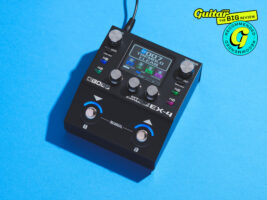
In essence, the EX-4 crams 120 onboard effects, mainly from Boss’s own enviable back catalogue, crammed into the rugged and compact (but not that compact) form factor of Boss’s 200 series enclosure.
You can run up to four of these effects simultaneously, so if you’ve ever fancied running four shimmer reverbs into each other just to see what happens, you’re in luck here. You can also control the routing options of said four effects, so you can run them either in old-fashioned serial, as two separate serial chains made up of one, two or three pedals each, or using three different types of parallel routing.
The sounds here are mainly focused on guitar, but there are a handy helping of bass options too, and the effects on board run the gamut from the standard to the downright weird. So yes you’ll find the usual suspects of overdrive, distortion, reverb, et al in various common Boss and non-Boss flavours, but that’s not all. Delve into the menu and you’ll find the likes of the Slow Gear, Super Feedbacker and Slicer pedals recreated here, but also some really esoteric flavours like the Defretter (for guitar and bass), the Humaniser and the guitar synth.
As you would well expect for a pedal with this much going on, there are 128 user presets to go with the 128 factory ones. All of this is controlled by a pair of footswitches that can either be used to switch up and down through the presets or, in manual mode, the two switches can be used to turn two of the effects in the bank on and off by default. They can also be configured to control master bypass, tap tempo and even individual parameter control. Coloured lights around each switch also make it easy to see at a glance what the switch is currently up to.
Image: Adam Gasson for Guitar.com
There’s plenty of onboard control for the pedal courtesy of five rotary controls, plus a 2.4-inch full-colour screen that shows you your current preset plus the four effects you have in that chain. You can turn these effects on using four FX buttons on the edges of the control panel, all of which handily light up in the colour of the effect that is currently in its bank. Editing the effect in question is a job for the rotary knobs, with the large knobs up top controlling the bank and the effect type, while the three smaller knobs tweak parameters contextually based on what’s above them. All the knobs also have a secondary click function that is represented on the second line of context-dependent info on the screen.
But that’s not all – in addition to tweaking all the effect types manually, the EX-4 also has a new feature called ‘Gear Suite’ that’s accessed by a dedicated small button on the top left. For each effect type that you select, if you hit the Gear Suite button, you’ll be presented with 10 factory and user presets for each individual effect type, meaning that you can not only streamline your auditioning process by zeroing in on some classic sounds, but it also means you can then save those presets and use them in any of your global presets. It’s presets within presets, basically – Preset-ception?
All these sounds come complete with a useful amount of IO to go with it – you get stereo ins and outs (half of which can double as effects send and return) plus a control for an external footswitch or effects pedal. There’s also a USB-C for software updates and – mercifully given the breadth and depth of tweakability at play here – full MIDI control, should that be your particular kink.
Power comes courtesy of an included Boss PSU, but should you be living in 2026 and want to power this off your own pedalboard power supply, you’ll need to make sure you have at least 300mA of juice on tap.
Image: Adam Gasson for Guitar.com
Usability and build quality
When AI goes full Skynet and wipes humanity out sometime in the near future, there’s a fair bet that alongside Keith Richards and cockroaches, Boss pedals will be the effect du jour of whatever guitar-playing ghouls occupy the wasteland in our absence. Now, the 200 series might not have the same indestructible reassurance of the trusty Compact Pedal, but that doesn’t mean this isn’t a serious bit of hardware – all bent powder-coated steel and sharp angles.
The footswitches are rugged, soft-click affairs – they’re nicely spaced out but rather small compared to the norm. Plenty will naturally lean towards footswitch toppers here, but be aware that this is likely to obscure the contextual LEDs around the switches themselves… that’s presumably what Boss’s own transparent toppers are meant to get around.
The rotary switches are plastic rather than metal, but they are stepped rather than smooth travelling. This feels rather satisfying, and it definitely makes it easier to be precise with your tweaking, but there is a flipside. Because each click represents a single notch on the scale, given that many of the parameter values are out of 100, making a significant adjustment to that takes many more twists of a knob than is wholly enjoyable. I can understand the rationale for why Boss did it this way, however; the alternative would be to have a knob that wasn’t sensitive enough for precise adjustment.
The colour LCD screen is bright, crisp and clear – 2.4 inches doesn’t look great on paper, but all the text is rendered clearly – it’s certainly an improvement on the HX One’s tiny little screen.
Image: Adam Gasson for Guitar.com
That text is still pretty small, mind you – you’re definitely going to want to get your presets sorted before a show because you’ll need the reading glasses/a pair of binoculars to make out the text on a dark stage in the heat of battle. This is unquestionably the nature of the beast with compact multi-effects units, however, and the preset name and number itself is rendered in large, legible type, while the various contextual coloured LEDs also make things much easier to navigate on the fly.
The problem that you often encounter with compact multi-effects units is how you include as much tweakability and deep-editing as the user will want without making the top of the pedal look like the control console at Abbey Road. Too often with compact pedal makers, especially those on the boutique side of things, they try to squeeze too much into too few controls, making any kind of editing a chore, and leaving you with the suspicion that the designers assume most people will be using MIDI to control the thing anyway.
Boss has sensibly opted for a middle ground in all this – the controls are relatively spartan and clearly labelled, but the contextual nature of those three central knobs means that you can do a huge amount of tone sculpting right there on the pedal.
I am very much a Guy Who Does Not Like Menus, so it really does say a lot that within a few minutes, without even looking at the quick start guide, I worked out how to do pretty much everything I wanted to do – from preset saving to parameter tweaking to signal path adjustment. For a pedal with a whole lot going on, it really is very easy to use.
Image: Adam Gasson for Guitar.com
Sounds
The reason that you’ll find a Boss pedal or two on practically every guitar player’s ’board is that for nearly 50 years now the company has been a byword for great effects sounds, and that’s very much in evidence across the broad span of tones on offer here.
It is a little frustrating that some classic Boss stompboxes are included here by name – the Metal Zone, the Turbo Overdrive, the Slow Gear, the Space Echo – while others are broken up into various generic modes that, while perhaps making sense on a bigger workstation like the GT-1000, feel a bit overly granular for a pedal of this type. Perhaps this is done to not tread too heavily on the toes of the polarising PX-1 Plugout FX pedal, which offers dedicated replications of individual Boss stompboxes, several of which have to be purchased separately.
This is a very different beast to the PX-1, and I get that, but it’s still annoying to me that I can’t simply select the DM-2 when I want a DM-2 sound, though, y’know?
Image: Adam Gasson for Guitar.com
The sounds themselves are ace, however – especially the ones that are directly derived from Boss pedals. Indeed, A/Bing them alongside their original pedal-based equivalents, it’s hard to find much difference – my Super Overdrive, DS-1 and CE-2 were pretty much indistinguishable with the EX-4 appropriately dialled in, and running the Slow Gear emulation on the PX-1 proved similarly indistinguishable.
What you are sacrificing in the quest for this cornucopia of sonic variety is the sheer sonic quality you might find in high-end separate effects or the very top end of the modelling world. You’re not going to get the same ethereal bliss you’ll find in a Strymon BigSky from the shimmer reverb mode here, nor will the glitch delay offer the sort of juddery brilliance of a Chase Bliss pedal.
But as Yngwie likes to remind anyone in earshot – less isn’t more: more is more. And in that regard, you cannot really fault the offering here – the ability to run four effects simultaneously, combined with the myriad routing and external and internal switching options, really is pretty compelling. It elevates this pedal above the utility Swiss Army Knife pedal into something that you can legitimately build your rig around.
Forget replacing one pedal on your ’board; I could easily see a world where a lot of guitar players could scale down to a mini pedalboard containing an EX-4 with maybe a tuner and a few choice dirt boxes, and still be able to cover pretty much any base in a cover band or function gig.
As with any multi-effects pedal, the question of where it goes on a larger board is a more philosophical one. The send and return sockets do increase your flexibility there for sure, but there are still likely to be signal chain compromises, especially if you’re using all for sound banks.
Image: Adam Gasson for Guitar.com
Should I buy one?
There are pedals out there that offer more sounds in a similarly-sized package – the HX One, for example – and you can definitely argue that using a sound engine from an eight-year-old pedal is not exactly that exciting.
But with respect to the good folk at Boss, they haven’t sold tens of millions of pedals because they sound way better than everyone else. Some Boss pedals are unimpeachable, sure, but mainly people love Boss because they are affordable, they sound good, and they don’t let you down. In all three senses, the EX-4 ticks those boxes, and it would be a really keen ear who would notice the lack of premium sonic fidelity in a live environment.
The ability to run four sounds at once in such a small format is also a pretty compelling offering, especially if you’re a guitarist who likes to run fast and light when it comes to pedalboards – far more than just a one-shot occasional pedal, it could be the inspiration for downsizers to finally ditch their two-row ’boards.
At just over $300, the Ex-4 is also an impressive value proposition, and its straightforward and sensible control layout also means it shouldn’t scare off those of us who get queasy at the thought of menu diving. The impressive I/O (including the internal routing options) make the issue of where it sits on your board more straightforward too – and if you’re hooking it up to a MIDI switcher, those options are only further enhanced.
In many ways, this is the pedal that I think a lot of people perhaps imagined or assumed the rather polarising Boss PX-1 would be when it was launched. And I do wonder if the EX-4 had come out first, would people have been a lot less hostile to the Plugout FX’s stated goal as an expandable library of classic and rare Boss effects? We’ll never know now, but it’s very easy to see the Effects Expander reaching a much wider audience – as a multi-function utility pedal on bigger ’boards, or as a force multiplier for compact builds, this is a really compelling proposition.
Image: Adam Gasson for Guitar.com
Alternatives
If you want more of an all-in-one solution, the Boss GT-1000CORE ($659/£649) offers more sounds and AIRD-powered amp simulation. The obvious elephant in the room is of course Line 6’s HX One ($299/£229), which offers more effects to choose from, but with the limit of just being able to use one at a time.
The affordable and even more compact TC Electronic Plethora X1 ($155/£119) offers a choice of seven different effects, but with the ability to use two at once, and the flexibility to load TonePrint presets onto there as well as your own. The sounds might not be up to the standards of Boss or Line 6, but the Valeton GP-50 ($119/£99) offers a huge array of effects and amps in a tiny package for very little cash.
The post Boss EX-4 Effects Expander review – a force multiplier for compact pedalboards appeared first on Guitar.com | All Things Guitar.
Source: www.guitar-bass.net