So you’re buying a second-hand guitar: these are the things you need to know
You’ve probably noticed that the very process of existing is getting more expensive every week it seems. As the fundamentals of life become more and more of a drain on all our resources, we often cut back on luxuries and look for savings on our hobbies to relieve some of the pressure. Guitarists are not immune to this.
READ MORE: Why guitar frets are made of different materials – and how it has a huge impact on your playing experience
But life without fun is hardly life at all, and there are ways in which we can still enjoy our favourite hobby (and the pull of GAS) in ways that still save us some cash. The most obvious way here is buying second-hand gear. While certain vintage guitars come with huge premiums, most used gear can be had with significant savings over buying new from a store or online retailer.
As long as you don’t mind a little wear and tear, you can easily find top-tier instruments with a lot of life left in them for a great price. But just how much life is left in your new-old guitar? And what should you look for when shopping, buying and even valuing your own guitar to sell?
Setups and playability
The setup of a used guitar is often a real problem, though easily fixed. Used or vintage guitars are often being sold because they’re underutilised or rarely played, sometimes relegated to the back of a closet, hopefully in a case or bag. Even guitars left safely perched on racks can slowly degenerate and affect the overall playability.
Things like high action, bad intonation, rusty strings and buzzy frets aren’t always a red flag, and can be easily remedied if you know what you’re looking for. When checking out the action of a guitar, a consistently high action along the fretboard is usually a sign of a bridge that is simply raised too high, an easy fix! Depending on your guitar’s design, there’s usually two screws at the bridge that can raise or lower the high and low side of the strings independently.
The Acoustic Questions
For an acoustic guitar, the action issue is a trickier one to fix. A flat-top’s bridge is often glued to the belly of the guitar, and string tension can slowly lift this over years, usually decades, of tension.
This will often create a bubble on the guitar’s belly, or the bridge itself can lift. Both of these will create high action, so a quick check can help you make a safe purchase. Neither of these are a total deal breaker, but definitely require big fixes, so tread lightly.
If the action is inconsistently high across the board, it can be for a few different reasons. Most likely the truss rod is improperly adjusted, or has been left untouched for a long time. This will be most obvious around the middle of the fretboard (by distance, not frets), usually the 8th or 9th fret.
This will result in either the strings being the furthest distance at this point if the neck is too bowed, or the closest point if the neck is adjusted with too much convex. Both of these are easily remedied as long as the truss rod is functioning correctly, so a quick adjustment with an allen key to check its effect on the neck’s straightness helps. A quarter turn should be enough to confirm the truss rod itself is working as expected!
Neck Warping
What’s difficult or impossible to remedy is a warped neck, meaning it’s more bowed on one side than the other. This can be easily checked by staring down the fretboard towards the bridge from the headstock, as imperfections will be much more obvious from this angle. You’ll easily be able to see how warped or bowed the neck is. Generally, a warped neck can’t be fixed without a lot of work, though if the price is right, a whole new neck could still yield a great deal!
Hardware Failures
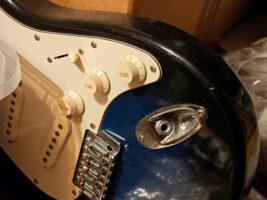
All this talk of adjustments, fixes and setup is reliant on the hardware itself. Used instruments are often well used, as such have rusty components, screws, scratchy pots, seized threads or other damage from sweat, dirt and grime. Screws that secure things like input jacks, scratchplates and pickup selectors are easily replaceable and don’t have any great effect on the guitar’s playability.
Tuning machines, tremolo bridges, nuts and rusty electronics, however, greatly affect both sound and function of a guitar, so a little check can go a long way. Ensure tuning machines are secure, turn evenly, smoothly and are generally free of rust, especially where wound strings make contact with the machine head. Equally important is the guitar’s nut, as this area often chips when made of bone, plastic or other materials, and while it is an easy fix by a professional, it’s still a cost that’ll have to be factored in.
Tremolo systems like a Floyd Rose or Ibanez’s Edge Trem operate on a knife’s edge that pivots on two bolts that bold the bridge in place— this sharp edge wears over time, causing the bridge to skid on the bolts and wrangles the whole thing out of tune. Both tremolo and hard tail bridges take a beating, and tiny screws and threads often fill with sweat and rust. They can be taken apart and cleaned out, but making sure all the parts move smoothly is essential for setting up the guitar for the best playability.
Pots And Jacks
Another issue that is common with older guitars won’t reveal itself until you’ve plugged it in – namely issues with the pots of the input jacks.
Scratchy pots (where there’s an audible sound when you’re adjusting the pot) or inconsistent jack connections are, thankfully, easily fixable or replaceable without too much investment. A little soldering know-how will have you switching out or upgrading parts if need be, which brings me to my next point.
Customisations and modifications
Pre-owned guitars are often modified or customised to the owner’s needs, so when buying an electric guitar, a quick look around the control cavity can be a good idea. Modifications might have been DIY, and while signal might be passing from A to B, a rat’s nest of cables, solder and switches might be hiding beneath it all. While the guitar passing signal at all can be a good sign, it can require an overhaul if you want to return the guitar to factory specs!
All in all, a little know-how can help you safely and confidently get a great deal on a used guitar. Many problems arise from a lack of use, guitars and basses requiring regular servicing as the wood expands and wears, and as components wear in and wear out over time.
There’s absolutely some red flags like warped necks, rat’s nests of electronics and more, besides obvious problems like breaks, cracks and chips. However, even problem areas that need total replacement can still come in on budget, as long as you know what you’re signing up for. There’s a world of unique, inspiring and totally affordable instruments out there, so happy hunting!
The post So you’re buying a second-hand guitar: these are the things you need to know appeared first on Guitar.com | All Things Guitar.
Source: www.guitar-bass.net