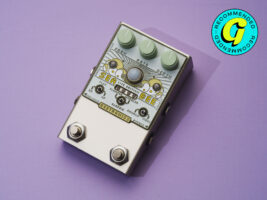
Beetronics Seabee Lite review – the kooky chorus pedal gets simpler, cheaper… and better
$249/£219, beetronicsfx.com
There are two reasons for me to dislike the Beetronics Seabee Lite. The first is that it’s a product of compromise, a cut-price version of an existing model with a bunch of features stripped out. The second is that I’m not a big fan of chorus pedals in the first place.
READ MORE: Crazy Tube Circuits White Whale Junior review – real spring reverb and analogue tremolo in a compact pedal
Luckily, there’s one very strong reason for me not to dislike the Seabee Lite at all: how it sounds. Because this unit is packing a whole range of usable modulation effects, and some of them are nothing short of gorgeous.
What is it?
The standard Seabee, an analogue bucket-brigade stereo chorus with digital control and presets, came out back in 2023. I gave it an 8/10 rating because it did make a bunch of wonderfully nice noises, but that’s not to say I truly liked the thing: it was clunky and overly complicated, and some of its more extreme effects had all the musicality of two foxes mating in a concrete mixer.
The Seabee Lite is less clunky and less complicated. But what has actually been lost in the name of simplicity? Not a lot, to be honest. The biggest difference is that the pitch-shifting ‘harmochorus’ effect has been left out – and I for one am not very upset about that – but you still get multiple modes, 16 preset slots (eight factory, eight to fill up yourself), an expression pedal input and two footswitches with bonus functions. And it still looks awesome.
Image: Adam Gasson
Build quality and usability
This California-built stomper certainly doesn’t feel any less robust than the full-fat Seabee, with a similar wedge-shaped enclosure and non-popping soft footswitches. In use, it’s still a lot more fiddly than the average chorus pedal – but you can at least get started quickly. Ignore the feedback control, the two three-way toggles and the tap-tempo footswitch, and you’ve got a straightforward two-knob job with switchable chorus and vibrato modes.
You’ll soon want to dig deeper, though. Dialling up the feedback will add resonance to the modulation, flipping the tone switch left or right will filter the ‘wet’ part of the signal, and selecting one of the non-chorus modes – ‘flangee’ or ‘wobblee’ – will dramatically change the character of the effect, turning it into a flanger or a… wobbler?
Image: Adam Gasson
Put all that together and you can see why Beetronics felt the need to keep the preset functionality. This is accessed by tapping both footswitches together, then hitting right or left to scroll up or down through the 16 slots, indicated by four colour-coded LEDs. The only snag here is that there’s no way to switch back into live mode instantly – you just have to scroll to the end of the line then tap once more, ie: up from slot 16 or down from slot 1. Bit of a pain, that.
Sounds
Did I say I wasn’t a big fan of chorus pedals? Dang, I must be getting old – because I love this one. The Seabee Lite in classic mode is a thing of lusciousness, adding depth and fluid movement to a dry sound in timeless style – in either mono or stereo. So that’s the basics ticked off right there, with the bonus of virtually hiss-free performance (which is not something you can say about all choruses).
Flipping to ‘wobblee’ mode brings a gently glitchy element of random shifting that reminds me of the Chase Bliss Generation Loss MkII; this can be fun, but ‘flangee’ is better, keeping the fundamentals of that liquid chorus sound and adding a gently metallic swirl. And remember, this is new – the other Seabee doesn’t even have a flanger mode.
It also doesn’t have the Lite model’s band-pass and high-pass filter options – although these are a minor enhancement rather than a transformative one, letting you adjust the tonality of the modulation without affecting the dry signal. The high-pass in particular is nice to have if you’re worried about your low end getting too throbby.
Image: Adam Gasson
There is pure pitch vibrato available if you turn the feedback down and flip the right-hand toggle, and here the tone switch becomes much more powerful – because there is no dry signal, so everything is filtered. Keep things tasteful by going easy on the depth, and this is another rich vein of sweet tones to explore.
Now, a long time ago I mentioned that the footswitches had bonus functions – and they’re worth a look. Hold down the left switch and the modulation speed will quickly rev up to something like maximum, then slow back down once you let go; the right switch does the same thing with the depth. It’s not quite Leslie-style ramping, but it works nicely and could be useful for the occasional cheeky wibble-blast.
Another thing I mentioned earlier is that this pedal sounds luscious in stereo… but there’s a caveat to that. The factory default setup has dry signal on one side and wet on the other, and this can sound weird with anything beyond low-level chorus effects. If you are using a stereo rig you might want to dive into the global settings and change it to wet plus wet with phase inversion, creating a more natural stereo picture. The process is explained in the little manual booklet.
Should I buy one?
The last thing I expected this to be was my new favourite chorus pedal, but here we are. The Seabee Lite is a gem, building on a beautiful fundamental voice with a host of extra options that have all been expertly judged to add genuine value.
The fact that it costs considerably less than the regular Seabee, and adds only worthwhile new features while dumping all the stuff that didn’t really hit the mark, just makes it even harder to resist. If you’re after more than just a chorus pedal, without going full-on into multi-effects, this has to be on your list – probably at the top.
Alternatives
A couple of more conventional multi-modulation offerings are the Kernom Elipse (€369/£369/$299) and Wampler Terraform ($299/£279). Then, of course, there’s the non-Lite version of the Beetronics Seabee ($349/£329)… or you could treat yourself to the fully analogue purity of the Asheville Music Tools ACV-1 ($397/£399) or Hamstead Redwing (£429/$599).
The post Beetronics Seabee Lite review – the kooky chorus pedal gets simpler, cheaper… and better appeared first on Guitar.com | All Things Guitar.
Source: www.guitar-bass.net