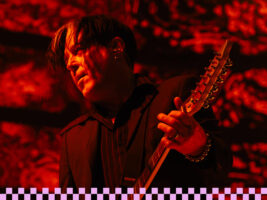
Troy Van Leeuwen on how 12-string guitars help make a “perfectly imperfect” sound
Queens Of The Stone Age’s Troy Van Leeuwen has pretty great taste. Between custom Echoparks, double-necked offsets and his very sought-after signature Jazzmaster, he’s rarely seen playing a guitar that doesn’t make you go “oh, what the hell is that and how do I get one?” And now, for one more guitar in his arsenal, that question just got a lot easier to answer.
While it started life as a custom-shop build, the new Troy Van Leeuwen Telecaster XII is not a high-end custom recreation, or even a mainline Fender model: it arrives as part of Squier’s ever-creative and weird Paranormal series, a perfect home for its mashup of design elements and unique approach.
I chatted to Troy about the origins of the guitar, how J Mascis paved the way for affordable signatures, and how the very nature of a 12-string gels with the perfectly imperfect approach of the new Queens record Perfecth.
Image: Press
Where did this guitar originate?
“There’s a little backstory that goes back to when I first started working with fender on my Jazzmaster. This was right when our record …Like Clockwork was coming out. There was so much 12-string on that record that I was like, I should probably have a double-neck guitar, you know – my idea was to have a Jazzmaster on the bottom and an Electric XII on the top.
“I was talking to Paul Waller, a Master Builder at the Custom Shop, and he was like, ‘This is probably gonna take six months from concept to playable guitar.’” We were about to hit the road, and I was using a Burns Double Six reissue for my 12-string. Paul basically said, ‘Why don’t I build you a 12-string Tele instead?’ – which was perfect, really, as I had always wanted a 12-string Telecaster, I just never saw one.
“So he took some measurements, and four weeks later I had this Custom Shop Telecaster 12-string, in a copper relic finish! Between myself and Dean [Fertita] we used that guitar a bunch – recording, live, what have you. So that’s how that particular guitar started. Recently when I was chatting to some of the guys at Fender, they were maybe talking about doing another signature. I just went, ‘we should do this 12-string Tele!’”
Squier Paranormal Troy van Leeuwen Telecaster XII. Image: Press
What was the benefit of working within the Squier range rather than making this a Fender release?
“My very first electric guitar was a Teisco Del Rey – that guitar always holds a special place in my heart! It was cheap, I got it from a garage sale for like 60 bucks – and it didn’t sound like anything else. So to me, to do something with Squier was important – there, J Mascis blazed the trail for us, really.
“It became about getting something out there that’s really simple and affordable for kids to try, too – I didn’t have a 12-string until I was in my late 20s! The new guitar is super accessible and simple. Plus, it’s a Tele. There’s a reason that guitar has been around for 75 years. It’s classic, it’s simple, it always sounds good!”
What makes you reach for a Telecaster over a Jazzmaster?
“There’s just a different kind of twang, you know. With a Jazzmaster, it’s more of a surf twang, the Tele, it’s more of a country twang. And if I grab a Jazzmaster, I’m probably gonna use the vibrato system, because it’s one of the best for staying in tune if you’ve got the right bridge, which for me is the Mustang bridge. The Tele is more straightforward: it’s a slab, it’s squared-off, it’s no-frills – the Jazzmaster gets you this plethora of other stuff, but with the Tele, you know what you’re gonna get.”
Squier Paranormal Troy van Leeuwen Telecaster XII. Image: Press
How do you make 12-string sounds fit well within a Queens Of The Stone Age song when it comes to writing and recording with them?
“A lot of what we do in Queens with 12-strings – because there’s three guitar players, myself, Dean and occasionally Josh – it’s usually single-note stuff. Especially focusing on the higher strings, for more of that ringy, doubled character. I guess you would call it a Middle Eastern sound. You can’t really get away with a lot of lushness with three guitar players. There’s not room for a lot of big, giant chords because it fills up the signal and the mix, and so with a 12-string in particular that’s why it’s more single-note parts.”
How has your approach to dialling in tones changed over the years?
“The older Queens stuff was leaning more on that big hollow-body, humbucker sound. But over the years, it’s definitely widened and sharpened at the same time. With single-coil you can get this clearer overdriven sound, if you’re pushing the amp with the right sort of boost. The cleans aren’t completely clean, and the overdrives aren’t searingly saturated – there’s this happy medium, and that’s where I hang out these days, I’m definitely leaning on the single coils.”
A 12-string arguably sounds great because it’s a slightly imperfect instrument, even more so than six-string guitars – always slightly out of tune with itself. Was that an approach you wanted to take generally on Perfecth, given the name?
“With this new record, it’s another examination of simplicity. Most of it was plugging straight into the amp without a lot of effects, even if there is a time and place for reverb and stuff. I’ve been using this really cool SG Systems amp, and it has a built-in Maestro phaser – it’s incredible, because you can plug it in and either have it phasing, or dial it in like a notched frequency thing. But it’s really liberating to just plug straight in on a record like this, and let it do the magic.
“As we’re also producers and guys that might jump in the mix, too. So you can kind of pre-mixing the record by deciding what tones are going to go down straight to the tape. There’s a song on the record called Insignificant Other, and it’s a seven-minute song that we recorded live at, well, probably 3am. It was take two. All of us in the room, no effects. Doing that you have to go, ‘Those are the frequencies Josh and Dean are going to live in,’ and so on. It’s when you start taking stuff away as part of that, everything opens up, and it feels more natural.”
The new record is taking a lot more of an analogue approach in a time where a lot of music is moving away from that.
“I’ll take it further than that: the name of our record is Perfecth, which is basically saying there’s no such thing for us. On Insignificant Other there are mistakes that we kept – some of those were happy mistakes, what you might call ‘magic’, and some of them are just us feeling it out in the room.
“Guitars are absolutely not perfect. They shouldn’t actually work. When you combine all the elements, a wooden neck, metal frets, metal strings – it’s never going to be truly in tune. So for us, we’re examining the human experience by doing things that are perfectly imperfect, perfectly human. I mean, people are using AI and that’s fine or whatever – but it’s just boring. It’s fucking boring!”
Find out more about the Squier Paranormal Troy Van Leeuwen Telecaster XII at fender.com.
The post Troy Van Leeuwen on how 12-string guitars help make a “perfectly imperfect” sound appeared first on Guitar.com | All Things Guitar.
Source: www.guitar-bass.net