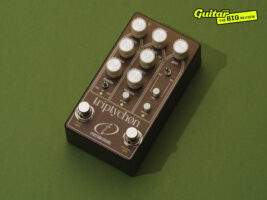
Crazy Tube Circuits Triptychon review – this might be the most ambitious dirt pedal ever made
€299/£269/$359, crazytubecircuits.com
A triptych is a painting with three panels, so you might assume the Crazy Tube Circuits Triptychon is some kind of three-in-one pedal. And it is, in a sense – but it’s also a seven-in-one, or possibly a nine-in-one… or even, at times, a nine-in-two.
Yes, those freaky Greek boutique geeks have done their best to confuse us all with this one. But if they really have squeezed all the fuzz, overdrive and boost tones you need into a single standard-sized pedal, who cares?
READ MORE: Walrus Audio Lüm review – one small box, three colossal reverb effects
What is it?
In line with its name (pronounced ‘trip tick on’), the Triptychon’s graphic design suggests some sort of three-panel church altarpiece, but this isn’t the world’s first Gregorian chant simulator – it’s a tribute to the much less godly rocking sounds of the late 1960s. That much is obvious from the four fuzz circuits that form the heart of the pedal: a Fuzz Face and three Tone Benders (Vox, Mk1.5 and MkII), selected via a rotary switch in the centre.
That would have made a pretty interesting pedal by itself, along the lines of CTC’s excellent Cyclone four-mode phaser, but there’s a whole lot more vintage rock noisiness going on here. Firstly, on the left you’ll find controls for an overdrive circuit, designed to recreate the sound and feel of plugging your fuzz box into a cooking amp; and then, on the right, you have a choice between two more old-school noise generators: an octave fuzz and a treble booster, each with two different modes to flip between using the ‘mod’ button.
So that’s four straight fuzzes, one overdrive, two octave fuzzes and two boosters – all in a pedal with just two footswitches? If you think that sounds like a stretch, you’re right – so you might want to consider thinking outside the box (literally) and digging out an extra 50-ish euros/pounds/dollars for the optional XT footswitch.
Image: Adam Gasson
Build quality and usability
The Triptychon is a weighty little unit, which is no surprise considering how much it’s got going on inside, but the first issue is has to tackle is one of ergonomics: you’re looking at seven knobs, two toggle switches and three push-buttons, and that’s always going to make things cramped. CTC has done well to keep everything reasonably clean and accessible… but there are compromises.
Navigating is actually a lot simpler with the XT footswitch plugged in: now you’ve got a pedal made up of three sections with a switch for each, so you can tap-dance your way in and out of overdrive, fuzz and octave/boost at will. And the layout is intuitive enough that, when you do want to make changes to settings, you won’t struggle.
As well as that four-way mode switch, the fuzz circuit has controls for gain and volume, plus a button to engage a buffer. The overdrive has drive, tone and volume; and the right-hand panel has a gain knob and another buffer switch, plus a toggle for octave or boost mode and the aforementioned mod button.
XT Switch. Image: Adam Gasson
Nothing too scary there… but without the XT switch (sold separately, €49.00), things suddenly start to look more fiddly. The problem is, with three sections but only two footswitches, you have to use a three-way toggle to set what those switches engage: left for fuzz and drive, and right for octave/boost; left for fuzz, and right for drive and octave/boost; or left for fuzz, right for octave/boost, and no drive at all.
If you got lost halfway through reading that sentence, don’t worry, I got lost halfway through writing it. In summary, using the Triptychon without the external switch is a pain in the hole. Mind you, it could be worse: the one other pedal CTC makes in this format, the Sidekick Jr, has a modulation section that can’t be bypassed on the unit itself.
Image: Adam Gasson
Sounds
We’re told the fuzz uses silicon transistors for a “true germanium tone and feel”, which is stretching the definition of the word ‘true’ somewhat, but it certainly sounds big, warm and fluffy in vintage style. All four options are nicely balanced, with plenty of shunt and no spikiness – which is just as well, as there’s no tone control.
The Fuzz Face and the Bender Mk1.5 sound quite similar, as they should (the circuits are very closely related), while the Vox TB has more midrange bite and the MkII piles on the gain. All sound decent with the guitar’s volume backed off, and the switchable buffer should not be overlooked: it adds a significant amount of pep and clarity, the only pity being that there’s no LED to let you know if it’s on.
I don’t have a lot to say about the overdrive, which is low-key brilliant: just about totally transparent, natural in feel, and perfect for giving those fuzzes an already crunchy base to build on. The octave fuzz is good too, really bringing the gnarl and offering a tidy ‘Hendrix in a box’ option when you run it into the Fuzz Face.
But for me the best non-fuzz bit of this pedal is the booster, which can be set for either a Rangemaster-style lift to the high mids or something reaching a little lower down the frequency spectrum. Both sound ace – and again, the only thing missing is an LED to tell you which mode you’re in.
On the subject of LEDs, I could use this thing every day for a month and not get used to the way the three status lights aren’t aligned with the footswitches – well, how could they be when one of those switches isn’t even on the pedal? – but maybe the answer to that is just to use it for two months. I certainly wouldn’t get sick of how it sounds.
Image: Adam Gasson
Should I buy one?
The Triptychon doesn’t quite live up to its fantastical space-saving promise, simply because it’s so compromised without the XT footswitch – which is small, yes, but could well take up almost as much room as another pedal depending on how your board is laid out. And that extra 50 notes is not something to take lightly, bearing in mind the serious price of the pedal itself.
Even so, this is an amazing feat of stompbox design, with nine different effects that all sound top-notch and work wonderfully well teamed up in twos and threes. If you can make the practicalities work, the tones on offer here are more than up to the job.
Alternatives
The Triptychon’s closest rival might be the Great Eastern FX Co. Focus Fuzz Deluxe (£299/$349), a consummate master of fuzz, drive and boost complete with footswitchable squawkage. The Walrus Audio Eons ($249.99/£235) has five different fuzz modes with variable voltage, while the Fender The Pelt V2 ($229.99/£159) offers a slightly more affordable mainstream option.
The post Crazy Tube Circuits Triptychon review – this might be the most ambitious dirt pedal ever made appeared first on Guitar.com | All Things Guitar.
Source: www.guitar-bass.net