Death By Audio x Rainger FX Amp Crash review – an amplifier, a speaker, a microphone and multiple effects… all inside one pedal
$395/£425, deathbyaudio.com / raingerfx.com
Sometimes, as a Brit, I find myself looking at Death By Audio’s freakiest pedals and thinking, “These Yanks are crazy!” But equally, I can well imagine American guitarists look at Rainger FX’s freakiest pedals and thinking, “These Limeys are crazy!” So… what if we’re both right?
READ MORE: Orange Baby Terror review: a minuscule lunchbox head that packs classic Orange punch
The Amp Crash is what happens if the universe is reckless enough to let two of the most eccentric stompbox makers from either side of the Atlantic work together. It’s an ambitious product, with a whole range of uses at home, in the studio and even on stage, but that doesn’t mean it’s some sort of problem-solving utility pedal. In fact, this thing is about as utilitarian as a pet crocodile.
Image: Richard Purvis
What is it?
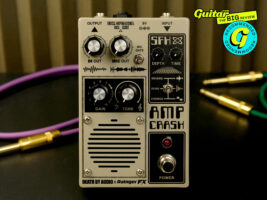
Where to even start? I suppose the most obvious use of the Amp Crash is as a 3W analogue practice amplifier, complete with two-inch speaker and built-in digital effects. You get controls for gain and tone, with two mini-knobs for adjusting the ‘SFX’ section according to whether you have it set to chorus, delay or reverb.
The next step from there might be to plug it into an external speaker cabinet (minimum eight ohms) for a considerable upgrade in sonic scale, turning a cutesy bedroom gadget into a viable gigging solution. Or you could use the line output to run the pedal into a standard amp, at which point it becomes a sort of maverick multi-effects unit.
But here’s where things get really fruity. Yes, there really is a little microphone inside this pedal, pointing at the speaker, so you can also use it as an amp and cab sim – but without the ‘sim’ – for direct recording. Naturally this is unlikely to sound like a perfect digital recreation of a top-class studio mic pointing at a pre-CBS Fender Deluxe Reverb, but that was never going to be the point – these Yanks and Limeys are crazy, remember?
All of this functionality is delivered in a stompbox that won’t take up an inordinate amount of pedalboard space, and will run off a standard pedal power supply with at least 300mA of current.
Image: Richard Purvis
Build quality and usability
DBA and Rainger have done a sterling job of keeping the interface as simple as possible given the number of features on offer here. Plug in a guitar, add nine volts and you’ve got the most basic of practice combos – maybe a master volume control would have been nice, but there is an old-school purity about going gain-only. Likewise there’s no bypass switch for the effects – to turn that section off you simply set the depth to minimum.
Worried about the mic picking up your seismic flatulence and general background chatter? It’s got a noise gate, which has an on/off toggle switch but nothing so fancy as a threshold control; and if you want to mute the speaker entirely – which most people will surely want to do when running into a ‘proper’ amp – you just have to plug something into the speaker output (an unconnected patch cable will do).
These connectivity options can get a tiny bit confusing at the beginning. But it’s all easily mastered with practice, and – as you have every right to demand from two companies with this kind of pedigree – it feels like a solid, well-built piece of gear.
Image: Richard Purvis
Sounds
The practice combo is first up. I’m expecting lo-fi larks here, in the ultra-punky tradition of those old Smokey amps built into cigarette packets, and that’s very much what the Amp Crash spits out… with two key differences. Firstly, it’s a much more grown-up sound with a decent gain range, from light crunch to sagging splat-fuzz; and secondly, it’s a whole lot louder. If you plan to crank it into the rawk zone, you might want to warn your housemates first.
What you don’t get is any kind of warmth or three-dimensionality, but that’s hardly surprising with a two-inch speaker. So don’t bother playing tasteful chords through this thing – it was born to frighten people, not read them bedtime stories.
The effects section offers up some interesting options for going in a more wild and experimental direction. The reverb and delay both get extremely dense, while the chorus is very wobbly indeed and tends towards the flangey zone. It’s all highly entertaining, and only in delay mode might you wish for a third knob to let you adjust the level and feedback separately.
All of the above applies equally when you plug into an external cab: it’s still ragged and raucous, but now with a far less boxy frequency spread and, above all, a hell of a lot more volume. This will be more than adequate for gigging, though the clean tones remain flat and unrefined so we’re really talking heavy stuff only.
Next up is the ‘normal stompbox’ scenario, and it’s probably the Amp Crash’s strongest suit – letting you enjoy all the gnarliness but now in more well-rounded form, complete with independent control over fuzziness and output level. As a medium-gain overdrive it’s great, as a high-gain fuzz it’s even greater, and as a brutally overloading splurge-beast it’s greatest of all.
The direct recording function is more complicated. Use the DI output on its own and it sounds… well, like a DI: bright and plasticky. Stick with the mic output, however, and you might find you’ve gone too far in the other direction, as it’s oh so scuzzy and dark. But blend the two together, and suddenly you’ve got the best of both worlds and the worst of neither: the DI gives you clarity and edge, while the mic provides natural colour to round it out. It’s far from hi-fi, but there are some surprisingly pleasant and well-balanced tones available here.
The only snag is that, in order to record the mic’s output, you’ll obviously need to leave the speaker unmuted – and as I’ve already mentioned, it can get awfully loud. This is not a problem you have to deal with when using a sim, but at least – unlike a traditional amp and mic setup – the Amp Crash can be hidden away in a cupboard or smothered with cushions.
Image: Richard Purvis
Should I buy one?
Oh dear, it’s time to get sensible. Because while the Amp Crash is a wondrous piece of work and I love it to bits, this is not the kind of product I’d recommend as a must-have for every guitarist’s arsenal. If you normally play clean, or you’re the kind of tonehound who demands warmly rounded smoothness in everything, it probably isn’t going to make much sense for you.
To be clear, though, this isn’t just about garage-rock shoutiness – the usable sounds range from Screamer-style drive to hyper-compressed filth, the three digital effects are all worthy additions, and above all it’s a genuine multi-purpose device that’s ready to impose its big personality pretty much anywhere in your music-making life.
Alternatives
Acorn Amplifiers Solid State ($299/£289) – good luck finding a true alternative to this thing… but you could have a look at the a Peavey-inspired preamp pedal with a built-in power amp so it can be plugged straight into a speaker cab. I reviewed the preamp-only version ($179/£169) and it was a retro riot.
The MXR Rockman X100 ($245/£229) – this is more of a standard distortion pedal, but it has that compression-heavy 80s thing going on and includes a chorus effect.
Positive Grid Spark GO ($99/£95) – right at the other end of the fidelity spectrum, there’s this thoroughly modern portable amp.
Specs
NAME: Death By Audio x Rainger FX Amp Crash
PRICE: $395/£425
TYPE: Hybrid multi-effects and practice/direct amp
POWER: 3W
SPEAKER: 1×2” (internal)
CONTROLS: DI out level, mic out level, gain, tone, mic gate toggle, effects select toggle, depth, time, power on/off
INPUTS: 1x standard instrument input
OUTPUTS: Hybrid DI/mic output (footswitchable), ext speaker out (8-ohm minimum, 3w or greater)
POWER: 9V centre-negative DC only (300mA current draw)
WEIGHT: 1.44lbs/0.65kg
The post Death By Audio x Rainger FX Amp Crash review – an amplifier, a speaker, a microphone and multiple effects… all inside one pedal appeared first on Guitar.com | All Things Guitar.
Source: www.guitar-bass.net